
Introduction
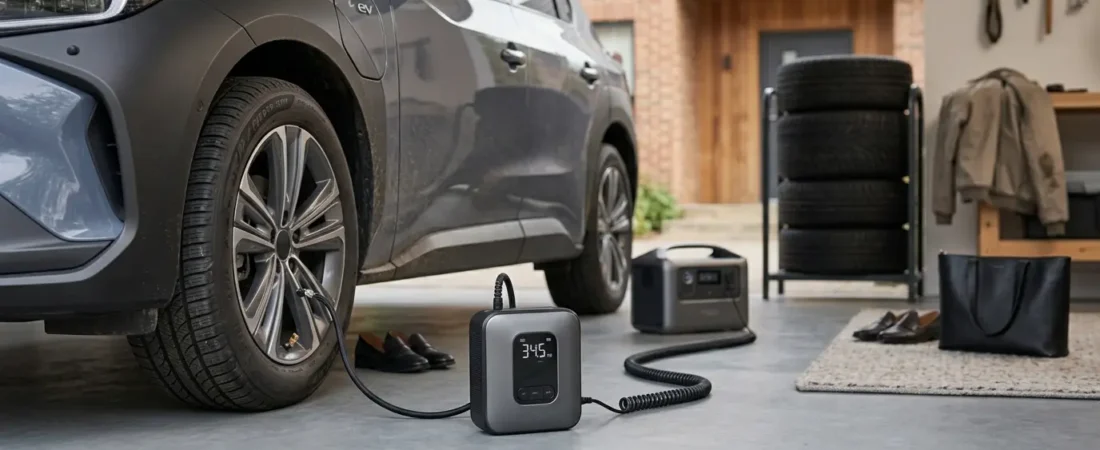
Finding a good tire inflator doesn’t necessarily mean spending a lot of money. For occasional top-ups, roadside emergencies, maintaining tire pressure at home, or keeping an inflator in the car, there are several compact options available for less than $50.
The challenge is figuring out which inexpensive models are actually worth considering.
We compared six portable tire inflators based on their specifications, intended use, customer feedback, portability, inflation performance, power options, convenience features, and recurring strengths and weaknesses reported by buyers.
Our goal wasn’t simply to find the cheapest options.
We looked for the models that offer the most useful combination of performance, convenience and value without crossing the $50 mark.
This post may contain affiliate links. If you click and make a purchase, we may earn a small commission at no extra cost to you.
Quick Answer: The Best Portable Tire Inflators Under $50
Best Overall: AstroAI L7 Tire Inflator Portable Air Compressor
Best Compact Option: AstroAI L10 Mini Tire Inflator
Best Dual-Power Option: OlarHike Tire Inflator
Best Corded Option: AstroAI AIRUN H Tire Inflator
Best Battery Flexibility: CRAFTSMAN Tire Inflator
Best Fast Corded Alternative: ROCGORLD R8 Tire Inflator
| Product | Best For | Power | Max PSI | Standout Feature | Link |
|---|---|---|---|---|---|
| AstroAI L7 | Best overall | Cordless | 150 PSI | Compact design, strong feature set | View on Amazon → (ad) |
| AstroAI L10 Mini | Compact portability | Cordless | 150 PSI | Pocket-sized design | View on Amazon → (ad) |
| OlarHike | Dual-power flexibility | Battery + 12V DC | 160 PSI | Can run from vehicle power | View on Amazon → (ad) |
| AstroAI AIRUN H | Corded use | 12V DC | 100 PSI | Proven, high-volume option | View on Amazon → (ad) |
| CRAFTSMAN | Battery flexibility | Battery + 12V | 150 PSI | 6,000mAh battery | View on Amazon → (ad) |
| ROCGORLD R8 | Fast corded inflation | 12V DC | 150 PSI | 40L/min claimed airflow | View on Amazon → (ad) |
Product specifications and manufacturer-stated performance can vary by model and configuration. Price eligibility for this guide is based on the product’s normal/list price being under $50, rather than a temporary discount.
Our Top Pick: AstroAI L7
The AstroAI L7 stands out as our best overall choice because it combines a genuinely portable cordless design with useful controls, multiple preset modes, a built-in battery, automatic shutoff and a strong body of customer feedback.
At the time of writing, its normal price is around $40, although the current selling price may be lower.
Its claimed ability to take a typical 195/65R15 tire from 30 to 36 PSI in around 1.5 minutes also puts it firmly in the practical category for everyday vehicle top-ups.
It isn’t the right choice for every situation, particularly if you need an inflator for heavy-duty tires or extended high-volume use. But for the typical driver who wants a compact inflator to keep in the vehicle, it’s a particularly well-rounded package for the money.
Before You Buy
One important point: “150 PSI” doesn’t mean an inflator is equally suitable for every tire or inflation task.
Maximum PSI is only one specification. Inflation speed, battery capacity, power source, hose and cable length, automatic shutoff, physical size and the manufacturer’s stated vehicle compatibility can matter much more in everyday use.
That’s why we look at the complete package rather than ranking these inflators by their headline PSI number alone.
How We Chose These Portable Tire Inflators
We looked at the specifications provided for each product alongside recurring patterns in customer feedback.
Our comparison considers:
- Inflation performance
- Power source
- Battery capacity where applicable
- Portability
- Automatic shutoff
- Controls and displays
- Preset modes
- Claimed inflation times
- Vehicle compatibility
- Customer-reported strengths
- Recurring complaints
- Warranty information where available
- Overall value within the under-$50 category
When we mention inflation times, battery capacity, maximum PSI or other performance figures supplied by the manufacturer, we identify them as manufacturer-stated specifications rather than independent test results.
We also pay attention to what customers repeatedly report after using the products. A product can look excellent on a specification sheet but have recurring complaints about battery life, reliability, pressure accuracy or usability.
Conversely, a relatively simple model can be a better choice if buyers consistently find it dependable and easy to use.
The goal is to identify the best fit for different buyers, not simply the product with the longest feature list.
AstroAI L7 Tire Inflator – Best Overall
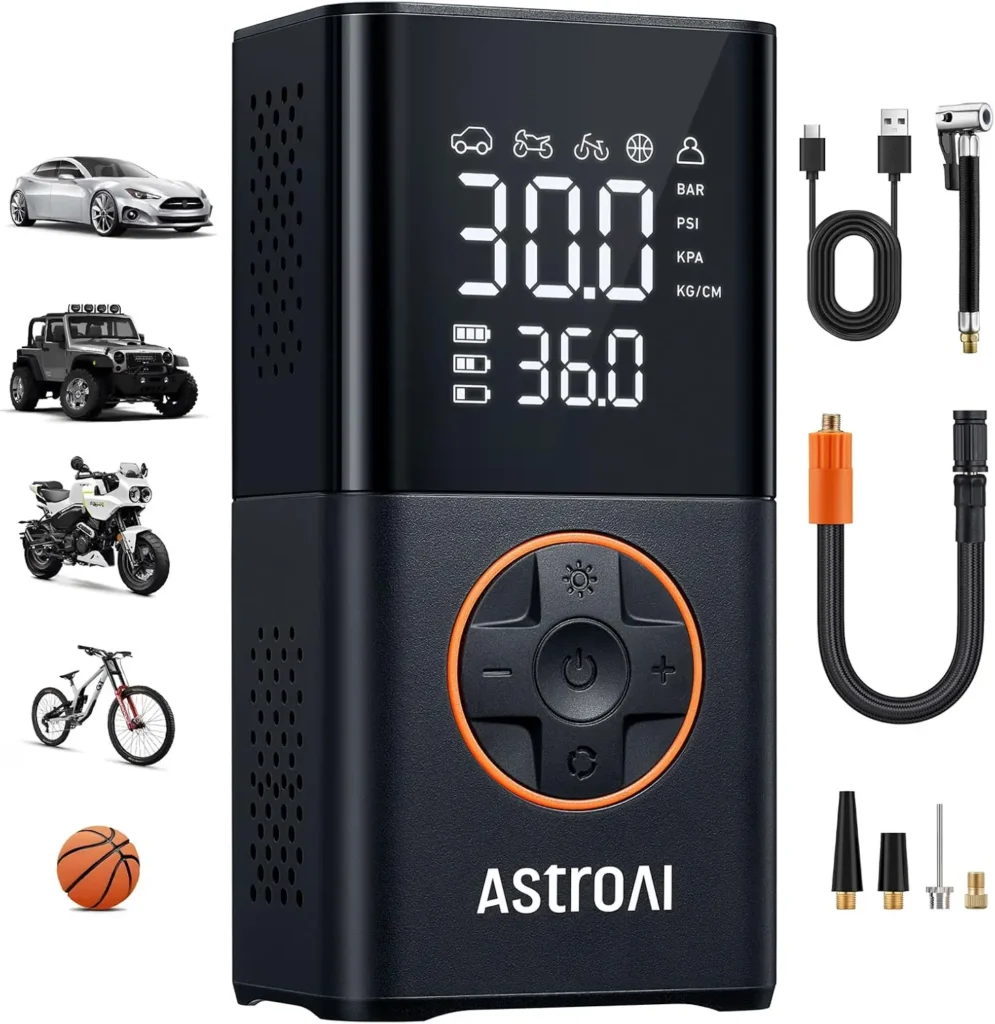
The AstroAI L7 is our Best Overall pick for a portable tire inflator under $50 because it offers a strong balance of portability, cordless operation, useful controls, and everyday convenience.
It is small enough to keep in a vehicle without taking up much space, but it still includes features that make it more versatile than a basic emergency pump.
The L7 uses a built-in 4,000mAh battery and supports four pressure units: PSI, KPA, BAR and KG/cm². It also has preset modes for cars, motorcycles, bicycles and balls, along with a custom mode that allows pressures from 3 to 150 PSI to be set manually.
Key Specifications
| Feature | AstroAI L7 |
|---|---|
| Power | Cordless |
| Battery | 4,000mAh |
| Maximum pressure | 150 PSI |
| Weight | 1.12 lb |
| Dimensions | 2.6 × 1.97 × 5.28 in |
| Pressure units | PSI, KPA, BAR, KG/cm² |
| Preset modes | Car, motorcycle, bicycle, ball, custom |
| Automatic shutoff | Yes |
| Charging | USB-C |
| USB output | Yes |
| Flashlight | 3 modes |
Why We Picked It
The biggest advantage of the L7 is that it feels designed around actual portability.
You don’t need to connect it to a vehicle’s 12V outlet every time you want to use it. The built-in battery means it can be taken out of the car, connected to a tire, and used without running a cable back to the vehicle.
AstroAI states that the L7 can inflate a typical 195/65R15 tire from 30 to 36 PSI in approximately 1.5 minutes. The manufacturer also claims that a fully charged battery can handle up to eight such inflation cycles under its stated test conditions.
Those figures are useful for understanding the product’s intended capability, but they’re manufacturer claims rather than independent test results. Actual performance can vary depending on tire size, starting pressure, temperature, battery condition and other factors.
The L7 also uses what AstroAI calls a TrueGauge pressure sensor, with the manufacturer stating that it samples pressure 200 times per second. Whether you need that level of sensor technology is debatable, but having a clear digital pressure reading and automatic shutoff is genuinely useful.
Useful Controls Without Excessive Complexity
The L7 gives you several ways to control the inflation process without making the device unnecessarily complicated.
You can select a preset for common applications or use the custom setting to choose your own target pressure. Once the desired pressure is set, the automatic shutoff is intended to stop inflation when that target is reached.
That’s particularly useful for routine tire top-ups because you don’t need to stand beside the tire watching the pressure continuously.
The device also supports four pressure units, which can be useful if the pressure specification you’re working from isn’t given in PSI.
Portable Enough to Keep in the Car
At around 1.12 lb, the L7 is considerably easier to carry than a traditional compressor.
Its dimensions are also relatively compact, making it practical to keep in a glove compartment, center console, trunk or other storage area depending on your vehicle.
The built-in flashlight adds another practical touch. It isn’t the reason we’d choose the L7, but having illumination available when dealing with a tire in low-light conditions can be convenient.
The USB input and output also give the L7 some usefulness beyond inflation, allowing it to function as a small emergency power source for compatible devices.
What Customers Like
Customer feedback is particularly strong around the L7’s general usability.
Recurring positive themes include:
- Overall product quality
- Functionality
- Ease of use
- Compact size
- Portability
- Fast and convenient inflation
The product has accumulated a substantial volume of customer feedback, which gives us more evidence to work with than a newly launched model with only a small number of reviews.
That doesn’t mean every experience is identical. Battery performance, power and automatic shutoff receive more mixed feedback than the broader usability of the device.
That’s worth noting because a cordless inflator’s convenience depends heavily on having enough battery capacity when you actually need it.
Where the L7 Falls Short
The L7 isn’t a universal compressor.
AstroAI specifically states that it isn’t compatible with heavy-duty tires, so it shouldn’t be treated as a solution for larger commercial, RV or other applications outside its intended range.
Cordless convenience also comes with the obvious limitation of battery dependence. If the battery isn’t charged when you need the inflator, the main advantage of the cordless design disappears.
And while the manufacturer quotes strong inflation performance for a typical passenger-car tire, larger tires or substantial pressure increases can take longer.
The important point is that 150 PSI is a maximum-pressure specification, not a guarantee of fast inflation for every type of tire.
Who Should Buy the AstroAI L7?
The L7 makes the most sense for someone who wants a compact emergency and maintenance inflator for a normal passenger vehicle.
It’s particularly appealing if you value:
- Cordless operation
- Small size
- Easy digital controls
- Automatic shutoff
- Preset inflation modes
- A built-in flashlight
- USB charging and output
- A product with a substantial body of customer feedback
If you specifically need a compressor for heavy-duty tires, repeated high-volume inflation or extended workshop use, we’d look at a different type of product.
Our Take
The AstroAI L7 doesn’t win because it has the highest headline specification in every category.
It wins because the individual features work together well for the job most people buying a portable tire inflator actually want it to perform: keeping a compact, convenient air pump available for tire-pressure top-ups and unexpected situations.
For an under-$50 buying guide, that balance makes it our Best Overall choice.
→ Check the AstroAI L7 on Amazon (ad)
AstroAI L10 Mini Tire Inflator – Best Compact Option
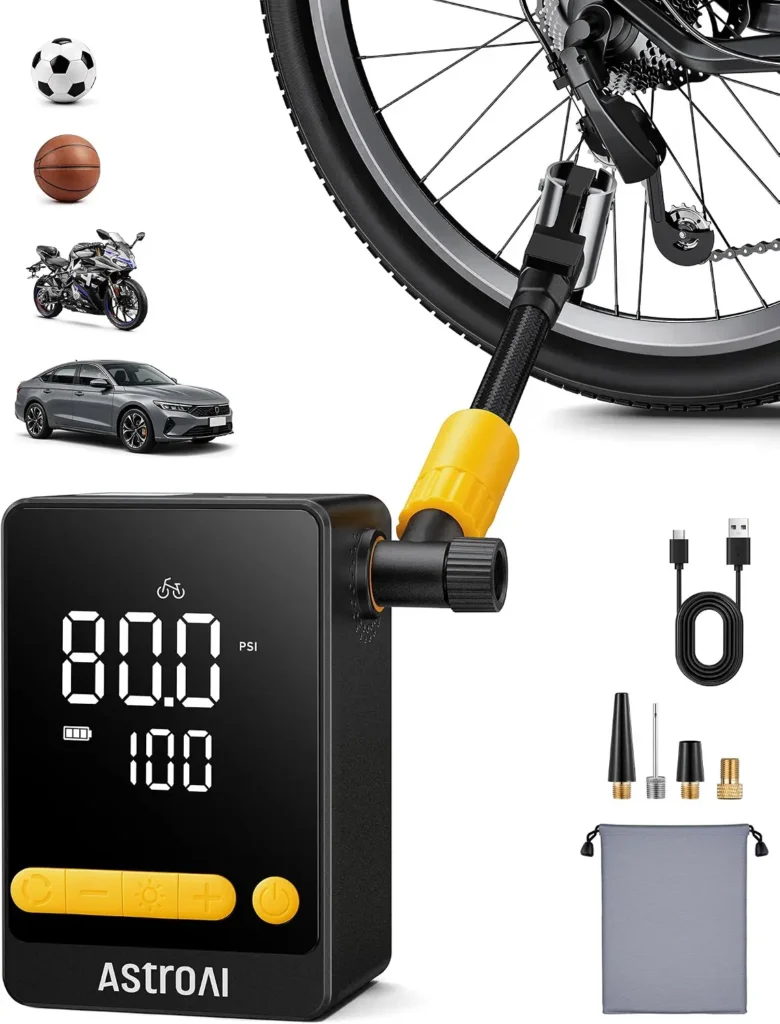
The AstroAI L10 Mini is our Best Compact Option for buyers who care more about portability and storage than having the largest possible battery or the broadest feature set.
Its main selling point is its size. At approximately 3.9 × 2.6 × 1.8 inches and weighing less than 1 lb, the L10 Mini is small enough to keep in a backpack, glove compartment or other tight storage space without becoming another bulky item to carry around.
Despite its small size, it still offers automatic shutoff, multiple preset modes and enough claimed inflation performance for everyday tire-pressure top-ups.
Key Specifications
| Feature | AstroAI L10 Mini |
|---|---|
| Power | Cordless |
| Maximum pressure | 150 PSI |
| Weight | 447g / under 1 lb |
| Dimensions | 3.9 × 2.6 × 1.8 in |
| Preset modes | Car, motorcycle, bicycle, basketball, custom |
| Automatic shutoff | Yes |
| Hose | 360° revolving hose |
| Flashlight | 3 modes |
Why We Picked It
The L10 Mini makes a compelling case for a simple reason: you are more likely to have an inflator available when you need it if it’s easy to store and carry.
A larger compressor may offer more capacity, but that doesn’t help much if it ends up buried in a garage or left at home.
The L10 Mini’s palm-sized design makes it much easier to keep with the vehicle or take with you. AstroAI describes it as suitable for storage in a pocket, backpack or car compartment, and its sub-1 lb weight reinforces that portability-first design.
It also doesn’t require you to sacrifice the basic controls you’d expect from a modern portable tire inflator.
Small Doesn’t Mean Bare-Bones
The L10 Mini includes five preset modes covering cars, motorcycles, bicycles and basketballs, along with a custom mode.
Automatic shutoff is also included, allowing you to set a target pressure and let the tire inflator stop when that pressure is reached.
There’s also a three-mode flashlight, which adds some utility if you’re dealing with a tire in poor lighting.
The 360-degree revolving hose is another small design detail that can make positioning easier, particularly when the valve stem isn’t sitting at a convenient angle.
Inflation Performance
AstroAI states that the L10 Mini can inflate a 195/65R15 tire from 30 to 36 PSI in approximately 70 seconds.
That’s a manufacturer-stated figure rather than an independent test result, so actual performance will vary depending on the tire, starting pressure, battery condition and other factors.
Still, the claimed figure gives us a useful indication of where this product sits in the category.
It’s not simply a tiny emergency gadget intended only for bicycles or sports equipment. The manufacturer positions it as a genuine option for passenger-car tire inflation as well.
What Customers Like
Customer feedback is generally positive around the L10 Mini’s portability and performance.
Recurring positive themes include:
- Compact size
- Performance
- Speed
- Value
- Versatility
- Power
- Ease of carrying and storing
Some buyers specifically appreciate being able to use it for multiple bicycle tires or keep it available for roadside situations without carrying a larger compressor.
The product has a smaller review base than the AstroAI L7, so there’s less customer evidence to work with. That’s worth considering when comparing the two.
Where the L10 Mini Falls Short
The biggest trade-off is also the reason to buy it: it’s designed to be small.
A miniature tire inflator has less room for battery capacity, cooling and other hardware than a larger compressor.
Customer feedback around battery performance is more mixed than the broader comments about the product’s compactness and usefulness. That’s not necessarily a deal-breaker, but it’s another reason we wouldn’t choose the L10 Mini simply because it’s smaller.
If you’re regularly inflating several vehicle tires from significantly underinflated pressures, a larger model may make more sense.
The L10 Mini is better thought of as a compact personal tire inflator for occasional use, rather than a substitute for a larger compressor designed for sustained work.
Who Should Buy the AstroAI L10 Mini?
The L10 Mini makes the most sense if your priority is keeping an inflator small, light and easy to access.
It’s a particularly good fit for:
- Drivers with limited storage space
- Cyclists who also want vehicle-tire capability
- People who want a lightweight emergency inflator
- Anyone who wants to keep an inflator in a backpack or small compartment
- Buyers who prioritize portability over maximum battery capacity
If you’re looking for the strongest all-around combination of capacity, controls and versatility, we’d still choose the L7.
But if minimum size is the feature you care about most, the L10 Mini deserves a close look.
Our Take
The AstroAI L10 Mini isn’t trying to be the biggest or most powerful inflator in this comparison.
Its appeal is simpler: it’s small enough that you can realistically keep it with you.
For buyers who value compact storage and lightweight portability above everything else, that makes the L10 Mini one of the more practical choices in this under-$50 category.
→ Check the AstroAI L10 Mini on Amazon (ad)
OlarHike Tire Inflator – Best Dual-Power Option
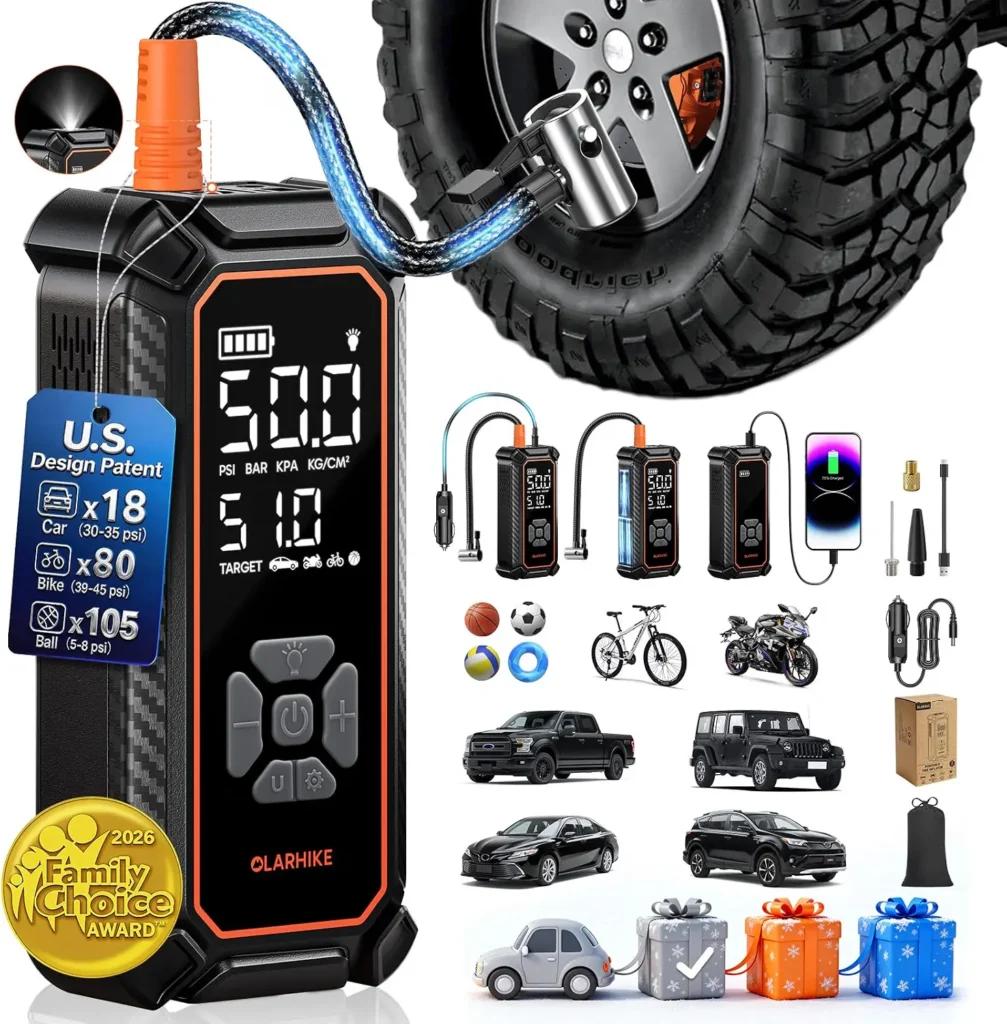
The OlarHike Tire Inflator is our Best Dual-Power Option because it gives you two ways to run the compressor: a built-in battery for cordless use and a 12V DC connection for continued power from your vehicle.
That combination addresses one of the biggest compromises with cordless inflators. A battery-powered pump is convenient, but once the battery runs low, you’re dependent on having enough charge to finish the job.
With the OlarHike, you can use the built-in battery for portability and switch to vehicle power when you need longer or more demanding operation.
Key Specifications
| Feature | OlarHike Tire Inflator |
|---|---|
| Power | Built-in battery + 12V DC |
| Battery | 3 × 2,000mAh |
| Maximum pressure | 160 PSI |
| Weight | Approximately 1.2 lb |
| Dimensions | 6.5 × 2.76 × 2.17 in |
| Preset modes | 4 |
| Automatic shutoff | Yes |
| Display | Dual LED display |
| USB output | Yes |
| Flashlight | Yes |
| Storage | Carrying bag included |
Why We Picked It
The biggest reason to consider the OlarHike is flexibility.
For a quick tire-pressure adjustment, you can use it as a cordless tire inflator without needing to connect anything to the vehicle.
For longer jobs or when the battery is running low, the 12V DC connection provides another power source.
That makes it particularly interesting for drivers who want the convenience of cordless operation without completely giving up the reliability of having direct vehicle power available.
It’s also relatively compact at around 1.2 lb, so carrying it in the vehicle shouldn’t be particularly difficult.
Claimed Inflation Performance
OlarHike states that the inflator can take a standard 195/65 R15 tire from 30 to 35 PSI in approximately 55 seconds.
For a larger SUV tire, the manufacturer states approximately 2.2 minutes to increase a 235/65 R17 tire from 30 to 35 PSI.
Again, these are manufacturer-stated figures rather than independent test results. Real-world performance can vary depending on tire size, starting pressure, temperature, battery condition and other factors.
The figures are nevertheless useful because they show that OlarHike isn’t positioning this as merely a slow emergency pump. It’s intended to handle normal passenger-vehicle top-ups at a practical pace.
Battery Capacity Is a Major Selling Point
The supplied version uses three 2,000mAh battery cells, giving it a stated 6,000mAh capacity.
OlarHike claims that this can provide enough power for up to 18 standard car tires or 11 SUV tires under its specified test conditions.
Those numbers shouldn’t be treated as a guaranteed number of real-world inflation cycles. Tire size, pressure difference and operating conditions can all change how much energy an inflation job requires.
Still, the relatively large battery combined with the ability to connect to 12V vehicle power gives the OlarHike a useful degree of flexibility.
What Customers Like
Customer feedback is particularly positive around the inflator’s general performance and portability.
Recurring positive themes include:
- Inflation performance
- Speed
- Value
- Compact size
- Portability
- Convenience
Some buyers also appreciate the ability to keep a portable tire inflator available instead of relying on gas-station air pumps when a tire needs a pressure adjustment.
That convenience can be especially useful for regular maintenance rather than only emergencies.
Where the OlarHike Falls Short
The main concern is reliability consistency.
Battery performance and reliability generate more mixed customer feedback than the product’s overall inflation performance and portability.
That’s important because the dual-power design is valuable partly because it gives you a fallback when the battery isn’t sufficient. If you’re buying primarily for emergency use, you’ll still want to make sure the unit is charged and that you understand how its 12V power connection works.
There are also limits to what this type of compact inflator is designed to handle.
OlarHike states that its car and pickup applications should be limited to tires up to 51 PSI and specifically excludes heavy-duty pickups and RVs. It’s therefore better suited to ordinary passenger vehicles and compatible lighter-duty applications.
Who Should Buy the OlarHike?
The OlarHike is a strong choice if you want cordless convenience without relying entirely on a battery.
It’s particularly suited to:
- Drivers who want both battery and 12V operation
- People who regularly maintain tire pressure
- Buyers who want a portable inflator with a larger battery
- Drivers who want a backup power option for longer inflation jobs
- People who value flexibility more than the smallest possible size
If you want the smallest inflator possible, the AstroAI L10 Mini is a better fit.
If you want the most balanced overall package, we’d still choose the AstroAI L7.
But if having two power options is high on your list, the OlarHike has a meaningful advantage.
Our Take
The OlarHike isn’t the smallest inflator in this comparison, nor is its dual-power design necessary for everyone.
Its strength is giving you more than one way to get the job done.
The built-in battery handles convenient cordless use, while the 12V connection gives you another option when you need sustained power or don’t want to rely entirely on the battery.
For buyers who see flexibility as more valuable than absolute compactness, that makes the OlarHike a particularly compelling option under $50.
→ Check the OlarHike Tire Inflator on Amazon (ad)
AstroAI AIRUN H Tire Inflator – Best Corded Option
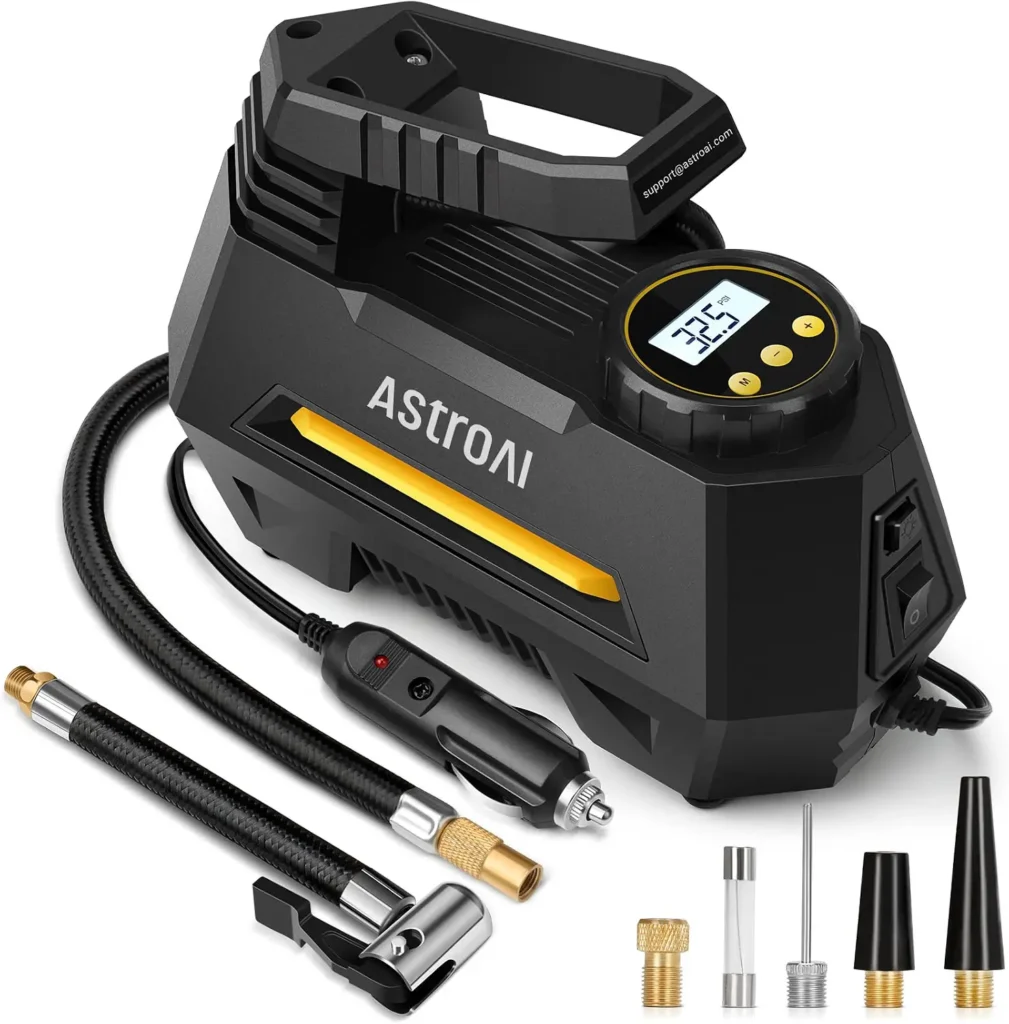
The AstroAI AIRUN H is our Best Corded Option for buyers who don’t need a built-in battery and would rather have a straightforward 12V inflator that runs directly from the vehicle.
Unlike the cordless models above, the AIRUN H is designed around continuous access to vehicle power.
That makes it particularly appealing for drivers who want a simple compressor to keep in the car without having to remember to recharge it.
It also has a substantial body of customer feedback, giving us more evidence about its everyday usability than many smaller or newer portable inflators.
Key Specifications
| Feature | AstroAI AIRUN H |
|---|---|
| Power | 12V DC |
| Motor | 120W |
| Maximum pressure | 100 PSI |
| Claimed airflow | 35L/min |
| Weight | 2.2 lb |
| Automatic shutoff | Yes |
| Pressure units | 4 |
| Cord | 9.84 ft |
| Warranty | 2-year limited warranty |
| Display | Backlit LCD |
| Flashlight | Yes |
Why We Picked It
The AIRUN H makes sense for a particular type of buyer: someone who wants a capable car tire inflator without worrying about battery charge.
The 12V DC connection plugs directly into the vehicle, while the nearly 10-foot power cord gives you more flexibility when positioning the compressor around the car.
AstroAI states that its 120W motor produces up to 35L/min of airflow and can inflate a 195/65R15 tire from 30 to 36 PSI in under one minute.
As with the other performance figures in this guide, that is a manufacturer-stated specification rather than an independent test result.
A Practical Corded Design
The AIRUN H doesn’t try to compete with cordless models on portability alone.
Instead, it uses its available space for a larger motor, longer power cable and other practical features.
The digital display allows you to set a target pressure, while automatic shutoff is designed to stop inflation once that pressure is reached.
The unit also includes four pressure units, a backlit LCD and an LED flashlight.
For a product that’s likely to spend most of its life stored in a vehicle, those are useful features rather than particularly complicated extras.
Customer Feedback Is a Major Advantage
One of the strongest reasons to consider the AIRUN H is the sheer volume of customer feedback behind it.
The product has accumulated more than 100,000 customer reviews, giving us a much larger evidence base than many of the compact tire inflators in this comparison.
Recurring positive themes include:
- Functionality
- Performance
- Ease of use
- Value
- Automatic shutoff
- Compactness
- Portability
Customers frequently describe the product as easy to use and convenient to keep available for travel or routine tire maintenance.
That doesn’t mean every review is positive. Inflation speed receives more mixed feedback than general functionality and usability, which is worth keeping in mind when comparing manufacturer-stated performance with individual customer experiences.
The 12V Trade-Off
The main disadvantage is obvious: you need access to the vehicle’s 12V power connection.
There’s no built-in battery to fall back on, so you can’t simply take the AIRUN H somewhere away from the vehicle and operate it independently.
For many drivers, that’s not a meaningful problem. If the intended use is maintaining the tires on your own car, having the compressor connected to the car is perfectly reasonable.
It can actually be an advantage because you’re not dependent on remembering to charge the unit before a trip.
The 9.84-foot cable also helps compensate for the limitations of a fixed power source.
Built for Short Inflation Sessions
AstroAI states that the AIRUN H includes thermal management and is designed to automatically shut off after 15 minutes, followed by a 10-minute cooling period.
That’s important because compact 12V compressors are not designed to operate indefinitely.
The manufacturer also states that the unit isn’t intended for high-volume inflatables. In other words, its intended use is closer to vehicle and everyday tire maintenance than running a continuous stream of air for large inflatables or other high-volume applications.
Who Should Buy the AstroAI AIRUN H?
The AIRUN H makes the most sense for buyers who:
- Prefer a corded tire inflator
- Don’t want to maintain a rechargeable battery
- Mainly use the inflator with their vehicle
- Want a longer power cable
- Value a large body of customer feedback
- Want automatic shutoff
- Prefer a straightforward car-based setup
It’s particularly attractive if your main concern is having a dependable tire inflator available in the vehicle, rather than having the smallest possible cordless device.
Our Take
The AstroAI AIRUN H takes a simpler approach than the cordless models in this guide.
You give up battery-powered freedom, but in return you get a straightforward 12V system that is always ready to draw power from the vehicle when needed.
Combined with its long cable, automatic shutoff, digital controls and extensive customer feedback, that makes it our Best Corded Option for buyers who don’t need cordless operation.
→ Check the AstroAI AIRUN H on Amazon (ad)
CRAFTSMAN Tire Inflator – Best Battery Flexibility
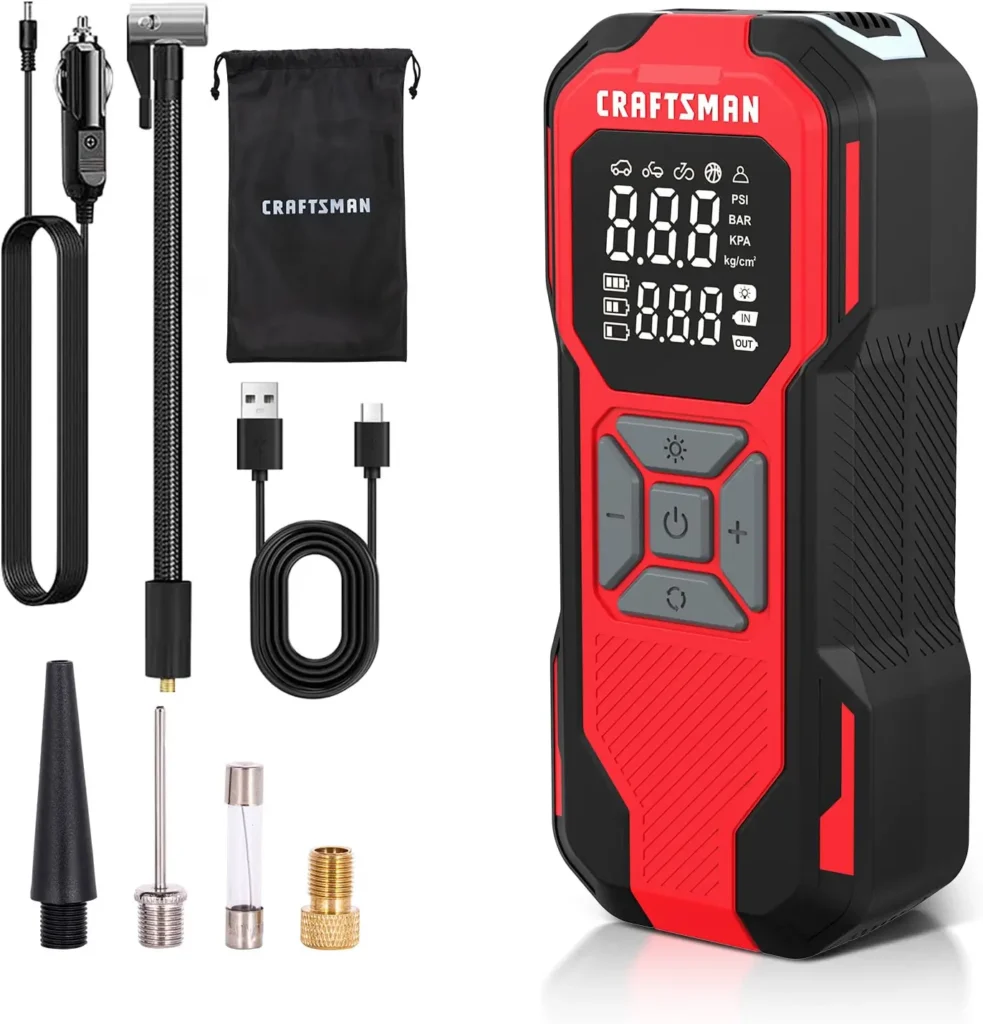
The CRAFTSMAN Tire Inflator is our Best Battery Flexibility pick for buyers who want a cordless inflator with a relatively large built-in battery while still having the option to use 12V vehicle power.
Its 6,000mAh battery gives it plenty of capacity for a compact emergency tire inflator, while the included 10-foot 12V cord provides another way to power the unit when necessary.
That combination makes it a practical middle ground between a fully cordless inflator and a traditional vehicle-powered compressor.
Key Specifications
| Feature | CRAFTSMAN Tire Inflator |
|---|---|
| Power | Battery + 12V |
| Battery | 6,000mAh |
| Maximum pressure | 150 PSI |
| Weight | 1.28 lb |
| Preset modes | 5 |
| Pressure units | 4 |
| Automatic shutoff | Yes |
| Cord | 10 ft |
| USB-C | Yes |
| USB output | Yes |
| Flashlight | 3 modes |
Why We Picked It
The CRAFTSMAN’s biggest advantage is power-source flexibility.
You can use the built-in battery when you want a completely cordless setup, then connect the included 12V cable when you’re near the vehicle and want direct power.
That makes it particularly useful as an emergency item. If you’ve forgotten to charge the battery, the vehicle connection can provide another option.
The 6,000mAh battery is also relatively substantial for a portable tire inflator of this size.
CRAFTSMAN states that the unit can inflate up to four 195/55 R15 car tires from 30 to 36 PSI in approximately 45 seconds each under its specified conditions.
As with the other inflation figures in this guide, this is a manufacturer-stated claim rather than an independent test result.
More Than Just a Tire Pump
The CRAFTSMAN includes five preset modes covering bicycles, motorcycles, cars and balls, along with a custom mode.
It also supports four pressure units and includes automatic shutoff, allowing you to set a target pressure rather than manually monitoring the display throughout the inflation process.
The three-mode LED light adds some emergency usefulness, while USB-C and USB output give the unit additional charging and power functions.
Those extras aren’t essential if all you want is a basic tire inflator, but they make the CRAFTSMAN more versatile as something to keep in a vehicle.
What Customers Like
Customer feedback is generally positive around the product’s reliability, ease of use and portability.
Recurring positive themes include:
- Reliability
- Value
- Ease of use
- Portability
- Power-source flexibility
- Automatic shutoff
Customers also report finding it useful to keep in the vehicle for emergencies and routine tire maintenance.
That practical use case matters here. A portable tire inflator doesn’t need to replace a workshop compressor to be valuable.
Its job can simply be to give you an accessible way to correct tire pressure without searching for an air pump.
Where the CRAFTSMAN Falls Short
The customer feedback isn’t uniformly positive.
Battery performance receives some mixed feedback, and inflation speed also varies in customer reports. Some buyers report significantly longer inflation times than the manufacturer’s stated figures.
That’s an important reminder that advertised performance and individual experience aren’t necessarily identical.
The CRAFTSMAN is also not the smallest model in this comparison. At approximately 1.28 lb, however, it’s still compact enough to be practical for vehicle storage.
Its main advantage isn’t being the absolute smallest or fastest option. It’s the combination of battery capacity, cordless operation and a backup 12V power option.
Who Should Buy the CRAFTSMAN?
The CRAFTSMAN is particularly well suited to buyers who:
- Want a relatively large built-in battery
- Prefer cordless operation
- Want a 12V backup power option
- Value multiple preset modes
- Want an inflator that can serve several types of inflation jobs
- Prefer having USB power available in an emergency
- Want something compact enough to keep in the vehicle
If minimum size is your priority, the AstroAI L10 Mini makes more sense.
If you want the strongest overall balance of portability and features, the AstroAI L7 remains our top pick.
But if having both a substantial battery and direct vehicle power available is the priority, the CRAFTSMAN is a compelling option.
Our Take
The CRAFTSMAN stands out because it doesn’t force you to choose between cordless convenience and vehicle power.
Its 6,000mAh battery gives you the freedom to use it without a cable, while the included 12V connection provides another option when you need it.
The mixed customer feedback around battery life and inflation speed keeps it from taking the overall top spot, but its combination of power options and useful features makes it our Best Battery Flexibility choice under $50.
→ Check the CRAFTSMAN Tire Inflator on Amazon (ad)
ROCGORLD R8 Tire Inflator – Best Fast Corded Alternative
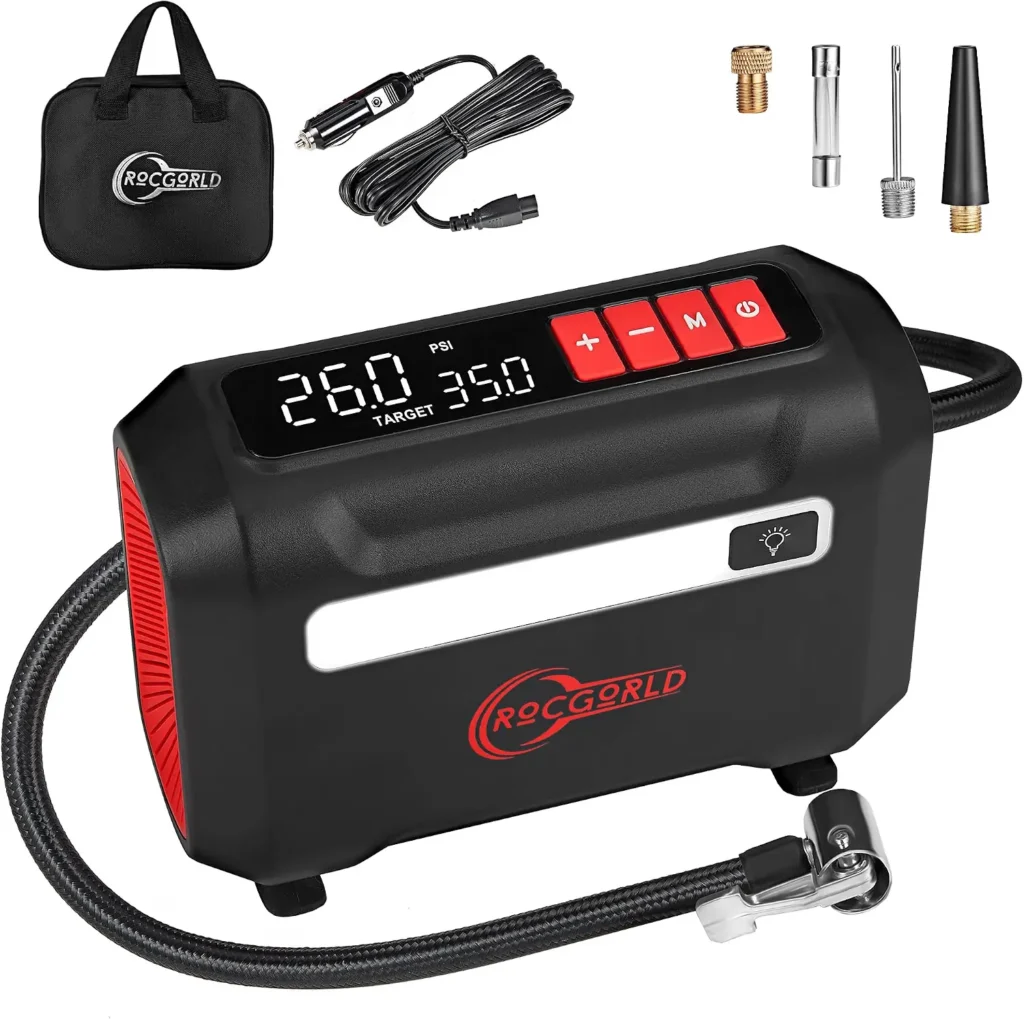
The ROCGORLD R8 is our Best Fast Corded Alternative for buyers who want a compact 12V inflator with strong claimed airflow and don’t need cordless operation.
Its 40L/min cylinder is one of the more notable specifications in this comparison, and the manufacturer claims that it can inflate a 215/50 R17 tire from 26 to 35 PSI in under one minute.
Unlike the cordless models in this guide, the R8 has no built-in battery. It draws power directly from a vehicle’s 12V outlet, making it a straightforward option for drivers who want a compressor that’s ready to operate whenever the car is available.
Key Specifications
| Feature | ROCGORLD R8 |
|---|---|
| Power | 12V DC |
| Claimed airflow | 40L/min |
| Maximum pressure | 150 PSI |
| Automatic shutoff | Yes |
| Display | Dual digital display |
| Cord | 10 ft |
| Hose | 2 ft |
| Warranty | 2 years |
| Flashlight | 3 modes |
| Battery | None |
Why We Picked It
The R8’s biggest advantage is its combination of claimed inflation speed and simple corded operation.
ROCGORLD states that the compressor can inflate a 215/50 R17 tire from 26 to 35 PSI in less than one minute. It also lists a Tesla 235/40 R19 example of approximately 1.5 minutes to increase pressure from 28 to 36 PSI.
These are manufacturer-stated figures rather than independent test results, but they indicate the type of performance the R8 is designed to provide.
Because it runs directly from a 12V vehicle outlet, there is also no battery to charge before use.
Straightforward Controls
The R8 uses a dual digital display that shows pressure and operating information, while automatic shutoff allows you to select a target pressure before starting inflation.
It also includes a memory function, so frequently used pressure settings can be easier to access.
The 10-foot power cable provides reasonable reach around a vehicle, while the 2-foot air hose gives you additional flexibility when positioning the compressor.
A three-mode light is included for use in low-light conditions.
What Customers Like
Customer feedback is particularly positive around the R8’s functionality and general portability.
Recurring positive themes include:
- Functionality
- Compact design
- Speed
- Automatic shutoff
- Inflation performance
- Portability
The corded design also receives some practical praise because the compressor can draw power directly from the vehicle rather than relying on a rechargeable battery.
For someone who mainly wants an inflator for keeping in the car, that can be a meaningful advantage.
The Main Concern: Durability
The R8 has one notable weakness that keeps it from ranking higher in this comparison: durability feedback is more concerning than we’d like to see.
While many customers report good performance and convenient operation, durability generates a significant number of negative comments.
Pressure control also receives mixed feedback.
That doesn’t make the R8 a bad product, but it does mean we’d be more cautious about choosing it if long-term reliability is your highest priority.
This is exactly why we don’t rank these products solely by advertised inflation speed.
A compressor that inflates quickly but doesn’t hold up as expected can ultimately be worse value than a slightly slower model with a stronger reliability record.
Who Should Buy the ROCGORLD R8?
The R8 makes the most sense for buyers who:
- Prefer a corded compressor
- Want strong claimed airflow
- Don’t want to maintain a rechargeable battery
- Value automatic shutoff
- Want a long power cable
- Mainly need the tire inflator for passenger vehicles
- Prioritize inflation speed over cordless convenience
It’s less compelling if your primary concern is long-term durability or if you specifically want a battery-powered tire inflator.
Our Take
The ROCGORLD R8 is a good example of why specifications alone don’t tell the whole story.
Its claimed 40L/min airflow, automatic shutoff, digital display and long power cable make it an appealing corded option, particularly for buyers who prioritize quick inflation.
But the recurring durability concerns in customer feedback are difficult to ignore.
That combination makes the R8 worth considering rather than an automatic recommendation. For buyers who specifically want a fast, corded inflator and are comfortable with the trade-off, it earns our Best Fast Corded Alternative designation.
→ Check the ROCGORLD R8 on Amazon (ad)
How These Six Compare
All six portable tire inflators can serve the basic purpose of topping up a vehicle tire, but they make different trade-offs to get there.
The biggest differences are power source, portability, inflation performance, battery capacity and long-term practicality.
That means the best choice depends less on finding the product with the biggest specification and more on deciding which compromise matters least to you.
AstroAI L7: The Best Balance
The AstroAI L7 is our Best Overall because it combines cordless operation, a compact design, useful controls, automatic shutoff and strong customer feedback without becoming overly specialized.
It’s the easiest recommendation for someone who simply wants a capable portable inflator to keep in the vehicle.
AstroAI L10 Mini: Choose It for Size
The L10 Mini gives up some capacity and versatility in exchange for an exceptionally compact design.
If your biggest concern is storage space, weight or simply having an inflator that’s easy to carry, its small footprint makes it particularly appealing.
It’s less compelling for frequent or demanding vehicle inflation where a larger unit may be more practical.
OlarHike: Choose It for Power Flexibility
The OlarHike takes a different approach by combining a built-in battery with 12V vehicle power.
That makes it a strong choice for someone who wants cordless convenience but doesn’t want the battery to be the only power source available.
It’s larger than the L10 Mini and has some mixed feedback around battery and reliability, but the dual-power design is a meaningful advantage.
AstroAI AIRUN H: Choose It for Corded Simplicity
The AIRUN H is the straightforward option.
It doesn’t need to be charged because it runs from the vehicle, and its long cable, automatic shutoff and substantial customer-review history make it a practical choice for drivers who don’t care about cordless operation.
For a dedicated car inflator that lives in the vehicle, that simplicity can actually be an advantage.
CRAFTSMAN: Choose It for Battery + 12V Flexibility
The CRAFTSMAN sits somewhere between a cordless emergency pump and a traditional car-powered inflator.
Its 6,000mAh battery provides cordless operation, while the included 12V cable gives you another power option.
The customer feedback around battery life and inflation speed is more mixed, but its combination of power sources makes it useful for buyers who want flexibility.
ROCGORLD R8: Choose It for Fast Corded Inflation
The R8 is the more performance-focused corded alternative.
Its claimed 40L/min airflow and manufacturer-stated inflation times make it attractive if speed is your main priority.
However, the recurring durability concerns in customer feedback make it harder to recommend as an all-around winner.
It’s a more specific choice for someone who prioritizes fast corded inflation and is willing to accept that trade-off.
The Simple Comparison
| If Your Priority Is… | Our Pick |
|---|---|
| Best overall balance | AstroAI L7 |
| Smallest, easiest-to-store option | AstroAI L10 Mini |
| Battery + 12V power | OlarHike |
| Simple corded operation | AstroAI AIRUN H |
| Large battery + 12V backup | CRAFTSMAN |
| Fast corded inflation | ROCGORLD R8 |
The important takeaway is that there isn’t one specification that determines which inflator is best.
A cordless model may be more convenient, while a corded model eliminates battery concerns.
A smaller pump may be easier to keep in the car, while a larger one may be better suited to repeated inflation.
And a model with impressive advertised performance may still have trade-offs that aren’t obvious from the specification sheet.
That’s why we’d choose based on how you expect to use the inflator, rather than simply picking the one with the highest PSI or fastest advertised inflation time.
Which Portable Tire Inflator Should You Buy?
The right portable tire inflator depends on what you actually need it to do.
If you’re buying one primarily for occasional tire-pressure top-ups and roadside emergencies, you probably don’t need the most powerful or feature-heavy model available.
On the other hand, if you regularly inflate multiple tires or want to avoid relying on a battery, a different type of inflator may make more sense.
Here’s how we’d narrow the choice down.
Choose the AstroAI L7 if You Want the Best Overall Option
For most drivers, the AstroAI L7 is the easiest choice.
It offers cordless operation, a compact design, multiple preset modes, automatic shutoff and a useful built-in battery. Its combination of features makes it versatile without becoming unnecessarily complicated.
It’s our recommendation if you want one portable inflator that can handle the typical jobs you’re likely to encounter.
Choose the AstroAI L10 Mini if Size Matters Most
If storage space is your biggest concern, choose the AstroAI L10 Mini.
It’s substantially smaller and lighter than many portable inflators, making it easy to keep in a glove compartment, backpack or other limited space.
The trade-off is that its smaller design isn’t as well suited to demanding or repeated vehicle inflation as a larger model.
Choose the OlarHike if You Want Two Power Options
The OlarHike makes the most sense if you don’t want to rely entirely on a rechargeable battery.
Its built-in battery gives you cordless convenience, while the 12V connection provides another way to power the compressor from your vehicle.
That flexibility is particularly useful if you expect to use the inflator for more than occasional emergency top-ups.
Choose the AstroAI AIRUN H if You Prefer Corded Operation
If you don’t want to think about battery charging, the AstroAI AIRUN H is the straightforward choice.
It runs directly from a vehicle’s 12V outlet and has a long power cable, automatic shutoff and a large body of customer feedback behind it.
For an inflator that will live in your vehicle, that simplicity can be more useful than cordless operation.
Choose the CRAFTSMAN if You Want Battery Flexibility
The CRAFTSMAN is worth considering if you want a relatively large battery but also want the option of direct 12V power.
Its 6,000mAh battery provides cordless flexibility, while the included vehicle cable gives you another option if the battery isn’t sufficient.
It’s a good fit for buyers who see an inflator as part of their broader vehicle emergency kit rather than simply a once-in-a-while gadget.
Choose the ROCGORLD R8 if Speed Is Your Priority
If your main concern is fast inflation and you don’t need cordless operation, the ROCGORLD R8 is the most obvious choice from this group.
Its manufacturer-stated airflow and inflation times are among its strongest selling points.
The trade-off is the less reassuring durability feedback, so we’d choose it specifically for its performance characteristics rather than treating it as the safest all-around recommendation.
Our Short Answer
If you don’t have a strong preference, start with the AstroAI L7.
If you know exactly what matters most to you, the decision becomes simpler:
- Best overall: AstroAI L7
- Smallest: AstroAI L10 Mini
- Battery + 12V: OlarHike
- Corded simplicity: AstroAI AIRUN H
- Battery flexibility: CRAFTSMAN
- Fast corded option: ROCGORLD R8
The best portable tire inflator isn’t necessarily the one with the highest PSI rating or the most features.
It’s the one you’ll actually keep available, understand how to use, and trust for the jobs you bought it to handle.
Final Verdict
You don’t need to spend a lot of money to keep a capable portable tire inflator in your vehicle.
The six models in this guide take different approaches, but each can make sense for a particular type of buyer. The key is choosing based on how you expect to use the inflator rather than getting caught up in the biggest PSI number or longest feature list.
For most people, the AstroAI L7 is the strongest overall choice. Its cordless design, compact size, useful controls, automatic shutoff and broad feature set give it a practical balance of convenience and capability.
The AstroAI L10 Mini makes more sense if keeping the inflator as small as possible is your priority.
The OlarHike and CRAFTSMAN are better suited to buyers who want battery power with the added flexibility of 12V operation.
If you prefer a simple corded setup, the AstroAI AIRUN H is the more straightforward option, while the ROCGORLD R8 is worth considering if fast corded inflation is your main priority.
The most important thing is to match the tire inflator to the job.
For occasional tire-pressure adjustments, keeping an emergency compressor in the car, or handling everyday top-ups, a well-chosen model under $50 can provide plenty of useful capability without requiring a larger investment.
Our overall pick remains the AstroAI L7 because it offers the most balanced combination of portability, convenience and performance for the typical driver.
And if another model better matches your priorities, that’s a perfectly good reason to choose it instead.
The best tire inflator isn’t the one with the most impressive specification.
It’s the one that fits your vehicle, your routine and the situations you’re actually preparing for.