
Introduction
A reliable tire pressure gauge is one of the simplest tools you can keep in your vehicle.
Regularly checking tire pressure can help you keep your tires at the pressure recommended by the vehicle manufacturer, whether you’re checking before a road trip, maintaining a daily driver, or simply want a gauge in the glove compartment for occasional checks.
The challenge is choosing the right one.
Digital and analog gauges vary considerably in accuracy, pressure range, readability, construction, and ease of use. Some are small enough to keep in a glove box, while others are designed for heavier vehicles, frequent use, or more precise readings.
We compared eight tire pressure gauges based on their stated accuracy, pressure range, design, readability, ease of use, vehicle compatibility, construction, customer feedback, and overall value.
Our goal was to identify the best tire pressure gauge for different types of drivers – not simply the gauge with the biggest PSI number or the longest feature list.
Quick Answer: The Best Tire Pressure Gauges
This post may contain affiliate links. If you click and make a purchase, we may earn a small commission at no extra cost to you.
| Product | Best For | Type | Pressure Range | Standout Feature | Amazon |
|---|---|---|---|---|---|
| AstroAI Digital Tire Pressure Gauge | Best Overall | Digital | 0–150 PSI | ±1 PSI stated accuracy and illuminated nozzle | View on Amazon (ad) |
| ETENWOLF Pencil Tire Pressure Gauge 2 Pack | Best Pencil Gauge | Pencil | 10–50 / 20–120 PSI | Two pressure ranges and all-metal construction | View on Amazon (ad) |
| ETENWOLF T300 Digital Tire Pressure Gauge | Best Heavy-Duty Digital | Digital | 3–200 PSI | Wide range and stated ANSI B40.7 Grade 2A calibration | View on Amazon (ad) |
| ETENWOLF Large Glow Dial Gauge | Best Analog Gauge | Dial | 0–75 PSI | Large glow dial and 360° swivel chuck | View on Amazon (ad) |
| AstroAI Pencil Tire Pressure Gauge 2 Pack | Best Budget Pencil Gauge | Pencil | 10–75 PSI | Stainless steel, battery-free design | View on Amazon (ad) |
| HYVOHEX Digital Tire Pressure Gauge | Best Budget Digital | Digital | 0–200 PSI | Large backlit display and replaceable AAA batteries | View on Amazon (ad) |
| AstroAI Digital Tire Pressure Gauge with Inflator | Best Inflator/Gauge Combo | Digital | 3–250 PSI | Measures, inflates, and deflates | View on Amazon (ad) |
| JACO ElitePro Digital Tire Pressure Gauge | Best Premium Option | Digital | Up to 100 PSI | ±0.50% FS stated accuracy and lifetime warranty | View on Amazon (ad) |
Product specifications and customer experiences can vary. Accuracy and performance claims above are based on manufacturer specifications and reported customer feedback unless otherwise stated.
Our Top Pick: AstroAI Digital Tire Pressure Gauge
For most drivers, the AstroAI Digital Tire Pressure Gauge offers the strongest combination of useful features, compact size, readability, and affordability.
It has a stated accuracy of ±1 PSI, a 0–150 PSI measurement range, a backlit display, an illuminated nozzle, four selectable measurement units, and automatic shutoff. It also weighs just 1.76 ounces, making it easy to keep in a glove compartment or vehicle storage compartment.
The gauge has also accumulated a very large volume of customer feedback, with buyers frequently praising its accuracy, ease of use, readability, and convenience.
There are some drawbacks. Customer feedback includes recurring concerns about battery life, reliability, and durability, so this isn’t necessarily the gauge we’d choose for demanding professional use.
For everyday drivers who want a straightforward digital gauge for routine tire-pressure checks, however, its combination of features and price makes it our Best Overall choice.
→ Check the AstroAI Digital Tire Pressure Gauge on Amazon (ad)
How We Chose These Tire Pressure Gauges
We looked at the factors that can make a practical difference when choosing a tire pressure gauge, including:
- Stated accuracy and calibration standards
- Pressure measurement range
- Digital versus analog design
- Display size and readability
- Low-light visibility
- Ease of attaching the gauge to the valve
- Swivel chucks and hose design
- Battery requirements
- Portability and storage
- Deflation or pressure-release features
- Vehicle compatibility
- Construction and materials
- Warranty coverage
- Recurring strengths and weaknesses in customer feedback
- Overall value
Manufacturer specifications are identified as such rather than presented as independent measurements. Customer feedback was also considered as a source of recurring user experiences, rather than treating individual reviews as definitive evidence of performance.
The goal is to compare what each gauge is designed to do and help you determine which type and feature set makes the most sense for your vehicle and your normal use.
AstroAI Digital Tire Pressure Gauge – Best Overall
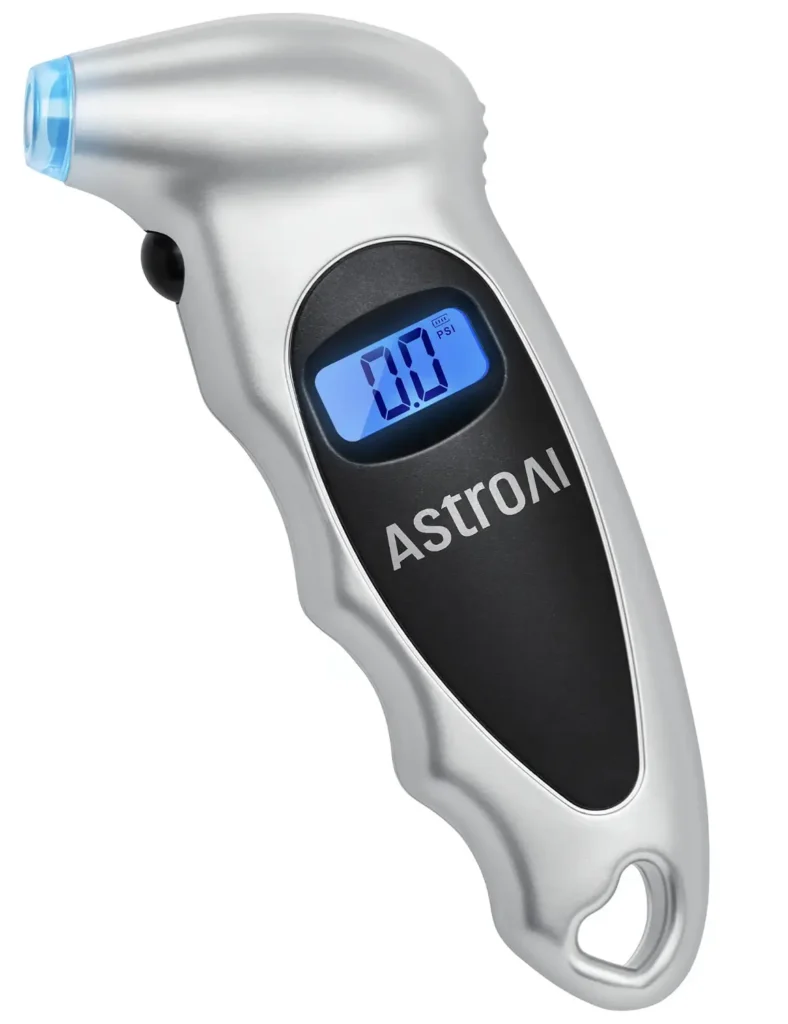
The AstroAI Digital Tire Pressure Gauge is our top pick because it combines the features most drivers are likely to want in a compact, everyday tire pressure gauge.
It isn’t the most rugged gauge in this comparison, nor does it offer the widest pressure range. Instead, it focuses on making routine tire-pressure checks straightforward, readable, and convenient.
Key Specifications
| Feature | AstroAI Digital Tire Pressure Gauge |
|---|---|
| Type | Digital |
| Pressure range | 0–150 PSI |
| Stated accuracy | ±1 PSI |
| Measurement units | PSI, Bar, Kgf/cm², KPa |
| Display | Backlit LCD |
| Nozzle light | Yes |
| Auto shutoff | 30 seconds |
| Power | 3 batteries |
| Weight | 1.76 oz |
| Dimensions | 5.31 × 2.17 × 1.1 in |
| Valve compatibility | Standard Schrader valves |
Easy-to-Read Digital Display
One of the biggest advantages of a digital tire pressure gauge is that you don’t have to interpret a physical scale.
The AstroAI uses a backlit LCD display, which can be particularly useful when checking tires in a dim garage, early in the morning, or at night. The gauge also has an illuminated nozzle to help locate the valve stem in low-light conditions.
That combination addresses two common sources of frustration with basic gauges: seeing the valve and seeing the reading.
Useful Pressure Range for Everyday Vehicles
The gauge measures from 0 to 150 PSI and supports four different measurement units: PSI, Bar, Kgf/cm², and KPa.
For normal passenger vehicles, SUVs, motorcycles, and spare tires, that range provides considerably more capacity than you’ll typically need.
The important point is that a high maximum PSI rating doesn’t automatically make one gauge better than another. Most drivers should be more interested in whether the gauge is appropriate for their vehicle and provides readings that are easy to obtain and interpret.
For everyday tire-pressure maintenance, the AstroAI’s range is more than sufficient.
Simple One-Button Operation
The AstroAI is designed around relatively straightforward controls.
A single button can be used to cycle through the available measurement units, while the gauge automatically shuts off after 30 seconds of inactivity.
That makes it a practical option for someone who doesn’t want to navigate a complicated interface just to check tire pressure.
What Customers Say
Customer feedback is particularly useful with this gauge because there is a large volume of reviews to examine.
The most frequently reported positive themes include:
- Accuracy: 2,900+ mentions
- Ease of use: 2,500+ mentions
- Readability: 1,100+ mentions
- Convenience: 500+ mentions
- Backlight: 500+ mentions
Customers commonly describe the gauge as accurate and easy to use, while the illuminated display and nozzle light are frequently appreciated for low-light checks.
That gives us a fairly consistent picture of where this product’s strengths lie: simple operation, readable measurements, and convenient everyday use.
There are also recurring negative themes worth considering.
Battery life is mentioned negatively by a significant number of customers, with some reporting that the gauge consumes batteries relatively quickly. Reliability and durability also receive criticism from a portion of buyers, including reports of units failing after relatively limited use.
Those concerns don’t necessarily make the gauge unsuitable for normal use, but they’re important when comparing it with more heavily constructed alternatives.
Who Should Buy the AstroAI Digital Tire Pressure Gauge?
This is a good fit if you want:
- A compact gauge for your glove compartment
- A simple digital readout
- Easy-to-see measurements
- An illuminated nozzle for nighttime checks
- Multiple measurement units
- A broad pressure range for everyday vehicles
- A lightweight tool for occasional or routine checks
It is less compelling if your priority is maximum durability for frequent professional use or if you specifically want a gauge that doesn’t rely on disposable batteries.
Our Take
The AstroAI Digital Tire Pressure Gauge doesn’t win because it has the highest accuracy specification or the toughest construction in this comparison.
It wins because it gets the fundamentals right for the average driver.
It’s compact, inexpensive, easy to read, simple to operate, and equipped with several genuinely useful features rather than a long list of unnecessary extras.
The recurring battery and durability complaints are worth taking seriously, particularly if you expect to use a gauge heavily.
But for routine tire-pressure checks, the combination of a digital display, ±1 PSI stated accuracy, illuminated nozzle, broad pressure range, and large volume of positive customer feedback makes it a strong all-around choice.
→ Check the AstroAI Digital Tire Pressure Gauge on Amazon (ad)
ETENWOLF Pencil Tire Pressure Gauge 2 Pack – Best Pencil Gauge
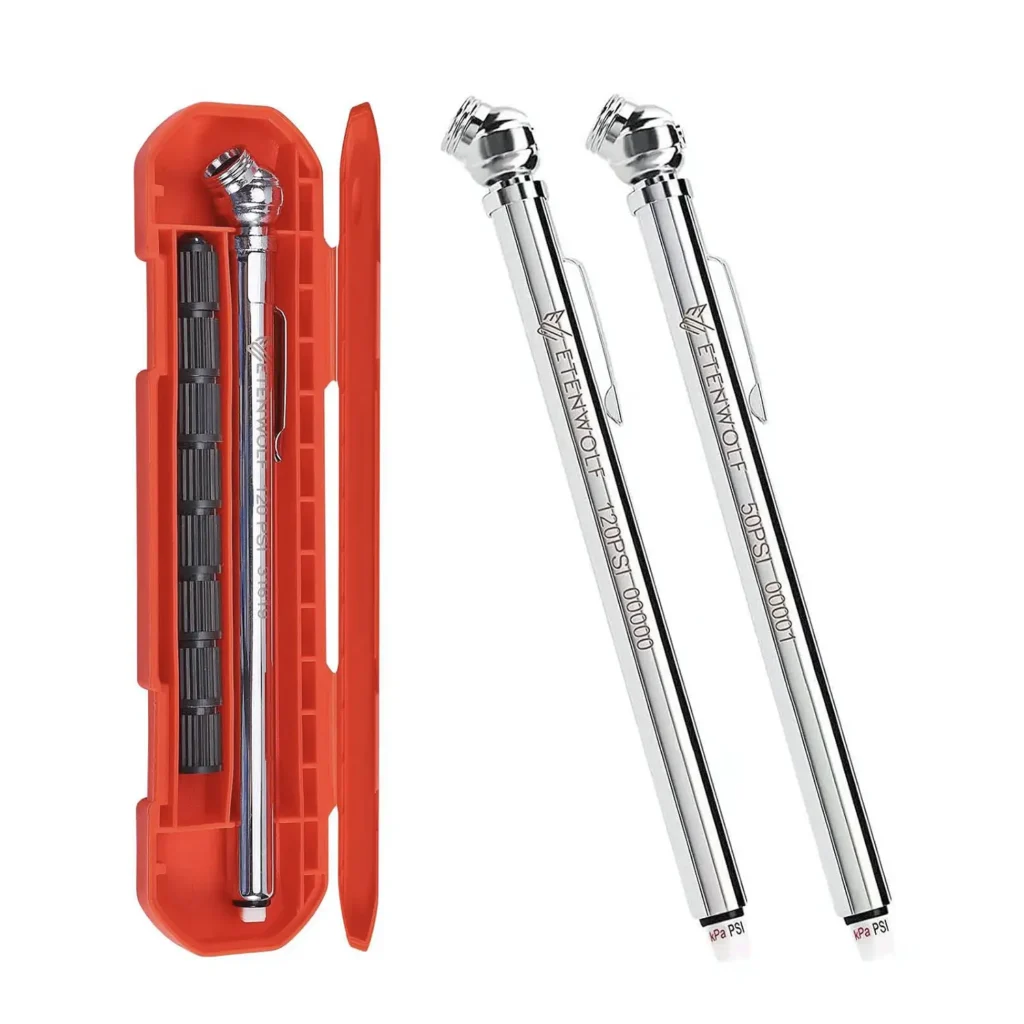
If you prefer a tire pressure gauge that is simple, compact, and doesn’t require batteries, the ETENWOLF Pencil Tire Pressure Gauge 2 Pack is one of the most practical options in this comparison.
Rather than using a digital screen, this set uses traditional pencil-style gauges with stainless steel bodies. It includes two different pressure ranges, giving you more flexibility than a single-range pencil gauge.
Key Specifications
| Feature | ETENWOLF Pencil Tire Pressure Gauge 2 Pack |
|---|---|
| Type | Pencil |
| Pressure ranges | 10–50 PSI and 20–120 PSI |
| Stated calibration | ANSI B40.1 Grade B |
| Stated accuracy | 2% of span in middle 50%; 3% in lower/upper 25% |
| Construction | Stainless steel / metal |
| Deflation | Yes |
| Power | Battery-free |
| Weight | 4.1 oz |
| Dimensions | 5.8 × 2.9 × 0.7 in |
| Included | 2 gauges, 16 valve caps, 2 storage cases |
Two Pressure Ranges in One Package
The biggest reason to consider this set is the inclusion of two separate gauges.
One covers 10–50 PSI, while the other covers 20–120 PSI. That makes the set more versatile across different tire types and pressure requirements than a single low-range gauge.
ETENWOLF also states that the gauges are calibrated to ANSI B40.1 Grade B standards, with accuracy specifications that vary depending on where the reading falls within the gauge’s range.
That distinction is worth understanding. A stated accuracy percentage for a gauge isn’t necessarily the same at every point in its operating range, so buyers shouldn’t assume that the headline specification represents identical accuracy at every PSI.
No Batteries to Replace
For some drivers, the biggest advantage of a pencil gauge is simply its simplicity.
There is no digital screen, charging cable, or battery compartment to worry about. You attach the gauge to the valve stem, take the reading, and remove it.
That also means the gauge can sit in your vehicle for long periods without you having to think about whether it has enough battery power when you need it.
Metal Construction
The gauges use stainless steel construction, while ETENWOLF also includes zinc-alloy components in the valve head.
This gives them a more traditional tool-like feel compared with lightweight plastic digital gauges.
They’re designed to be carried and stored easily, and the included cases provide a convenient place to keep each gauge when it’s not being used.
Pressure Release Function
The ETENWOLF gauges can also be used to release air from an overinflated tire.
That’s a useful addition because checking tire pressure and correcting an overinflated tire can be handled with the same tool rather than requiring a separate deflation tool.
As always, the target pressure should come from the vehicle manufacturer’s recommendation rather than the maximum pressure printed on the tire.
What Customers Say
Customer feedback is consistently positive across the main areas buyers tend to mention.
Frequently reported strengths include:
- Functionality: 385+ mentions
- Value for money: 340+ mentions
- Portability: 270+ mentions
- Accuracy: 225+ mentions
- Extra valve caps: 150+ mentions
- Ease of use: 135+ mentions
- Pressure range: 100+ mentions
Customers commonly describe the gauges as accurate, easy to use, portable, and good value for the money.
The two pressure ranges are also a recurring positive, particularly for people who want one set that can cover different vehicle or tire-pressure requirements.
The included valve caps are another small but practical bonus.
Who Should Buy the ETENWOLF Pencil Gauge Set?
This set makes sense if you want:
- A battery-free tire pressure gauge
- A simple mechanical design
- Two pressure ranges
- Metal construction
- A compact tool for vehicle storage
- A gauge that can also release excess air
- A low-cost option for routine tire checks
It may be less appealing if you strongly prefer digital displays or want illuminated readings for checking tires at night.
Our Take
The ETENWOLF set demonstrates that a good tire pressure gauge doesn’t have to be complicated.
There are no batteries, digital menus, or screens to worry about. You simply choose the appropriate gauge for the pressure range you’re checking, attach it to the valve, and read the result.
The two-range approach is particularly useful, while the metal construction and included storage cases make the set feel more like a conventional tool than a disposable accessory.
For drivers who value simplicity and want a gauge they can leave in the vehicle without worrying about batteries, this is our Best Pencil Gauge and one of the strongest value-oriented options in the lineup.
→ Check the ETENWOLF Pencil Tire Pressure Gauge 2 Pack on Amazon (ad)
ETENWOLF T300 Digital Tire Pressure Gauge – Best Heavy-Duty Digital
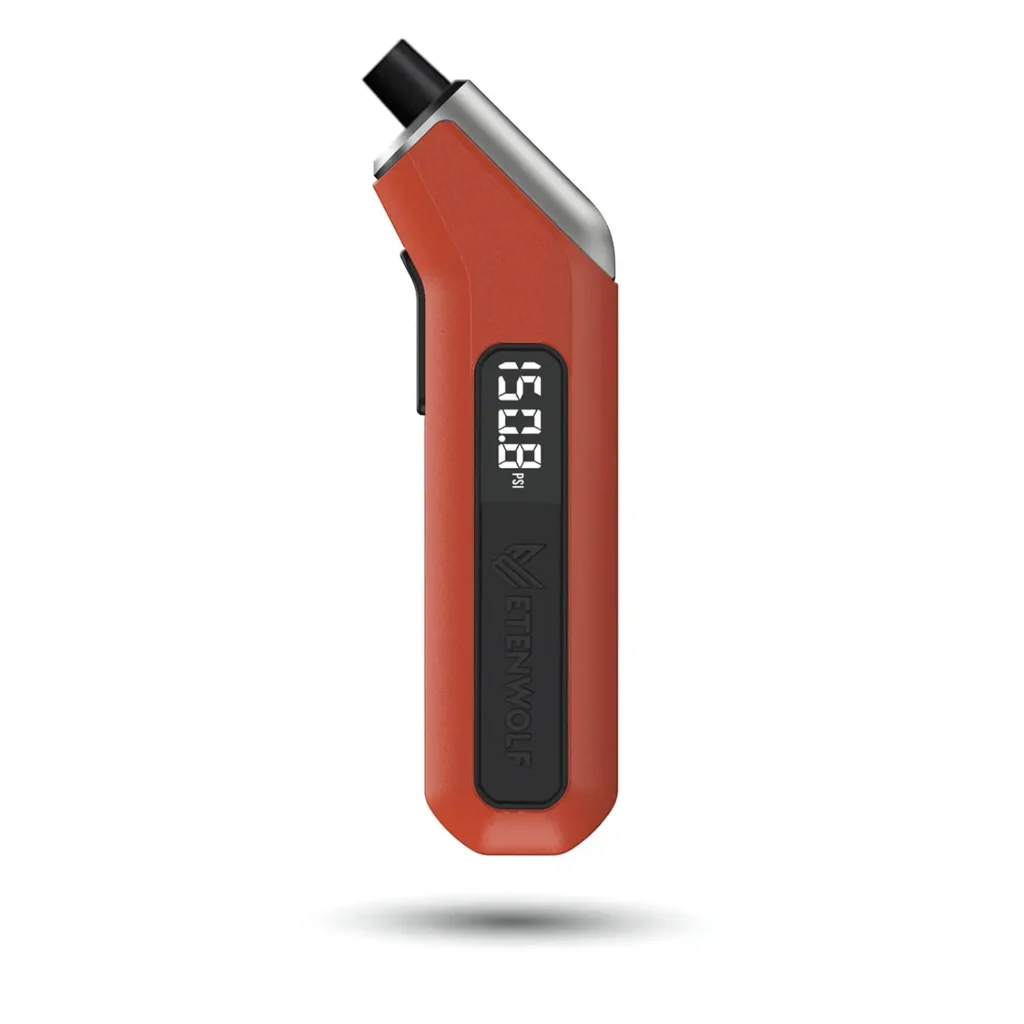
The ETENWOLF T300 Digital Tire Pressure Gauge is a strong choice for drivers who want a digital gauge with a particularly wide pressure range.
Its 3–200 PSI measurement range goes well beyond what most passenger-car owners need, but that extra capacity can make the T300 more appealing for pickups, RVs, trucks, motorcycles, and other applications where a broader range is useful.
It also combines a digital display with replaceable AAA batteries, an illuminated LED, and stated calibration to an industrial pressure-gauge standard.
Key Specifications
| Feature | ETENWOLF T300 |
|---|---|
| Type | Digital |
| Pressure range | 3–200 PSI |
| Stated calibration | ANSI B40.7 Grade 2A |
| Stated accuracy | ±0.5% of span |
| Display | Digital |
| Low-light illumination | LED light |
| Batteries | Replaceable AAA |
| Auto shutoff | 30 seconds |
| Weight | 2.86 oz |
| Dimensions | 6.3 × 1.46 × 1.06 in |
| Bicycle compatibility | Presta adapter sold separately |
A Very Wide Pressure Range
The T300’s biggest differentiator is its 3–200 PSI range.
For a typical passenger car, you won’t come close to needing 200 PSI. That’s not a problem, but it does mean the T300’s main advantage is less about everyday necessity and more about versatility.
ETENWOLF specifically positions the gauge for pickups, RVs, and heavy-duty vehicles, while its broad range also gives it flexibility for motorcycles and other applications.
The manufacturer states that the gauge is designed to maintain accuracy across both lower and higher pressure ranges, including pressures below 12 PSI and above 140 PSI.
Those are manufacturer claims rather than independent measurements, but they help explain why this model is positioned differently from a basic passenger-car gauge.
Replaceable AAA Batteries
Unlike a battery-free pencil gauge, the T300 uses replaceable AAA batteries.
That’s a practical choice for a digital tool that may spend long periods stored in a vehicle. When the batteries eventually run down, they can be replaced rather than requiring the entire gauge to be discarded or recharged.
The gauge also automatically shuts off after 30 seconds of inactivity to reduce unnecessary battery consumption.
Digital Readout With Low-Light Illumination
The digital display provides an easy-to-read numerical measurement, while the built-in LED helps illuminate the valve area in darker conditions.
Customers frequently mention the large numbers and readability as strengths.
That makes the T300 particularly useful if you regularly check tire pressure in garages, driveways, or parking areas where lighting isn’t ideal.
Built for a Broader Range of Vehicles
The T300 is designed around versatility rather than being a minimal glove-box gauge.
Its pressure range can accommodate many different vehicle types, while its construction is intended to withstand more demanding use.
ETENWOLF also makes a particularly strong durability claim for this model, stating that it can continue working after being run over by a vehicle.
That’s a manufacturer claim rather than something independently verified in our evaluation, so it should be treated accordingly. Still, the emphasis on durability is consistent with the T300’s positioning as a more heavy-duty option.
What Customers Say
Customer feedback is strongly positive across the major performance categories.
Frequently reported strengths include:
- Quality: 1,200+ mentions
- Accuracy: 900+ mentions
- Ease of use: 750+ mentions
- Value for money: 550+ mentions
- Readability: 400+ mentions
- Tire pressure: 350+ mentions
- Display: 300+ mentions
Customers commonly describe the gauge as accurate and easy to use, with large numbers that are easy to read.
The built-in light is also frequently appreciated, particularly when checking tire valves in low-light conditions.
Who Should Buy the ETENWOLF T300?
The T300 is particularly well suited to:
- Pickup owners
- RV owners
- Drivers with higher-pressure tires
- People who want a very broad measurement range
- Anyone who prefers digital readings
- Drivers who want replaceable batteries
- People who regularly check multiple types of tires
For a normal sedan or crossover, its 200 PSI maximum may be considerably more than necessary. If you’re only looking for the simplest possible gauge for routine passenger-car checks, a smaller model can make more sense.
Our Take
The ETENWOLF T300 isn’t trying to compete with basic tire gauges on simplicity alone.
Its appeal comes from versatility and range.
A 3–200 PSI measurement range, digital display, replaceable AAA batteries, low-light illumination, and stated industrial-grade calibration make it a compelling choice for someone who wants one gauge capable of handling a broader range of vehicles.
For the average passenger-car driver, some of that capability may be unnecessary. For pickups, RVs, trucks, or anyone who regularly deals with different tire-pressure requirements, however, the T300’s broader operating range makes considerably more sense.
→ Check the ETENWOLF T300 Digital Tire Pressure Gauge on Amazon (ad)
ETENWOLF Tire Pressure Gauge – Best Analog Gauge
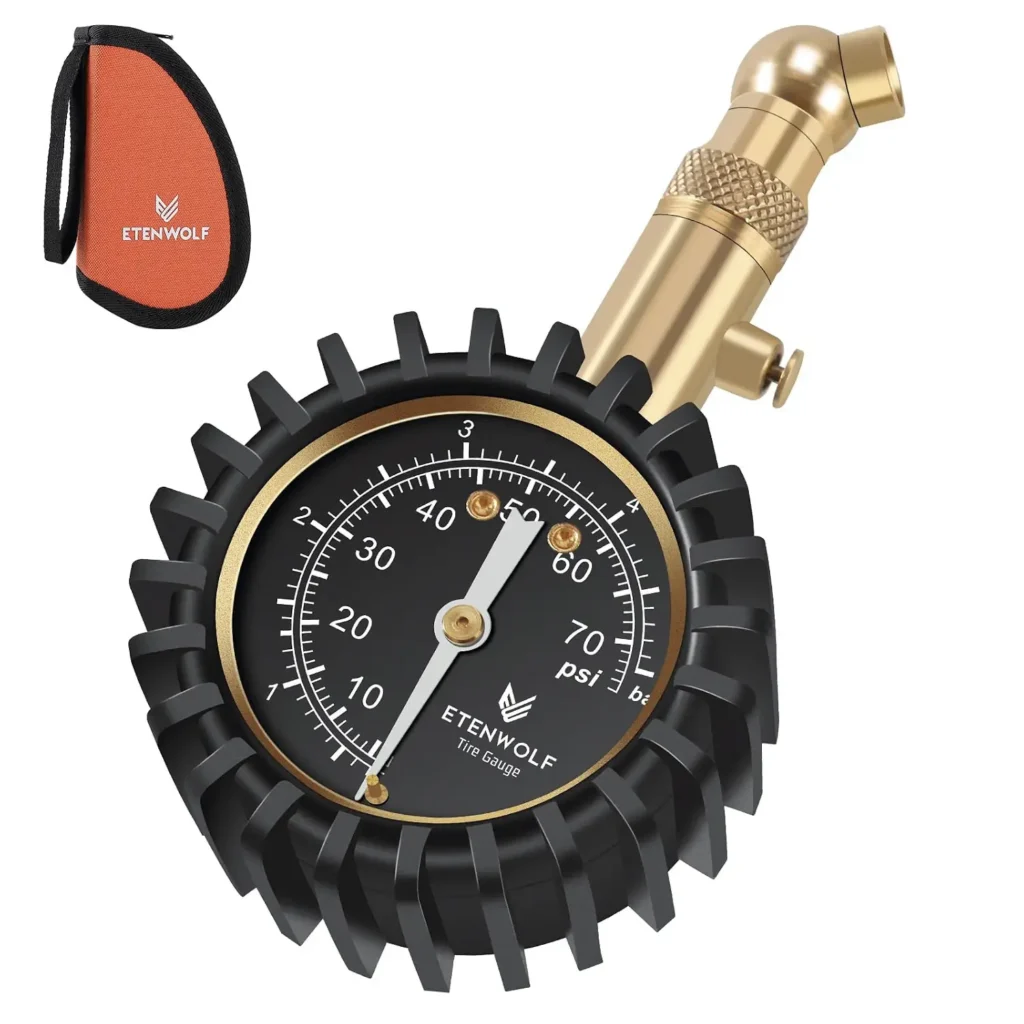
Not everyone needs a digital tire pressure gauge.
The ETENWOLF Tire Pressure Gauge with Large Glow Dial takes a more traditional approach, using a large analog dial that is designed to remain easy to read in low-light conditions.
It also adds a 360-degree swivel chuck, making it easier to position the gauge around awkwardly placed valve stems.
For drivers who prefer a conventional mechanical gauge, this is one of the most compelling alternatives to the digital models in our lineup.
Key Specifications
| Feature | ETENWOLF Large Glow Dial |
|---|---|
| Type | Analog dial |
| Pressure range | 0–75 PSI |
| Stated calibration | ANSI B40.1 Grade A |
| Stated accuracy | ±1% of span |
| Dial | Large glow-in-the-dark |
| Chuck | 360° swivel |
| Construction | Brass and rubber |
| Weight | 10.1 oz |
| Dimensions | 4.76 × 2.83 × 1.38 in |
| Included | Carrying case, valve stems and caps |
Large Dial for Easy Reading
The most obvious difference between this gauge and the digital models is the display.
Instead of showing a numerical reading on an LCD, the ETENWOLF uses a large physical dial. The manufacturer designed the dial to glow in low-light conditions, which can make it easier to read when you’re checking tires without ideal lighting.
Some drivers simply prefer this format. There’s no battery-powered display to activate and no digital controls to navigate.
The tradeoff is that reading an analog dial requires you to interpret the needle position rather than simply reading a number.
0–75 PSI Range
The gauge measures from 0 to 75 PSI.
That range covers the normal requirements of many cars, SUVs, motorcycles, and other everyday vehicles, while also providing enough capacity for a variety of higher-pressure applications.
It isn’t as broad as the 200 PSI range offered by the ETENWOLF T300, so drivers with unusually high-pressure tires should check their vehicle’s requirements before choosing this model.
360-Degree Swivel Chuck
The swivel chuck is one of the more useful physical design features.
Valve stems aren’t always positioned conveniently, particularly on some wheels or vehicles. A 360-degree swivel allows the gauge to be positioned from different angles rather than requiring you to hold the entire tool in one fixed orientation.
That can make attaching the gauge easier and reduce awkward wrist positioning.
Heavy-Duty Construction
The gauge uses brass and rubber construction and weighs 10.1 ounces, making it substantially heavier than the lightweight digital and pencil gauges elsewhere in this comparison.
That isn’t necessarily a disadvantage.
For someone who wants a more substantial tool that can live in a garage or vehicle toolkit, the added weight and physical construction may actually be preferable to a very lightweight plastic gauge.
The manufacturer also states that the gauge is manually calibrated to ANSI B40.1 Grade A with ±1% of span accuracy.
What Customers Say
Customer feedback is particularly positive around the areas that matter most for an analog gauge.
Frequently reported strengths include:
- Accuracy: 350+ mentions
- Build quality: 175+ mentions
- Carrying case: 130+ mentions
- Readability: 100+ mentions
- Functionality: 50+ mentions
- Included accessories: 50+ mentions
- Swivel: 45+ mentions
Customers commonly describe the gauge as accurate, well built, and easy to read.
The large dial is frequently appreciated, while the carrying case and included accessories add practical value.
Size is the main area where opinions are less consistent. Some customers appreciate its compact enough-to-store design, while others find it larger than expected.
Who Should Buy the ETENWOLF Large Glow Dial?
This gauge makes sense if you want:
- An analog rather than digital display
- A large, readable dial
- A battery-free design
- A 360-degree swivel chuck
- More substantial physical construction
- A gauge that can stay in a garage or vehicle toolkit
- A pressure range suitable for many cars, SUVs, motorcycles, and similar vehicles
It’s less suitable if you want the smallest possible gauge or strongly prefer numerical digital readings.
Our Take
The ETENWOLF Large Glow Dial proves that digital isn’t automatically better.
For drivers who prefer a conventional mechanical gauge, the large dial is straightforward, the 0–75 PSI range is practical for many everyday vehicles, and the 360-degree swivel chuck adds useful flexibility when accessing valve stems.
It’s also one of the more substantial gauges in this comparison, which may appeal to buyers who want something that feels like a proper workshop tool rather than a lightweight emergency accessory.
If you prefer digital displays, the T300 or AstroAI will probably be more convenient. But if you want a battery-free analog gauge with a readable dial and solid construction, this ETENWOLF model is our Best Analog Gauge.
→ Check the ETENWOLF Large Glow Dial Tire Pressure Gauge on Amazon (ad)
AstroAI Pencil Tire Pressure Gauge 2 Pack – Best Budget Pencil Gauge
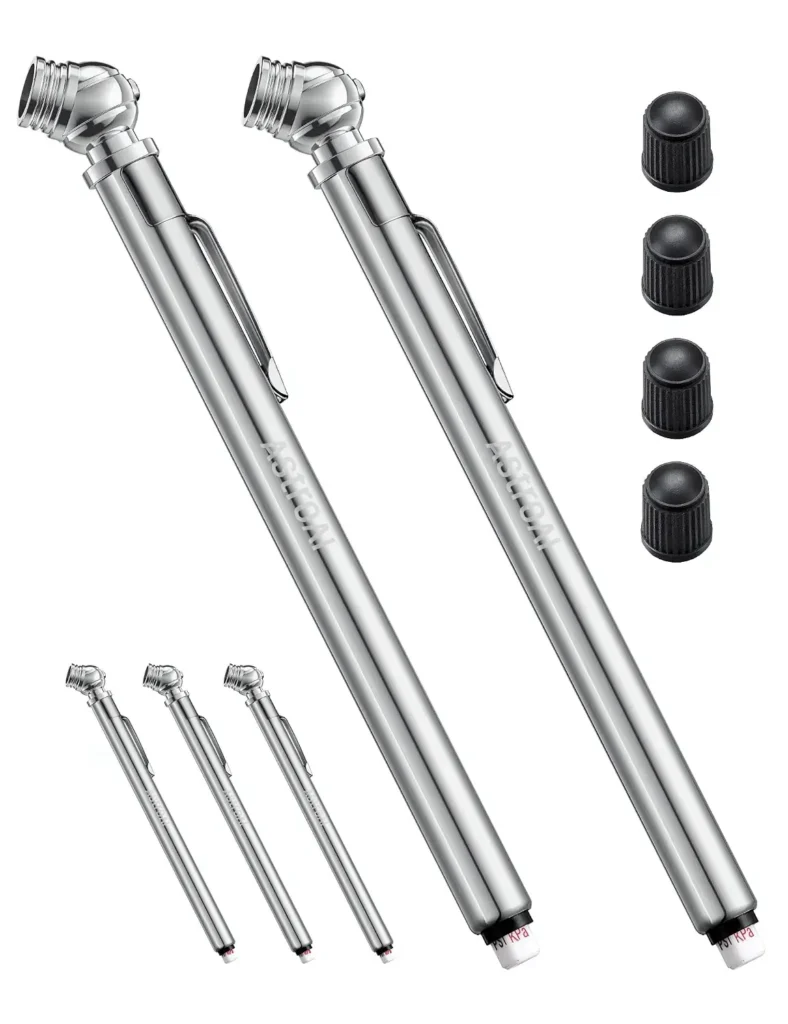
If you want a basic tire pressure gauge that is inexpensive, compact, and doesn’t depend on batteries, the AstroAI Pencil Tire Pressure Gauge 2 Pack is a straightforward option.
The traditional pencil-style design keeps the tool simple, while the stainless steel construction, integrated deflation function, and included valve caps give it more utility than its low price might suggest.
The two-pack also means you can keep one gauge in your vehicle and another in a garage, toolbox, or second vehicle.
Key Specifications
| Feature | AstroAI Pencil Tire Pressure Gauge 2 Pack |
|---|---|
| Type | Pencil |
| Pressure range | 10–75 PSI |
| Stated accuracy | ±2% of span |
| Standard | ANSI B40.1 Grade B |
| Construction | Stainless steel |
| Measurement units | PSI, kPa, Bar |
| Deflation | Yes |
| Power | Battery-free |
| Weight | 1.76 oz |
| Dimensions | 6.89 × 1.18 × 0.71 in |
| Included | 2 gauges and 4 valve stem caps |
Simple, Battery-Free Design
The biggest appeal of a pencil gauge is its simplicity.
There’s no screen to turn on, no batteries to replace, and no electronic controls to learn. The gauge attaches to the tire valve and the internal indicator provides the pressure reading.
For someone who simply wants a basic tool for checking tire pressure periodically, that can be all that’s necessary.
The battery-free design also makes it easy to leave in a glove compartment or toolbox for long periods without worrying about whether it will be operational when you need it.
Stainless Steel Construction
AstroAI uses stainless steel for the gauge’s construction, which gives it a more traditional metal-tool feel than many inexpensive digital alternatives.
The company also describes the nozzle as precision crafted to seal against the valve stem, while the integrated pocket clip makes the gauge easier to carry or attach to a tool belt.
Its small size means it can be stored in places where a larger dial or digital gauge might be inconvenient.
Useful 10–75 PSI Range
The gauge measures from 10 to 75 PSI and also supports kPa and Bar.
That covers the pressure requirements of many passenger vehicles and other common applications.
The 75 PSI maximum is worth keeping in mind, however. Drivers with vehicles or tires requiring pressures above that range should choose a gauge with a higher maximum instead.
Built-In Deflation Function
One useful feature is the integrated deflation valve.
If a tire has been inflated beyond the recommended pressure, you can use the gauge to release some air rather than needing another tool for the job.
As with any tire pressure gauge, the target pressure should come from the vehicle manufacturer’s recommended specification, typically found on the driver’s door-jamb label or in the owner’s manual.
What Customers Say
Customer feedback is generally positive around value and everyday usability.
Frequently reported strengths include:
- Value for money: 380+ mentions
- Accuracy: 370+ mentions
- Ease of use: 215+ mentions
- Convenience: 100+ mentions
- Build quality: 100+ mentions
- Portability: 60+ mentions
Customers commonly appreciate the low price, solid feel, compact design, and straightforward operation.
There is, however, some disagreement about measurement accuracy. While many customers report accurate readings, others say their gauge reads several PSI lower than expected.
That doesn’t necessarily mean the gauge is universally inaccurate, but it does highlight why consistency and calibration matter more than a low purchase price alone when choosing a pressure gauge.
Who Should Buy the AstroAI Pencil Gauge?
This gauge is a good fit if you want:
- A very inexpensive tire pressure gauge
- A battery-free design
- Stainless steel construction
- A compact tool for vehicle storage
- An integrated deflation function
- A two-pack for multiple vehicles or locations
- A simple alternative to digital gauges
It’s less suitable if you want a large digital display, illuminated readings, or the widest possible pressure range.
Our Take
The AstroAI Pencil Tire Pressure Gauge 2 Pack is a good example of how little you actually need for basic tire-pressure checking.
It’s small, inexpensive, battery-free, and made from stainless steel. The two-pack adds practical value, while the integrated deflation function means the gauge can also help correct an overinflated tire.
The mixed customer feedback around readings is the main reason we wouldn’t automatically choose it over the stronger digital and mechanical gauges in this comparison.
But if simplicity, portability, and low cost are your priorities, this is an appealing option – and our Best Budget Pencil Gauge.
→ Check the AstroAI Pencil Tire Pressure Gauge 2 Pack on Amazon (ad)
HYVOHEX Digital Tire Pressure Gauge – Best Budget Digital
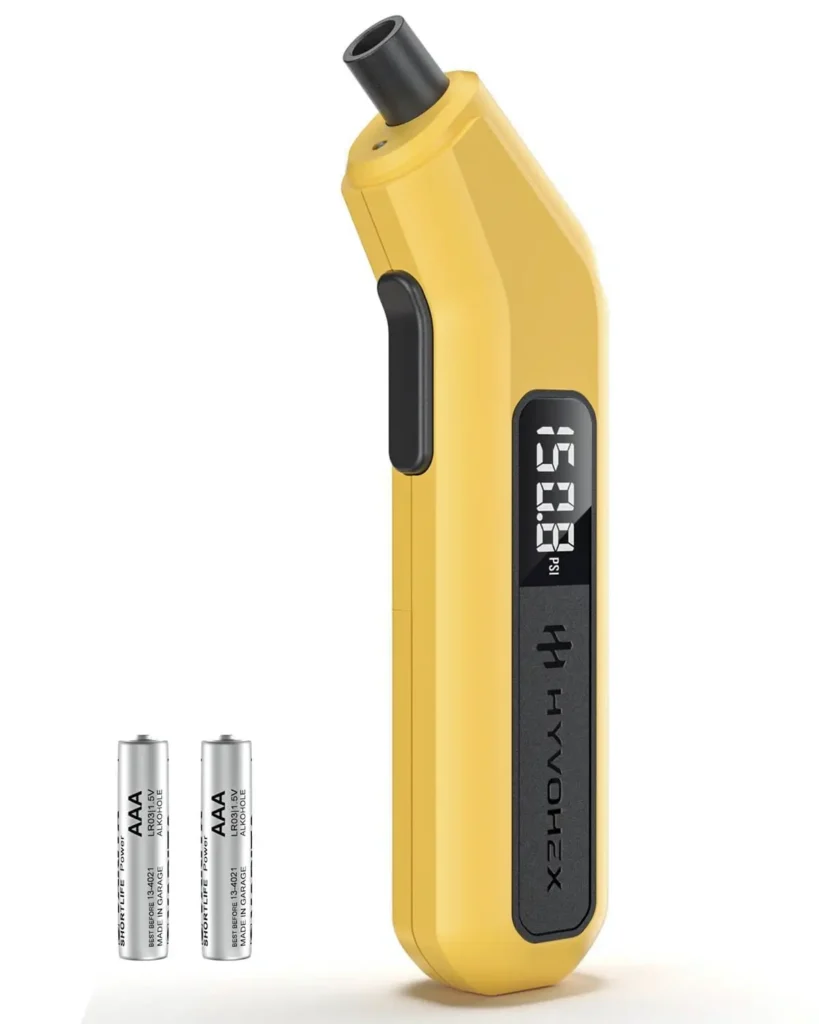
The HYVOHEX Digital Tire Pressure Gauge is aimed at buyers who want the convenience of a digital display without spending much.
It offers a 0–200 PSI measurement range, a large backlit screen, replaceable AAA batteries, automatic operation, and a compact design. That gives it a surprisingly broad feature set for a budget-oriented gauge.
The main reason to consider it is straightforward: you get a digital readout and a wide pressure range at a very low price.
Key Specifications
| Feature | HYVOHEX Digital Tire Pressure Gauge |
|---|---|
| Type | Digital |
| Pressure range | 0–200 PSI |
| Stated calibration | ANSI B40.7 Grade 2A |
| Stated accuracy | ±0.1 PSI claimed |
| Display | Large backlit LED display |
| Batteries | 2 AAA |
| Auto operation | Yes |
| Valve | 360° rotating valve |
| Weight | 3.53 oz |
| Dimensions | 6.3 × 1.46 × 1.06 in |
| Vehicle compatibility | Cars, RVs, trucks, bikes |
Digital Readout at a Low Price
The main attraction here is the digital display.
Instead of interpreting a pencil indicator or analog dial, you get a numerical pressure reading on a large backlit screen. That can be especially convenient for drivers who want a quick reading without having to estimate the needle position on a traditional gauge.
The display is also designed for use in dim conditions, while the valve area can be illuminated to make nighttime checks easier.
For occasional vehicle maintenance, those small conveniences can make a noticeable difference.
0–200 PSI Measurement Range
HYVOHEX lists a 0–200 PSI range, which gives this gauge considerable flexibility.
Most passenger vehicles require nowhere near 200 PSI, so the upper end of the range isn’t particularly important for ordinary car owners. However, it can make the gauge more versatile for people who want to check different types of vehicles or equipment.
The manufacturer also states that the gauge is calibrated to ANSI B40.7 Grade 2A and claims ±0.1 PSI accuracy.
That is a manufacturer-stated specification, not an independent measurement from our testing, so it shouldn’t be interpreted as proof that every real-world reading will be accurate to exactly 0.1 PSI.
Replaceable AAA Batteries
The HYVOHEX uses two AAA batteries rather than a built-in rechargeable battery.
That makes replacements straightforward and avoids having to charge the gauge before use.
The automatic power functions are also designed to reduce unnecessary battery consumption, although battery life is ultimately dependent on usage and battery quality.
Rotating Valve Design
The gauge uses a 360-degree rotating valve, which can help when the valve stem isn’t positioned conveniently.
Rather than needing to hold the entire gauge in one fixed orientation, you can adjust the angle of the connection to suit the tire.
That’s a relatively small feature, but it can make checking tires easier when access is awkward.
What Customers Say
Customer feedback is positive across several important categories.
Frequently reported strengths include:
- Quality: 130+ mentions
- Accuracy: 115+ mentions
- Readability: 40+ mentions
- Lighting: 35+ mentions
- Battery type: 25+ mentions
- Convenience: 20+ mentions
- Flashlight: 15+ mentions
Customers frequently praise the large, bright display and report that the gauge provides accurate readings. The built-in illumination is also appreciated for locating and checking tire valves in darker conditions.
There is one important counterpoint: durability feedback is less consistent.
Some customers report that the gauge continues working well over time, while others say their unit stopped working after a relatively short period.
With a budget product, that’s worth keeping in mind. A low purchase price can make a product attractive, but long-term reliability is still part of the overall value calculation.
Who Should Buy the HYVOHEX?
This gauge makes sense if you want:
- A low-cost digital tire pressure gauge
- A large, easy-to-read display
- A wide 0–200 PSI range
- Replaceable AAA batteries
- Low-light illumination
- A rotating valve connection
- A compact gauge for vehicle storage
It’s less appealing if long-term durability is your highest priority or if you want a more established premium tool with a longer warranty.
Our Take
The HYVOHEX is an interesting budget option because it doesn’t feel limited to the basics on paper.
A large backlit display, 0–200 PSI range, replaceable batteries, rotating valve, and automatic operation give it a feature set that looks considerably more expensive than its price suggests.
The customer feedback largely supports the gauge’s ease of use, readability, and accuracy, but the reports of shorter-than-expected lifespan prevent us from treating it as an unquestionable reliability winner.
For someone who wants a digital tire pressure gauge with plenty of range at a low upfront cost, however, it’s a compelling budget choice.
→ Check the HYVOHEX Digital Tire Pressure Gauge on Amazon (ad)
AstroAI Digital Tire Pressure Gauge with Inflator – Best Inflator/Gauge Combo
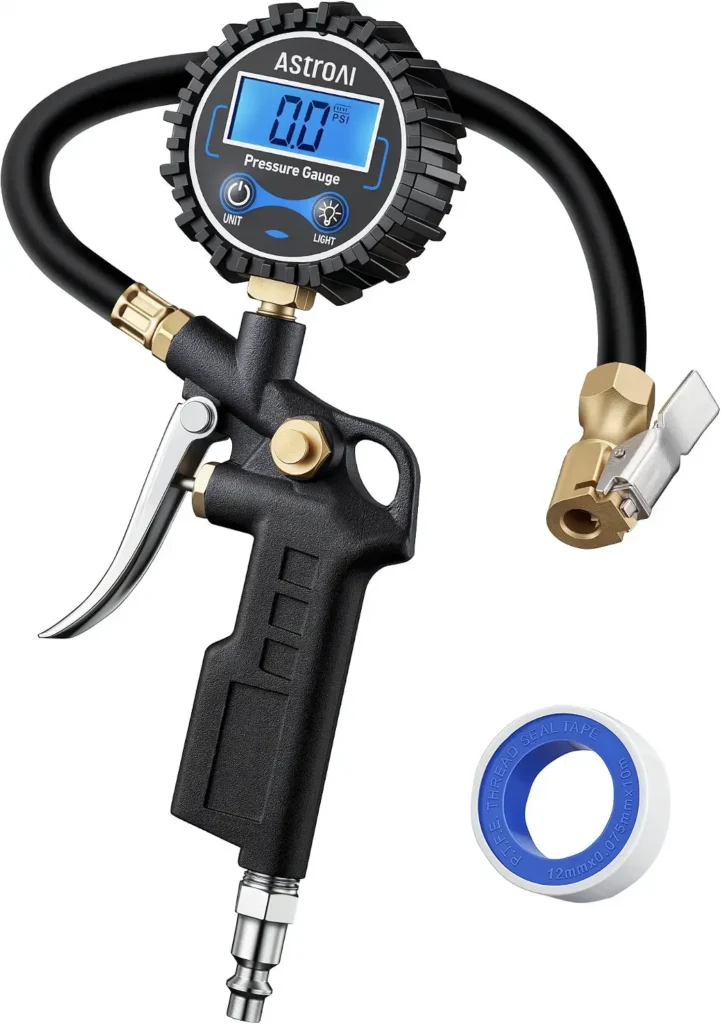
If you want more than a standalone pressure gauge, the AstroAI Digital Tire Pressure Gauge with Tire Inflator combines three useful functions in one tool: measuring, inflating, and deflating.
That makes it particularly useful for drivers who already have an air compressor and want a dedicated tool for controlling and monitoring tire pressure while adding air.
It also has one of the widest pressure ranges in this lineup, reaching up to 250 PSI.
Key Specifications
| Feature | AstroAI Digital Tire Pressure Gauge with Tire Inflator |
|---|---|
| Type | Digital inflator/gauge |
| Pressure range | 3–250 PSI |
| Stated accuracy | ±0.5% full scale |
| Resolution | 0.1 PSI |
| Pressure units | PSI, Bar, KPa, Kg/cm² |
| Functions | Measure, inflate, deflate |
| Display | Backlit LCD |
| Hose | 19.7 in |
| Valve connection | 360° swivel chuck |
| Lighting | Built-in LED |
| Auto shutoff | 15 seconds |
| Construction | ABS, aluminum and copper alloy |
| Weight | 10.6 oz |
More Than a Pressure Gauge
The biggest difference between this AstroAI and the other gauges in this guide is functionality.
Instead of measuring pressure and then switching to a separate inflator, this tool lets you monitor the pressure while adding or releasing air.
The trigger controls inflation, while the built-in deflation function lets you lower pressure when necessary.
For regular tire maintenance, having those functions together can make the process more convenient.
Wide 3–250 PSI Range
The gauge measures from 3 to 250 PSI, giving it a broader stated range than most of the standalone gauges in this lineup.
For ordinary passenger cars, that upper limit is far beyond what you’ll normally need. The advantage is versatility rather than necessity.
The 0.1 PSI resolution also allows you to monitor pressure in small increments on the digital display.
The manufacturer states accuracy of ±0.5% of full scale. As with the other manufacturer specifications in this guide, that is a stated specification rather than an independent measurement from our testing.
Backlit Display and Built-In LED
The digital display is backlit, making the pressure reading easier to see in lower-light conditions.
There’s also a built-in LED around the tool’s working area, which can help when you’re trying to locate the valve stem in darker conditions.
These features aren’t essential during a daytime tire check, but they can be useful when you’re dealing with a tire in a driveway or parking lot at night.
Swivel Chuck and Flexible Hose
The tool includes a 19.7-inch hose and a 360-degree swivel chuck.
The swivel connection gives you some flexibility when positioning the tool against the valve stem, while the hose keeps the main body of the gauge away from the tire.
That can be more comfortable than holding a compact gauge directly against the valve throughout the measurement.
A Useful Choice for Compressor Owners
This isn’t a replacement for an air compressor itself.
Instead, it’s designed to work with an external air supply, allowing you to control and monitor inflation from the gauge.
If you already own a compressor, this combination can be considerably more useful than carrying a simple pressure gauge alone.
If you don’t have an air source, however, the additional inflation functionality won’t provide much benefit by itself.
What Customers Say
Customer feedback is particularly strong around the tool’s core functions.
Frequently reported strengths include:
- Quality: 2,400+ mentions
- Functionality: 2,200+ mentions
- Accuracy: 1,800+ mentions
- Ease of use: 1,300+ mentions
- Value: 900+ mentions
- Readability: 575+ mentions
- Durability: 380+ neutral mentions
Customers commonly praise the clear digital display, ease of use, and ability to measure and control tire pressure with the same tool.
There is one recurring concern worth noting: sealing around the air chuck.
Some customers report difficulties getting a good seal at the valve connection. That’s important because even an accurate gauge becomes frustrating to use if the connection doesn’t seal properly.
Who Should Buy the AstroAI Inflator/Gauge?
This model makes the most sense if you:
- Already own an air compressor
- Want to measure and inflate with one tool
- Prefer a digital pressure display
- Want inflation, deflation, and measurement together
- Value a flexible hose and swivel connection
- Want a very wide pressure range
It’s probably more tool than you need if all you want is a compact gauge for occasional pressure checks.
Our Take
The AstroAI stands apart from the other products here because it isn’t really competing as a simple pressure gauge.
Its value comes from combining measurement, inflation, and deflation in one tool.
The wide pressure range, 0.1 PSI resolution, backlit display, LED, flexible hose, and swivel chuck make it a practical option for people who regularly maintain their own tires.
The main caveat is the recurring customer feedback about the air chuck sealing properly. That’s something we’d take seriously when comparing it with simpler standalone gauges.
For DIY vehicle maintenance and compressor owners, though, this is one of the most functional options in the lineup.
→ Check the AstroAI Digital Tire Pressure Gauge with Inflator on Amazon (ad)
JACO ElitePro Digital Tire Pressure Gauge – Best Premium Option
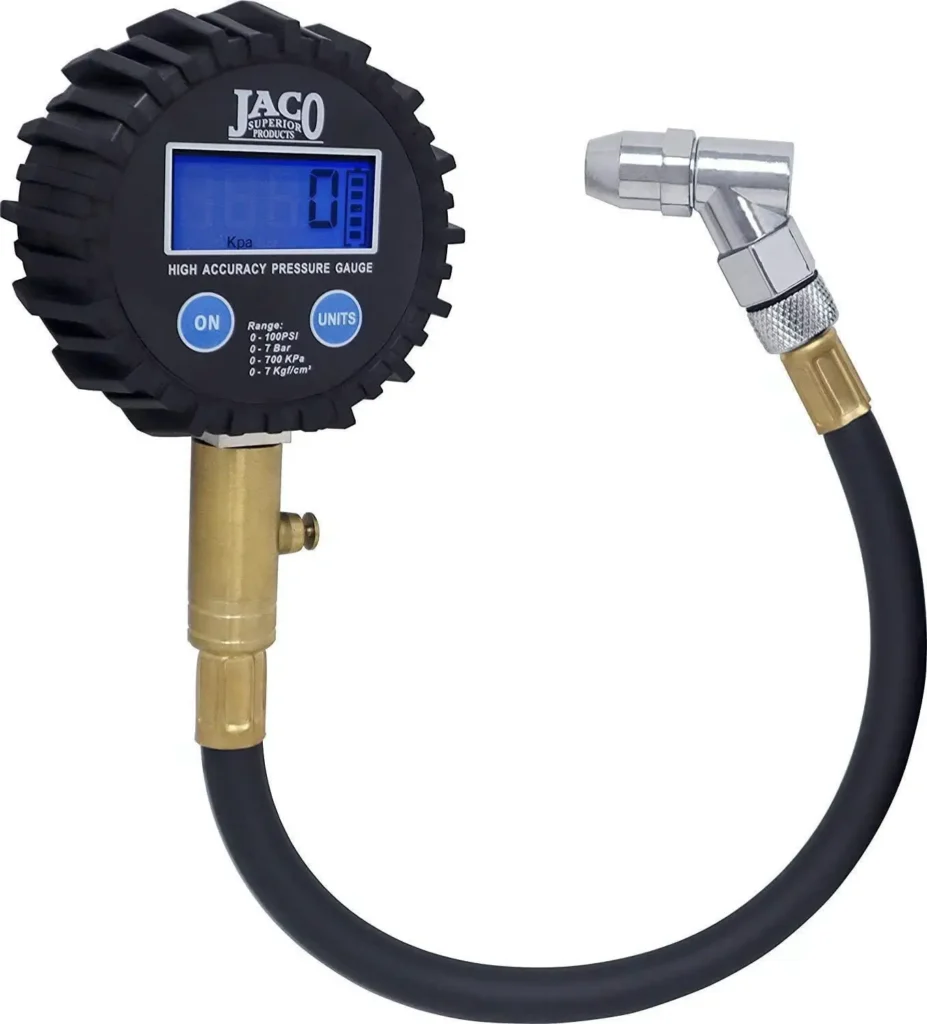
The JACO ElitePro Digital Tire Pressure Gauge takes a more professional approach to tire pressure measurement.
Rather than competing primarily on price or maximum pressure range, it focuses on construction, pressure accuracy, a substantial hose and chuck assembly, and features designed for repeated use.
It’s also backed by a lifetime warranty, giving it an advantage for buyers who would rather spend more on a gauge intended to remain in their toolkit for years.
Key Specifications
| Feature | JACO ElitePro Digital Tire Pressure Gauge |
|---|---|
| Type | Digital |
| Pressure range | Up to 100 PSI |
| Stated accuracy | ±0.50% full scale |
| Resolution | 0.10 PSI |
| Pressure sensors | Dual |
| Display | 2.5-inch LCD |
| Hose | 10-inch rotational leak-proof hose |
| Chuck | 360° swivel angled chuck |
| Construction | Solid brass and steel |
| Air bleeder | Built-in |
| Battery | 2 AAA |
| Auto shutoff | 150 seconds |
| Warranty | Lifetime |
Built for More Than Occasional Checks
The ElitePro is designed differently from lightweight pencil-style gauges.
Its brass and steel construction gives it a more substantial feel, while the shock-resistant protective guard is intended to help protect the tool during normal garage and vehicle use.
That makes it particularly appealing to buyers who expect to keep a pressure gauge in their workshop or vehicle rather than replacing an inexpensive gauge every few years.
Accuracy and 0.1 PSI Resolution
JACO states that the ElitePro uses dual pressure sensors and is accurate to ±0.50% of full scale, with readings displayed in 0.10 PSI increments.
The gauge can also lock the pressure reading on the display, which means you don’t necessarily have to keep staring at the valve while taking the measurement.
As with the accuracy specifications for the other products in this guide, these are manufacturer-stated specifications rather than independent measurements from our testing.
The important point is that JACO has built the product around precise digital pressure measurement rather than simply offering the lowest-cost way to check a tire.
2.5-Inch LCD Display
The ElitePro uses a relatively large 2.5-inch LCD screen.
That gives the pressure reading plenty of space and can make it easier to read while you’re working around the vehicle.
There’s also a battery indicator, while the built-in LED can help illuminate the valve area when you’re working in lower-light conditions.
10-Inch Hose and Swivel Chuck
One of the more useful physical features is the 10-inch rotational hose.
The hose gives you some separation between your hands and the tire valve, while the 360-degree swivel chuck allows you to position the connection more naturally.
JACO also includes a built-in air bleeder, allowing you to release excess pressure directly from the gauge.
That combination makes the ElitePro more than a simple read-only digital gauge.
Interchangeable Chuck
The chuck uses a 1/4-inch NPT connection and is designed to be interchangeable.
For users who spend a lot of time maintaining vehicles or working with compressed air equipment, that adds another layer of flexibility that isn’t generally found on inexpensive consumer gauges.
It’s less important for someone who only checks their car’s tires once a month, but potentially valuable for more frequent use.
What Customers Say
Customer feedback is particularly strong across the areas that matter most for a premium gauge.
Frequently reported strengths include:
- Accuracy: 790+ mentions
- Ease of use: 650+ mentions
- Readability: 370+ mentions
- Tire pressure: 340+ mentions
- Value: 300+ mentions
- Build quality: 225+ mentions
- Durability: 100+ mentions
- Display: 80+ mentions
Customers commonly praise the accuracy of the readings, the clear display, and the overall construction.
The feedback around build quality and durability is particularly relevant here because those are two of the reasons to consider paying more for the ElitePro in the first place.
Who Should Buy the JACO ElitePro?
The ElitePro makes the most sense if you want:
- A premium digital tire pressure gauge
- Fine 0.1 PSI resolution
- A substantial brass and steel construction
- A flexible hose and swivel chuck
- A built-in air bleeder
- A large LCD display
- A tool designed for repeated use
- A lifetime warranty
It’s probably unnecessary if you simply want the cheapest reliable gauge for checking your car’s tires occasionally.
Our Take
The JACO ElitePro isn’t trying to win the budget category.
Its appeal comes from the combination of construction, accuracy-focused specifications, useful physical controls, and long-term support.
The solid brass and steel construction, swivel chuck, 10-inch hose, air bleeder, pressure-locking display, and lifetime warranty make it feel much more like a workshop tool than a disposable accessory.
The 100 PSI maximum is also worth putting into perspective.
You don’t need an enormous pressure range for ordinary passenger vehicles, so JACO’s focus is clearly on the quality and usability of the gauge rather than chasing the highest number on the specification sheet.
For buyers who are willing to spend more for a pressure gauge they expect to keep and use regularly, the ElitePro is the strongest premium choice in this lineup.
→ Check the JACO ElitePro Digital Tire Pressure Gauge on Amazon (ad)
How to Choose the Best Tire Pressure Gauge
Choosing a tire pressure gauge doesn’t have to be complicated. The best option depends less on having the most features and more on how you plan to use it.
Before buying, focus on these key factors.
Choose Digital or Analog
Digital gauges display the pressure as a number, which can make readings quick and easy to interpret. They’re especially useful if you prefer precise numerical readings or regularly check your tires in different lighting conditions.
Analog gauges use a mechanical dial and don’t require batteries. They’re a good choice if you prefer a traditional design or want a tool that’s ready whenever you need it.
Neither type is automatically better. Choose the format you find easiest to use consistently.
Check the Pressure Range
Make sure the gauge covers the pressures you actually need.
For most passenger cars, you don’t need an extremely high maximum PSI rating. A gauge that reaches 150 or 200 PSI may sound more capable, but that extra range won’t necessarily make it better for everyday car maintenance.
If you also check trucks, RVs, bikes, or other equipment, a wider range may be more useful.
Look at Accuracy
Accuracy matters because the purpose of a pressure gauge is to tell you what’s actually happening inside the tire.
Look for a clearly stated accuracy specification and, where relevant, an established calibration standard. Keep in mind that manufacturer-stated accuracy isn’t the same as independent testing, so recurring customer feedback can provide useful additional context.
Consider Readability
A pressure reading isn’t useful if you struggle to see it.
Digital gauges with large or backlit displays can be convenient in low light, while analog gauges with large, clear dials can be equally practical.
Also consider the position of the display. You want to be able to read the pressure comfortably while the gauge is connected to the valve.
Think About the Valve Connection
The connection between the gauge and valve can have a surprisingly large effect on usability.
A secure chuck helps prevent air from escaping while you’re taking the reading. A swivel connection can also make it easier to reach awkwardly positioned valve stems.
If you’re buying a gauge with a hose, consider whether the hose gives you enough room to hold and read the tool comfortably.
Decide Whether You Need Extra Functions
Some gauges simply measure pressure. Others can also deflate tires, while inflator/gauge combinations can measure, add, and release air.
Extra functions can be useful, but they aren’t automatically worth paying for.
If you already own an air compressor, an inflator/gauge combination may be particularly useful. If you only need to check pressure periodically, a simple standalone gauge may be the better choice.
Consider Power and Construction
Digital gauges need batteries, so check what type they use and whether they’re easy to replace.
For construction, consider how the gauge will be stored and used. A lightweight pencil gauge can be convenient to keep in a glove box, while a heavier brass-and-steel model may make more sense as a workshop tool.
Match the Gauge to Your Routine
Ultimately, the best tire pressure gauge is the one you’ll actually use correctly and consistently.
For simple everyday checks, prioritize readability, ease of use, and appropriate pressure range. For more frequent maintenance, construction, connection quality, and additional functions become more important.
You don’t need the most expensive gauge or the longest list of specifications.
You need one that gives you a clear reading, connects securely, and fits the way you maintain your tires.
Digital vs. Analog Tire Pressure Gauges
The choice between a digital and analog tire pressure gauge mostly comes down to how you prefer to read and use the tool.
Both can be effective. The differences are mainly in display, power requirements, convenience, and design.
| Feature | Digital | Analog |
|---|---|---|
| Reading | Numerical display | Mechanical dial |
| Batteries | Usually required | Not required |
| Readability | Often very easy to read | Depends on dial size and lighting |
| Low-light use | Often better with backlighting | Glow or illuminated dials can help |
| Precision | Often displays fine increments | Depends on gauge design |
| Maintenance | Requires batteries | No battery maintenance |
| Typical design | Compact to multifunctional | Simple and mechanical |
Digital Tire Pressure Gauges
Digital gauges are a good choice if you want to see the pressure as a clear numerical reading.
There’s no needle to interpret, and many models include backlit displays or lights around the valve area. Some also provide additional functions such as pressure locking, automatic shutoff, or multiple measurement units.
The trade-off is that digital gauges require batteries, and electronic components can introduce another potential point of failure.
Analog Tire Pressure Gauges
Analog gauges use a mechanical dial and don’t require batteries.
Their simplicity can be appealing if you want a tool that can sit in your vehicle or garage and remain ready whenever you need it. A large, clearly marked dial can also be easy to read, particularly on models designed for automotive use.
The downside is that reading a needle requires slightly more interpretation than reading a digital number, and visibility depends more heavily on the dial design and lighting.
Which Should You Choose?
Choose digital if you prioritize:
- Easy-to-read numerical measurements
- Backlit displays
- Fine pressure increments
- Additional electronic features
- Convenience in different lighting conditions
Choose analog if you prioritize:
- No batteries
- Mechanical simplicity
- A traditional dial
- Straightforward long-term storage
- A more conventional workshop tool
Neither technology is inherently the better choice.
The best tire pressure gauge is the one that gives you a clear, dependable reading and is convenient enough that you’ll use it regularly.
What Matters Most: Accuracy, Range, Readability & Construction
After comparing these eight tire pressure gauges, a few differences matter considerably more than others.
The headline specifications can make products look very different, but the practical buying decision usually comes down to four things: accuracy, pressure range, readability, and construction.
Accuracy Comes First
A tire pressure gauge has one fundamental job: tell you the tire’s pressure.
That’s why accuracy should be near the top of your checklist.
Several gauges in this comparison provide specific manufacturer-stated accuracy figures or reference ANSI standards. Those specifications are useful when comparing products, but they shouldn’t be treated as independent proof of real-world accuracy.
Customer feedback can add another layer of context. Consistent reports of accurate readings are encouraging, while recurring reports of significant discrepancies deserve attention.
If you’re choosing between two otherwise similar gauges, accuracy is generally more important than extra features you may never use.
Range Should Match Your Tires
A higher maximum PSI isn’t automatically better.
The AstroAI inflator/gauge reaches 250 PSI, while the HYVOHEX and ETENWOLF T300 reach 200 PSI. That’s impressive on paper, but most passenger-car owners will never come close to those limits.
For everyday cars, a gauge covering the required operating pressure with some headroom is usually sufficient.
A wider range becomes more useful if you regularly work with trucks, RVs, bikes, or other equipment with different pressure requirements.
Think of range as a compatibility feature rather than a quality score.
Readability Makes Accuracy Useful
Even a highly accurate gauge isn’t particularly helpful if you can’t comfortably read the result.
Digital gauges generally make this straightforward by displaying a numerical value, while backlighting can be particularly useful in poor lighting.
Analog gauges can work just as well when they use a large, clearly marked dial. The ETENWOLF glow-dial model is a good example of how an analog gauge can address visibility without relying on an electronic display.
The important question is simple:
Can you see and interpret the pressure reading quickly while the gauge is connected to the tire?
Construction Matters More for Frequent Use
A gauge that lives in your glove box and gets used once a month has different requirements from one that stays in a workshop and gets used constantly.
Lightweight pencil gauges are convenient and easy to store. More substantial brass-and-steel designs can make more sense when durability and repeated use are priorities.
The JACO ElitePro, for example, takes a much more substantial approach to construction than the inexpensive pencil gauges in this comparison.
That doesn’t make the JACO automatically better for everyone. It means its design is better aligned with someone who values a more durable, workshop-oriented tool.
Connection Quality Is Easy to Overlook
There’s another practical factor that doesn’t always appear prominently in a product title: how well the gauge connects to the valve.
A secure connection makes getting a reading easier and helps minimize air loss while checking pressure.
Swivel chucks and flexible hoses can also make awkward valve positions easier to reach.
This is one area where customer feedback can be particularly useful because connection problems may not be obvious from a specification sheet.
Extra Features Come After the Basics
Backlights, LEDs, multiple pressure units, deflation valves, automatic shutoff, pressure-locking displays, and inflator functionality can all be useful.
But they shouldn’t distract from the fundamentals.
A gauge with fewer features but a clear reading and reliable connection can be more useful than a feature-packed model that’s awkward to operate.
Start with accuracy and usability. Then choose the features that genuinely fit your routine.
The Bottom Line
The eight gauges in this comparison take noticeably different approaches.
Some prioritize simplicity and portability, while others emphasize digital convenience, wide pressure ranges, or heavier-duty construction.
The best choice isn’t determined by a single specification.
It’s the combination of accurate readings, an appropriate pressure range, easy visibility, and construction that matches how often you’ll use the gauge.
Final Verdict
After comparing eight different tire pressure gauges, there’s no single model that’s perfect for every driver.
The right choice depends on whether you prioritize overall convenience, simplicity, budget, versatility, or premium construction.
Best Overall: AstroAI Digital Tire Pressure Gauge
For most drivers, the AstroAI Digital Tire Pressure Gauge is the easiest recommendation.
It combines a clear digital display, useful 0–150 PSI range, backlighting, a valve-area light, simple controls, and a compact design without moving into premium pricing.
Its customer feedback also shows strong recurring praise for accuracy, readability, and ease of use.
The main caveats are battery dependence and some mixed feedback around durability, but for ordinary vehicle owners who want a straightforward digital gauge, it offers a strong balance of features and practicality.
Best Pencil Gauge: ETENWOLF Pencil 2 Pack
If you prefer a simple, battery-free gauge, the ETENWOLF two-pack stands out.
You get two different pressure ranges, all-metal construction, deflation capability, and useful accessories. It’s particularly appealing for someone who values mechanical simplicity and wants a gauge that can sit in the vehicle without worrying about batteries.
Best Heavy-Duty Digital: ETENWOLF T300
The T300 is the better fit for drivers who want a wider pressure range and a more versatile digital gauge.
Its 3–200 PSI range makes it suitable for a broader range of vehicles and applications, while its digital display and replaceable AAA batteries add everyday convenience.
Best Analog: ETENWOLF Large Glow Dial
For a traditional mechanical gauge, the ETENWOLF glow-dial model is the standout.
Its large dial, glow display, 360-degree swivel chuck, and substantial construction make it a practical choice for anyone who would rather avoid batteries and electronic displays.
Best Budget Pencil Gauge: AstroAI Pencil 2 Pack
The AstroAI pencil two-pack is a straightforward low-cost option.
It’s compact, battery-free, stainless steel, and includes a deflation function. The main reason we’d place it below the ETENWOLF pencil gauge is the more mixed customer feedback around accuracy.
Best Budget Digital: HYVOHEX
The HYVOHEX is worth considering if low price and digital convenience are your priorities.
Its backlit display, 0–200 PSI range, replaceable AAA batteries, and rotating valve give it an appealing feature set for the money.
The main reservation is durability: customer feedback isn’t as consistent in this area as it is for some of the higher-rated options.
Best Inflator/Gauge Combo: AstroAI Digital with Inflator
If you already own an air compressor and want one tool for measuring, inflating, and deflating, this AstroAI is the obvious choice from the lineup.
Its 3–250 PSI range, digital display, flexible hose, swivel chuck, and multi-function design make it substantially more capable than a basic pressure gauge.
Best Premium Option: JACO ElitePro
The JACO ElitePro is the choice for buyers who are willing to spend more for premium construction and a more workshop-oriented design.
Its solid brass and steel construction, flexible hose, swivel chuck, air bleeder, large display, pressure-locking function, and lifetime warranty make it particularly attractive for frequent use.
So, Which One Should You Buy?
If you just want a reliable, easy-to-use gauge for your car, start with the AstroAI Digital Tire Pressure Gauge.
If you want something completely mechanical, choose the ETENWOLF Pencil 2 Pack or its large-dial analog alternative.
If you need broader vehicle compatibility, look at the ETENWOLF T300.
If you’re working with an air compressor, the AstroAI inflator/gauge combination makes more sense.
And if you’re building a serious workshop toolkit and don’t mind paying more, the JACO ElitePro is the premium choice.
There is no need to spend the most money to get a good tire pressure gauge.
Choose the model that fits your vehicle, your routine, and the way you prefer to work.
Tire Pressure Gauge FAQ
What is the best tire pressure gauge?
For most drivers, the AstroAI Digital Tire Pressure Gauge is our best overall choice.
It combines a clear digital display, useful pressure range, backlighting, compact size, and straightforward operation at a relatively accessible price.
If you prefer a battery-free design, the ETENWOLF Pencil 2 Pack is a strong alternative.
Are digital tire pressure gauges more accurate than analog?
Not necessarily.
A quality digital gauge can offer finer resolution and an easier-to-read numerical display, but accuracy depends on the specific gauge, its calibration, and its construction rather than the display type alone.
A good analog gauge can also provide dependable readings when properly maintained.
What PSI range should a tire pressure gauge have?
For a typical passenger vehicle, you generally don’t need an extremely high PSI range.
Choose a gauge that comfortably covers your vehicle’s recommended tire pressure with some additional range.
If you also check trucks, RVs, bikes, or other equipment, a wider-range gauge may be more useful.
How accurate should a tire pressure gauge be?
For normal passenger-car maintenance, a gauge with a clearly stated accuracy specification and appropriate pressure range is a sensible choice.
More precise gauges can be useful when pressure needs to be controlled more closely, but accuracy specifications should be considered alongside calibration, construction, and consistent customer feedback rather than treated as the only measure of quality.
Are cheap tire pressure gauges accurate?
Some inexpensive gauges can provide perfectly useful readings, but price alone doesn’t tell you how accurate a gauge will be.
Look for a stated accuracy specification, appropriate range, readable display or scale, and a secure valve connection.
Customer feedback can also help identify recurring accuracy or durability concerns.
How often should you check your tire pressure?
A common recommendation is to check tire pressure at least once a month and before longer trips.
Check when the tires are cold and use the vehicle manufacturer’s recommended pressure, usually found on the driver’s doorjamb placard or in the owner’s manual.
Ready to Choose Your Tire Pressure Gauge?
A good tire pressure gauge doesn’t need to be complicated.
For most drivers, the AstroAI Digital Tire Pressure Gauge offers the best balance of readability, convenience, useful range, and price.
If your priorities are different, the other options in this guide cover everything from simple battery-free pencil gauges to premium workshop tools and multifunction inflator/gauge combinations.
Choose the gauge that fits your vehicle and your routine, then make regular tire-pressure checks part of your normal maintenance.
→ Check the AstroAI Digital Tire Pressure Gauge on Amazon (ad)