
Introduction
A foot massager can sound like an easy purchase: sit down, put your feet in, turn it on and let the device do the work.
But once you start looking at the options, the question becomes more complicated.
There are shiatsu foot massagers, rolling models, vibration devices, compression systems and combination devices with heat, multiple intensity levels and a long list of additional settings. Prices can vary considerably, too.
So are foot massagers worth it?
The honest answer is: it depends on what you want from one, how often you expect to use it and whether the design matches your preferences.
A relatively inexpensive foot massager that you genuinely enjoy using several times a week may provide far more value than an expensive model that ends up sitting in a cupboard.
Likewise, paying more for additional features doesn’t automatically make a foot massager a better purchase.
Stronger massage, more settings, heat, compression and broader coverage can all sound appealing, but their value depends on whether they improve the experience you’re actually looking for.
That’s what this guide is designed to help you work out.
We’ll look at what people generally want from foot massagers, what can make one feel worthwhile, where the common tradeoffs appear, which features may justify spending more and when buying one may simply not make much sense.
We’ll also look at questions people commonly have when researching a purchase, including whether electric foot massagers are worth it, whether shiatsu models are worth considering, how often you’d realistically need to use one and what to think about if you’re specifically searching for a foot massager because of ongoing foot discomfort.
The goal isn’t to convince you that you need a foot massager.
It’s to help you decide whether one actually fits your routine, preferences and budget before you spend the money.
What Are You Actually Paying For When You Buy a Foot Massager?
When you look at a foot massager online, the price can seem to be tied to a long list of specifications.
One model might offer multiple massage modes, heat, rolling mechanisms, compression, adjustable intensity and a large enclosed design. Another might be much simpler, with basic vibration and a few controls.
It is tempting to assume that more features automatically mean more value.
But that isn’t really what you’re paying for.
When you buy a foot massager, you’re primarily paying for the experience the massager creates and how well that experience fits the way you want to use it.
That distinction matters because two products with very different specifications can both be worthwhile purchases for completely different people.
You’re Paying for the Massage Experience
The first thing you’re paying for is the actual sensation produced by the device.
Different mechanisms create very different experiences.
A shiatsu-style foot massager may use moving nodes or rollers to create a more pronounced kneading sensation. A vibration model may feel simpler and gentler. Compression systems use air pressure around parts of the foot, while combination devices may layer several sensations together.
None of these is automatically “better.”
The important question is whether the type of massage feels good and appropriate to you.
A foot massager with an impressive mechanism is not necessarily good value if you dislike the sensation. Conversely, a relatively simple model can be excellent value if you find it comfortable and actually enjoy using it.
This is one reason specifications should be treated as information rather than a final verdict.
You’re Paying for Coverage
You’re also paying for where the device actually interacts with your feet.
Some models concentrate primarily on the soles. Others include the heel and arch, while enclosed designs may surround much of the foot and sometimes extend toward the sides or ankles.
Coverage can make a noticeable difference to the overall experience.
For example, someone who mainly wants a sensation underneath the soles may have little reason to pay extra for a large device with extensive surrounding coverage.
Someone else may specifically prefer a design that surrounds more of the foot.
The key is matching the coverage to your priorities rather than assuming that maximum coverage is automatically better.
You’re Paying for Control
A foot massager can also become more valuable when it gives you useful control over the experience.
That might include:
- Different intensity levels
- Adjustable massage modes
- Independent heat controls
- Direction or speed adjustments
- Compression settings
- A timer or automatic shutoff
- The ability to use certain functions independently
But there is an important distinction between useful control and feature overload.
If you always use the same setting, having twelve different modes may not add much value.
On the other hand, if you share the foot massager with someone else, have changing preferences or like to adjust the intensity depending on the situation, additional control may be genuinely useful.
More settings are only worth paying for when they give you something you are likely to use.
You’re Paying for Fit and Comfort
This is an easy part of the buying decision to overlook.
A foot massager can have excellent specifications and still be a poor purchase if your feet don’t fit comfortably inside it.
Maximum foot size matters, but so does the shape of the opening, how enclosed the design feels and whether your feet sit naturally in the intended position.
Comfort also affects whether you’ll actually use the device.
If you have to constantly reposition your feet, struggle to get comfortable or dislike the pressure created by the design, the product may end up spending most of its life in storage.
That is why fit isn’t just a specification.
Fit affects value because it affects usage.
You’re Paying for Convenience
Another part of the price goes toward making the product easier to incorporate into everyday life.
Consider where you plan to use it.
If you want something beside the sofa that you can switch on while watching television, convenience may be more important than portability.
If you want to move it between rooms or store it after every use, weight and size become much more important.
Cord length, controls, setup time, storage requirements and cleaning can all influence whether the massager feels convenient or annoying after the novelty wears off.
A product that takes seconds to use and can be easily put away may provide more practical value than a technically more advanced device that is awkward to handle.
You’re Paying for Construction and Longevity
Price can also reflect the physical construction of the foot massager.
Materials, moving components, motors, electronics, padding, cables and overall construction can all affect what a product costs to manufacture.
But this is where buyers need to be careful.
A higher price does not automatically prove better durability.
Likewise, a low price does not automatically mean a product is poorly made.
If durability matters to you, look beyond the headline price and consider the available product information, warranty or replacement policy, construction details and patterns in customer feedback.
A foot massager that costs more but provides a better experience for several years may ultimately represent better value than a cheaper model that you stop using or need to replace quickly.
You’re Paying for Features You May or May Not Need
This is probably the most important point of all.
Foot massagers can become expensive surprisingly quickly once manufacturers start adding features.
Heat.
Compression.
Multiple massage modes.
Different intensity levels.
Remote controls.
Timers.
Adjustable settings.
Enclosed designs.
Rechargeable batteries.
Additional accessories.
None of these features is inherently bad.
The problem is paying for a feature simply because it sounds impressive.
Imagine two buyers.
The first wants a simple massager to use for fifteen minutes while relaxing in the evening. They don’t care about portability and rarely change settings.
The second wants to move the device around the house, share it with another person and adjust the experience depending on the situation.
The second buyer may genuinely benefit from additional controls and portability.
The first might not.
Value comes from useful features, not from the number of features.
The Real Question: Will You Use It?
This is where the entire value equation comes together.
A foot massager isn’t particularly good value if you buy it because it looks impressive, use it twice and then forget about it.
It can be a much better purchase if you use it regularly and enjoy the experience it provides.
That means the most useful way to think about price isn’t simply:
“How much does this cost?”
Instead, ask:
“What am I getting for that money, and how often am I realistically going to use it?”
A $100 massager used several times a week may provide more practical value to you than a $250 massager that offers more features but rarely gets switched on.
This is also why there isn’t a single price point at which a foot massager suddenly becomes “worth it.”
The right value depends on the experience, the design, the features you actually care about and your expected usage.
And once you look at the purchase that way, comparing foot massagers becomes much easier.
You’re no longer asking which device has the longest feature list.
You’re asking which device gives you the combination of experience, comfort, convenience and useful features that you are actually willing to pay for.
What Makes a Foot Massager Actually Worth It?
Once you’ve separated the price from the feature list, the next question is more useful:
What actually makes a foot massager worth buying?
There isn’t one feature that determines the answer.
A foot massager becomes worthwhile when the combination of its massage experience, comfort, controls, convenience and build quality matches what you genuinely want from it – at a price that makes sense for how often you’ll use it.
That means a more expensive device can be excellent value for one person and unnecessary for another.
It also means a simpler massager shouldn’t automatically be dismissed just because it has fewer features.
1. It Gives You the Experience You Actually Want
The starting point should always be the massage itself.
If you prefer a more pronounced kneading sensation, a shiatsu-style design may make more sense to you.
If you prefer something simpler, a vibration-based device may be enough.
If surrounding pressure is part of what you’re looking for, compression may be more appealing.
And if you want several sensations in one device, a combination model may justify the additional cost.
The important thing is that the mechanism matches your preference.
A long list of massage technologies doesn’t create value by itself.
The experience has to be one you actually enjoy.
2. It Covers the Areas You Care About
Coverage is another major part of value.
Some foot massagers focus primarily on the soles. Others are designed to work around the heel, arch, toes, sides or broader areas of the foot.
Before paying extra for a larger or more elaborate design, think about which areas matter to you.
If your priority is simply a comfortable sensation underneath your feet, extensive surrounding coverage may not be necessary.
If you prefer a more enclosed experience, broader coverage could be worth paying for.
There’s no universal winner here.
The better choice is the one that provides the coverage you actually want.
3. The Intensity Is Adjustable Enough for You
More powerful isn’t necessarily better.
A foot massager that feels comfortable at one setting might feel excessive at another. Being able to adjust intensity gives you more control over the experience and can make the device easier to use regularly.
This is particularly useful if the device will be shared between people with different preferences.
Even if you’re buying it for yourself, having a few sensible intensity options can be more valuable than simply having one extremely strong setting.
The goal isn’t maximum intensity.
The goal is useful control.
4. Heat Is Useful – If You Actually Want It
Heat can be an attractive feature because it adds another dimension to the experience.
But it’s worth separating useful heat from simply having the word “heated” in the product description.
Consider whether the temperature is adjustable, whether heat can be used independently and whether the warmth feels appropriate for the way you intend to use the device.
If you rarely want heat, paying substantially more for a premium heating system may not make much sense.
If warmth is an important part of your preferred experience, however, it can become a feature worth prioritizing.
As with the other features, the value comes from how you use it, not from the specification itself.
5. It Fits Your Feet Comfortably
A massager can have an impressive feature set and still be a bad purchase if it doesn’t fit properly.
Check the manufacturer’s stated foot-size range and consider the physical design of the foot chambers or openings.
But don’t stop at maximum foot size.
The shape of your feet, how enclosed the device feels and how comfortably your feet sit inside it can all affect the experience.
This matters because discomfort creates friction.
If using the device is awkward, you’re less likely to use it regularly.
And if you don’t use it, even a relatively inexpensive purchase can become poor value.
6. It’s Easy Enough to Use Regularly
Convenience is one of those features that doesn’t always appear prominently in a specification table, but it can have a major effect on value.
Think about the entire process.
Where will you keep the device?
Can you reach the controls easily?
Is it heavy or awkward to move?
Does it require much setup?
Is the cable long enough for where you want to use it?
Is cleaning straightforward?
Can you put it away without having to rearrange half the room?
These may sound like minor details.
But they’re exactly the sort of things that determine whether a product becomes part of your routine or ends up forgotten in storage.
7. It Doesn’t Make You Fight With It
A good everyday device should generally make the experience easier, not more complicated.
Controls should be understandable.
Settings should be reasonably easy to adjust.
Getting your feet into position shouldn’t feel like a chore.
Cleaning shouldn’t be unnecessarily difficult.
And when you’re finished, putting the device away shouldn’t become a project of its own.
This is particularly important with products designed for relaxation.
If the setup process is frustrating, some of the value disappears before the massage even begins.
8. The Construction Matches the Price
Build quality matters, but it should be considered alongside everything else.
You’re not necessarily looking for the most expensive construction available.
You’re looking for a device whose overall design and construction seem appropriate for the price you’re paying.
Useful things to consider include:
- Materials and finish
- Quality of controls
- Cables and connectors
- Moving components
- Padding and interior surfaces
- Ease of cleaning
- Warranty or replacement coverage
- Patterns in customer feedback about durability
Customer reviews can be particularly useful here because they may reveal issues that aren’t obvious from a specification sheet.
If multiple buyers independently mention similar problems with reliability or durability, that’s worth paying attention to.
Likewise, repeated comments about comfortable construction, straightforward controls or long-term usability can provide useful context.
9. You Have a Reason to Use It
This may sound obvious, but it’s one of the strongest predictors of whether a purchase will feel worthwhile.
Ask yourself when you expect to use the massager.
Perhaps you want something for your evening routine.
Perhaps you spend a lot of time standing and want a convenient comfort device when you get home.
Perhaps you enjoy using massage devices while watching television.
Perhaps you’re buying one for multiple people in the household.
Whatever the reason, having a realistic use case is more important than simply being attracted to the product.
A foot massager doesn’t need to be used every day to provide value.
But you should have a reasonably clear idea of why you’ll reach for it.
10. The Price Makes Sense for Your Expected Use
Finally, there is the question of price.
A useful way to think about this is value per use, rather than simply purchase price.
Imagine a $100 foot massager that you use three times a week for a year.
That’s more than 150 uses.
Now compare that with a $250 device that looks impressive but gets used only a handful of times.
The cheaper device could easily provide more practical value, even if it has fewer features.
Of course, this doesn’t mean everyone should buy the cheapest option.
A more expensive massager can absolutely be worth it when the additional cost buys something you genuinely value – better fit, better controls, a preferred massage mechanism, more useful coverage, easier everyday use or other features that you’ll actually use.
The key is being able to explain why you’re paying more.
The Bottom Line on Value
A foot massager doesn’t become worthwhile because it has the most settings, the strongest motor or the longest specification list.
It becomes worthwhile when its design solves the problem you actually have.
The best value is the combination of features you want, comfort you enjoy, convenience you will use and quality you are willing to pay for.
That’s why the right question isn’t:
“What’s the best foot massager?”
It’s:
“What’s the best foot massager for the way I actually plan to use it?”
Once you know that, comparing specific models becomes much more straightforward.
What Do People Actually Like About Foot Massagers?
A foot massager can look like a fairly simple purchase, but the reasons people choose one can be surprisingly different.
Some people want a relaxing addition to their evening routine. Others are attracted to the convenience of having a massage device at home rather than arranging or paying for something elsewhere. Some prefer the sensation of kneading or rolling, while others simply want warmth and a comfortable way to unwind.
Understanding these different motivations is useful because it helps separate genuine reasons to buy a foot massager from features that merely sound impressive on a product page.
Convenience Is One of the Biggest Advantages
Perhaps the most obvious appeal is having the experience available whenever you want it.
You don’t need to leave the house, arrange an appointment or plan your day around using it.
If the device lives somewhere convenient, you can sit down, put your feet in and use it as part of your normal routine.
That convenience can be particularly valuable for someone who enjoys massage regularly.
A product doesn’t necessarily need to deliver an extraordinary experience every time to be useful. Sometimes the biggest benefit is simply making something you enjoy easy to repeat.
Many People Like the Relaxation Aspect
Relaxation is another common reason people are interested in foot massagers.
A comfortable massage sensation can make sitting down at the end of the day feel more enjoyable, particularly when combined with other relaxing activities such as watching television, reading or simply taking some time away from a busy routine.
Different people will naturally prefer different sensations.
Some may enjoy deeper kneading.
Others may prefer gentler vibration.
Some may particularly like the combination of massage and warmth.
There is no single sensation that everyone will prefer, which is why trying to identify your own preferences is more useful than assuming one mechanism is universally superior.
Heat Can Add to the Experience
For people who enjoy warmth, a heated foot massager can provide another reason to use the device.
Heat is often included alongside massage rather than as a standalone feature, allowing the user to combine warmth with kneading, rolling, vibration or another mechanism.
But again, the value is subjective.
Some people may consider heat one of the most appealing features of the entire device.
Others may barely use it.
That makes adjustable or independently controlled heat particularly useful for buyers who know they want warmth without necessarily wanting it every time they use the massager.
The Variety of Settings Can Be Enjoyable
Another attraction is having some ability to change the experience.
Different modes, intensity levels, massage directions or compression settings can make a device feel more adaptable.
This can be useful if your preferences change depending on the situation.
You might want a gentler experience one evening and something more pronounced another time.
However, the important distinction is between variety that you’ll actually use and variety that simply increases the specification list.
Five useful settings can be more valuable than fifteen settings that you never touch.
It Can Become Part of a Routine
One of the strongest arguments for owning a foot massager is not necessarily what happens during one individual session.
It’s what happens when the device becomes part of your routine.
For example, someone might use a foot massager for a short period while watching television in the evening.
Someone else might use it after spending much of the day on their feet.
Another person might use it occasionally on weekends when they have more time to relax.
The exact routine doesn’t matter.
What matters is whether the device naturally fits into your life.
A product that is easy to access, comfortable to use and pleasant enough that you want to return to it has a much better chance of becoming worthwhile.
Some People Like Having More Control Than a Simple Massage Provides
A basic massage experience can be enough for some buyers.
Others appreciate being able to adjust the experience themselves.
This might mean changing intensity, selecting a different massage mode, controlling heat or choosing whether certain functions are active.
That control can be particularly useful when several people share the same device.
Instead of everyone having to accept the same fixed experience, different users can adjust the settings to suit themselves.
But once again, more control only creates value when it is usable control.
A complicated interface with dozens of poorly differentiated settings may not be an improvement over a handful of straightforward options.
Some Buyers Appreciate the Feeling of a More Enclosed Experience
Foot massagers vary considerably in how much of the foot they surround.
Open designs can feel less restrictive and may be easier to access.
Enclosed designs can create a more immersive experience by surrounding more of the foot.
Neither approach is automatically better.
Some people will enjoy the feeling of being surrounded by the device, while others may prefer a more open design.
This is another example of why product specifications need to be interpreted rather than simply counted.
More coverage can be valuable.
It can also be unnecessary.
The Biggest Benefit May Simply Be That You Enjoy Using It
This is easy to overlook when comparing products online.
A foot massager doesn’t need to justify itself through an enormous number of features.
If you find the sensation comfortable, enjoy using it and naturally reach for it when you want to relax, that can be enough to make the purchase worthwhile.
The practical value of a comfort product is closely tied to actual usage.
A device that becomes part of your routine can provide considerably more value than one that looks better on paper but rarely gets used.
That’s why customer feedback can be useful when researching foot massagers.
Repeated comments about comfort, massage quality, ease of use, heat, controls or overall enjoyment can help you understand how a product is experienced beyond its specification sheet.
At the same time, individual preferences vary considerably.
One person’s favorite feature may be another person’s least-used setting.
What People Like Isn’t Necessarily What Everyone Needs
This is the important takeaway.
The fact that buyers commonly praise a particular feature doesn’t mean you need that feature.
Heat may be highly appreciated by one group of users.
Another group may care much more about massage intensity.
Someone else may value portability or simple controls above everything else.
And some buyers may be perfectly happy with a basic device that does one thing well.
So when researching foot massagers, don’t just ask:
“What do people like about this product?”
Also ask:
“Would I personally care about those things?”
That second question is where product research becomes useful.
The goal isn’t to find the foot massager with the most universally praised features.
It’s to identify the combination of features and characteristics that make sense for your own routine, preferences and budget.
What Do People Dislike About Foot Massagers?
The appeal of a foot massager is easy to understand.
But the ownership experience isn’t always perfect.
The same features that make a device attractive can also create tradeoffs. Stronger massage can feel excessive. Enclosed designs can be harder to clean. More settings can make controls more complicated. A larger device may provide broader coverage while taking up considerably more space.
These aren’t necessarily reasons not to buy one.
They’re reasons to understand what you’re giving up in exchange for the features you want.
The Massage Can Feel Too Intense
One of the biggest potential drawbacks is that the massage sensation simply isn’t comfortable for everyone.
A shiatsu-style device with pronounced kneading or rolling can feel quite strong, particularly if you’re accustomed to gentler massage.
This is one reason adjustable intensity matters.
A product described as “powerful” might sound appealing during the buying process, but maximum intensity isn’t necessarily the experience you’ll want every time.
If you’re sensitive to pressure, being able to start at a lower setting and adjust gradually may be more useful than having an exceptionally strong massage mechanism.
Some Devices Can Be Noisy
Noise is another practical consideration that can be easy to overlook.
Motors, rollers, pumps and moving components can all produce sound during operation.
That may not matter much if you’re using the massager while watching television.
It can matter considerably more if you want to use it while reading, working, listening to something quietly or relaxing in an otherwise silent room.
Noise is therefore less about whether a device is objectively “too loud” and more about whether its operating sound fits your intended environment.
If quiet operation matters to you, look for customer feedback that specifically discusses noise rather than assuming that a premium-looking product will automatically be silent.
Larger Models Can Be Awkward to Store
More coverage often requires more physical space.
A full-size enclosed foot massager may provide a more comprehensive experience, but it can also be considerably less convenient to move or store than a compact design.
Before buying, think about where the device will actually live.
Will it remain beside your sofa?
Will you need to put it away after every use?
Do you have enough cupboard or floor space?
Will you realistically want to move it between rooms?
A product that fits comfortably into your home is generally easier to use regularly.
Cleaning Can Be More Complicated Than Expected
Foot contact also means cleaning deserves attention.
Enclosed foot chambers can be particularly important to consider because they may have more surfaces that come into contact with your feet.
Depending on the design, cleaning may involve wiping interior surfaces, removing washable liners or following specific care instructions from the manufacturer.
The exact maintenance requirements vary considerably between products.
That’s why it is worth checking the cleaning instructions before buying rather than assuming every foot massager can simply be wiped down.
A device that is easy to maintain may be more appealing for frequent use than one that requires considerably more effort.
More Features Can Mean More Complexity
Feature-rich devices can look impressive when you’re comparing them online.
But every additional setting can potentially make the controls more complicated.
You may encounter separate buttons for massage modes, intensity, heat, compression, direction and timing.
For some people, that’s useful flexibility.
For others, it creates unnecessary friction.
If you already know that you want a straightforward experience, a simpler foot massager may actually be the better choice.
The question isn’t how many controls a device has.
It’s whether the controls help you get the experience you want.
Fit Can Be a Dealbreaker
A foot massager isn’t useful if your feet don’t fit comfortably inside it.
This sounds obvious, but it is an easy detail to overlook when shopping online.
Manufacturers may provide a maximum foot size, but that number doesn’t necessarily tell you everything about how the device will feel.
The shape of the foot chamber, the amount of space around the toes, the position of the massage components and how tightly the device surrounds your feet can all influence comfort.
This is particularly important for enclosed designs.
If possible, look beyond the headline size specification and pay attention to customer feedback about fit and comfort.
Heat Isn’t Always a Positive
Heat sounds like an obvious upgrade.
For many people, it can be.
But not everyone wants warmth during every session.
Some buyers may find that the heat is weaker than expected, while others may prefer to use the massage without it.
This makes adjustable heat more useful than simply having a “heated” label.
It’s also worth remembering that advertised temperature figures don’t necessarily describe how warm the entire foot will feel in real-world use.
Design, contact, insulation and other factors can influence the experience.
If heat is important to you, treat it as a feature to investigate rather than a box to tick.
Corded Designs Limit Where You Can Use Them
Many electric foot massagers are designed to plug into a wall outlet.
That’s not inherently a problem.
In fact, corded designs can make sense for a device intended to stay in one location.
But the cable can become a limitation if you want to move the massager around your home.
Think about where you expect to use it and whether the cable length is practical for that location.
If portability matters, a rechargeable design may be more appealing – although battery-powered products introduce their own considerations, including charging time, battery life and additional weight.
Some People May Simply Stop Using Them
This is perhaps the biggest practical downside of any comfort product.
The initial purchase can be exciting.
You try the different modes, experiment with the settings and enjoy having something new.
Then the novelty wears off.
If the device is difficult to store, awkward to set up, uncomfortable to use or simply doesn’t fit naturally into your routine, you may use it less and less.
Eventually, it becomes something that sits in a cupboard.
That doesn’t necessarily mean the product itself is bad.
It may simply mean that the product didn’t fit the buyer’s lifestyle.
And that’s exactly why expected usage should be part of the buying decision.
A More Expensive Device Can Still Disappoint
Price is not a guarantee of satisfaction.
A premium foot massager may offer more sophisticated features, larger coverage or a more elaborate design.
But if you don’t like its massage sensation, it doesn’t fit comfortably or you rarely use the additional features, the extra money may not have improved your experience very much.
Likewise, a less expensive device can sometimes make more sense if it provides the specific features you care about without adding unnecessary complexity.
The goal isn’t to spend as little as possible.
It’s to avoid paying for things that don’t meaningfully improve the experience for you.
Customer Reviews Can Reveal the Tradeoffs
This is where reviews can become particularly useful.
Product descriptions are generally designed to explain what a device offers.
Customer feedback can provide additional context about what living with that device is actually like.
Look for recurring themes rather than isolated comments.
For example:
- Do buyers repeatedly mention uncomfortable pressure?
- Is the device commonly described as easy or difficult to clean?
- Do people comment on noise?
- Are there repeated complaints about fit?
- Do customers frequently mention heat performance?
- Do owners find the controls intuitive?
- Are durability concerns recurring?
- Do people say they actually use the device regularly?
No individual review should be treated as definitive.
People have different feet, different preferences and different expectations.
But recurring patterns can help you identify tradeoffs that aren’t obvious from a specification sheet.
The Important Question Isn’t “Are There Downsides?”
There will almost always be some.
The better question is:
“Are the downsides acceptable given what I’m getting in return?”
A larger foot massager may take up more space, but perhaps the broader coverage is exactly what you want.
A corded device may be less portable, but perhaps it will stay beside your sofa permanently.
A stronger shiatsu mechanism may feel intense, but perhaps that’s precisely the sensation you prefer.
A simpler model may have fewer settings, but perhaps that makes it easier to use.
This is why a good buying decision isn’t about finding a product with no disadvantages.
It’s about understanding the tradeoffs before you spend your money.
And once you know both what people tend to like and what can frustrate them, you’re in a much better position to answer the bigger question:
Is a foot massager actually worth it for you?
When Is a Foot Massager Actually Worth Buying?
By this point, the answer to “are foot massagers worth it?” should be becoming clearer.
There isn’t a universal yes or no.
A foot massager is more likely to be worthwhile when it fits naturally into your routine, provides a sensation you enjoy and offers features that solve a problem you actually have.
It may be less worthwhile when you’re buying primarily because the product looks impressive, you’re unlikely to use it regularly or the features don’t match your preferences.
Here are some of the situations where buying one can make the most sense.
A Foot Massager May Be Worth It If You Enjoy Regular Massage
If you already know that you enjoy foot massage, owning a device can make that experience considerably more convenient.
Instead of relying on someone else to provide the massage, you have a dedicated device available whenever you want to use it.
That doesn’t mean an electric foot massager will feel identical to hands-on massage.
It won’t.
But if you enjoy the particular sensation created by the device, the convenience of having it at home can be a significant part of its value.
In this situation, regular usage can make the purchase easier to justify.
It May Be Worth It If You Want a Relaxation Routine
Some buyers aren’t looking for anything particularly complicated.
They simply want something they can use while sitting down at the end of the day.
A foot massager can fit naturally into that kind of routine.
You might use it while watching a programme, reading, listening to music or simply taking some quiet time.
If that sounds like something you would genuinely enjoy doing several times a week, a foot massager may have more practical value for you than it would for someone who rarely sits still long enough to use one.
It May Make Sense If You Spend a Lot of Time on Your Feet
People who spend much of their day standing or walking may be particularly interested in foot massage as part of their personal comfort routine.
That could include people working in retail, hospitality, healthcare, trades or other jobs where being on your feet is simply part of the day.
But the important distinction is that a foot massager is a comfort device, not a substitute for professional evaluation when you have persistent, severe or unexplained foot problems.
If you’re considering one because of ongoing discomfort, the appropriate choice may depend on what’s causing that discomfort and whether massage or heat is suitable for you.
For ordinary relaxation and comfort, however, a foot massager may be an appealing addition to an evening routine.
If you spend much of your day standing or walking, you may also want to see our guide to Best Foot Massagers for People Who Stand All Day, which focuses on the features and tradeoffs that matter for this particular use case.
It May Be Worth It If You Want Something the Whole Household Can Use
A shared device can make the economics of a purchase look different.
If several people in your household enjoy foot massage, a single massager may provide value to multiple users.
In that situation, adjustable settings can become more important.
One person may prefer stronger pressure.
Another may prefer a gentler experience.
Someone may want heat while another person doesn’t.
A versatile device can therefore make more sense for a household than a highly specialised model designed around one particular preference.
It May Be Worth It If You Know Which Features Matter to You
Having a clear idea of what you want can prevent you from overspending.
For example, perhaps you specifically want:
- Shiatsu-style kneading
- Heat
- Adjustable intensity
- Compression
- Broad foot coverage
- A compact design
- Simple controls
- A rechargeable battery
- A device that can accommodate a particular foot size
Once you know your priorities, you can compare products based on those characteristics rather than getting distracted by every feature available.
This is one of the strongest arguments for doing your research before buying.
You don’t need every feature. You need the right features.
It May Be Worth It If You Have a Realistic Place to Use It
A surprisingly practical question is:
Where will you actually use the foot massager?
If you already have a comfortable chair near a power outlet and enough space for the device, using it may be effortless.
If you live in a smaller space and would need to unpack a large device, move furniture and find somewhere to store it every time, your actual usage may be much lower than you expect.
Think about the physical environment before buying.
The best foot massager for you isn’t necessarily the most capable one.
It may be the one you can conveniently leave nearby and use without thinking about it.
It May Be Worth It If You Can Afford the Purchase Comfortably
Even a genuinely useful product isn’t worth putting yourself under unnecessary financial pressure for.
Foot massagers are available across a broad range of prices, so there is usually no reason to assume you need the most expensive option.
Set a budget first.
Then identify the features that matter most within that budget.
This approach is generally more useful than starting with the most premium products and trying to justify their prices afterward.
A product can be worthwhile without being expensive.
And a product can be poor value despite having a premium price tag.
When a Foot Massager May Not Be Worth It
There are also situations where buying one probably doesn’t make much sense.
You may want to think twice if:
- You don’t particularly enjoy massage
- You rarely have time to use one
- You have very limited storage space
- You dislike enclosed foot designs
- You don’t want to deal with cleaning or maintenance
- You prefer hands-on massage
- You are primarily buying because of advertising or a long feature list
- You aren’t sure where or when you’d use it
- The price would put unnecessary pressure on your budget
None of these automatically means you shouldn’t buy one.
They’re simply reasons to pause and ask whether the product genuinely fits your life.
Be Careful If You’re Buying One Mainly Because of Foot Pain
This deserves a little extra attention.
Searching for a foot massager because your feet are uncomfortable is understandable, but it’s important not to assume that a massage device is automatically the appropriate answer.
Different causes of foot discomfort can require very different approaches.
A foot massager can be considered as a comfort product if massage or heat is appropriate for you, but it shouldn’t be treated as a diagnosis or a guaranteed solution.
If discomfort is persistent, severe, unexplained or concerning, professional advice is more appropriate than relying on a device to figure out what’s happening.
That distinction is especially important when shopping around terms such as “best foot massager for plantar fasciitis” or “foot massager for heel pain.”
Those searches can help you discover products, but the search term itself shouldn’t be interpreted as proof that a particular massager will treat the underlying condition.
The Frequency Question
One of the simplest ways to judge whether a foot massager is worth buying is to estimate how often you’ll realistically use it.
Don’t imagine your ideal routine.
Imagine your normal week.
Would you use it:
Every day?
Several times a week?
Once a week?
Only occasionally?
If you can picture yourself using it regularly, the purchase may make more sense.
If you struggle to imagine when you would actually turn it on, that’s useful information too.
The same device can be excellent value for one person and a wasted purchase for another simply because their usage is different.
A Simple Test Before You Buy
Try completing this sentence:
“I’ll use my foot massager when ______.”
If you immediately have a realistic answer – after work, while watching television, on weekend evenings, after a long day standing, or as part of another established routine – that’s a positive sign.
If the answer is something vague like “whenever I have time,” it may be worth thinking a little longer.
You don’t need to predict exactly how many sessions you’ll have over the next year.
You just want enough evidence from your own routine to believe the device will actually get used.
The Real Definition of “Worth It”
Ultimately, a foot massager is worth buying when three things line up:
You want the experience.
You will actually use the device.
The price makes sense for what you’re getting.
Everything else is secondary.
A premium model with every available feature isn’t automatically a better purchase.
A basic model isn’t automatically a worse one.
The right choice depends on what you value, how you plan to use it and which tradeoffs you’re comfortable making.
And that’s the key distinction between wanting a foot massager and buying a foot massager you’ll actually be glad you own.
Are More Expensive Foot Massagers Better?
It’s natural to assume that a more expensive foot massager should provide a better experience.
Sometimes it does.
But price alone doesn’t tell you whether a particular device is actually better for you.
Higher-priced models may offer more sophisticated massage mechanisms, broader coverage, additional controls, better materials or a more elaborate overall design. Those differences can be meaningful if they solve something you care about.
But if the extra features don’t improve your experience, paying more may simply mean spending more.
The goal is therefore not to find the most expensive foot massager you can afford.
It’s to understand what additional money is actually buying you.
What Can Drive the Price Up?
There are several reasons why one foot massager can cost considerably more than another.
A more expensive model may include:
- More massage mechanisms
- Larger or more comprehensive coverage
- More adjustable settings
- Heat with greater control
- Compression
- More sophisticated controls
- Different massage zones
- Higher-quality materials
- More substantial construction
- A larger enclosed design
- Additional accessories
- A more established warranty or support offering
None of these automatically makes the product better.
They simply explain some of the things you may be paying for.
The important question is whether those differences are meaningful to your intended use.
More Massage Functions Can Be Useful – But Only If You Want Them
Suppose one device offers basic vibration while another combines rolling, kneading and compression with several adjustable modes.
The second product may provide a much more varied experience.
But that doesn’t necessarily mean it’s the better purchase.
If you already know that you prefer a simple vibration experience, the additional mechanisms may have very little value to you.
On the other hand, if you enjoy experimenting with different sensations and want more control, those additional functions may justify spending more.
The value of an additional feature depends on whether it changes the experience in a way you actually appreciate.
Better Fit Can Be Worth Paying For
Fit is one area where spending more can potentially make a meaningful difference.
A more expensive device may offer a design that accommodates a wider range of foot sizes or provides a particular type of enclosure or positioning.
But don’t assume that expensive automatically means better fitting.
Check the actual dimensions and manufacturer’s stated size range.
A premium device that doesn’t fit your feet comfortably is still a poor purchase.
Conversely, a reasonably priced model that fits well may be a much better choice.
More Control Can Have Real Value
Additional controls can be worthwhile when they solve a genuine problem.
For example, adjustable intensity can make a device easier to share between people with different preferences.
Independent heat control can be useful if you want warmth sometimes but not every time.
Different massage modes can make sense if you genuinely enjoy changing the experience.
But there is a point where additional controls become diminishing returns.
Going from one intensity level to three can be a meaningful improvement.
Going from several useful settings to an enormous number of barely distinguishable modes may not add nearly as much value.
More control isn’t automatically more useful control.
Build Quality Is Harder to Judge From Price Alone
This is one area where buyers should be particularly cautious.
A higher price can reflect better construction, but it doesn’t prove it.
When assessing whether a premium foot massager is worth the additional cost, look for evidence rather than relying on the price tag.
Consider the materials, construction, warranty, manufacturer information and recurring customer feedback.
Pay particular attention to repeated comments about durability and reliability.
A single complaint doesn’t tell you much.
A consistent pattern across many buyers is more useful.
The same principle applies to positive feedback.
Repeated comments about comfortable construction, easy controls or continued use over time can provide useful context.
Bigger Doesn’t Necessarily Mean Better
Larger foot massagers can offer broader coverage and a more enclosed experience.
But larger also means:
- More storage space
- More weight
- Potentially less portability
- More physical presence in your room
- Possibly more cleaning surface
If you have plenty of space and specifically want extensive coverage, those tradeoffs may be completely acceptable.
If you live in a smaller space and need to put the device away after every use, a compact design could actually be more valuable.
Again, “better” depends on the buyer.
Premium Features Can Have Diminishing Returns
This is where the idea of diminishing returns becomes important.
Imagine a basic foot massager that gives you the massage experience you want.
Moving up to a somewhat more capable model might add useful improvements:
- Better intensity control
- Better fit
- Heat
- Improved coverage
- More convenient controls
Those improvements may be noticeable.
But moving from that already-capable model to an extremely expensive premium device may add features that are much less important to you.
You could spend considerably more money for relatively small improvements in your personal experience.
That doesn’t make premium products bad.
It simply means the relationship between price and value isn’t linear.
Ask What the Extra Money Buys
A useful question when comparing two foot massagers is:
“What specifically do I get for paying more?”
Don’t accept “more premium” as the answer.
Identify the actual difference.
Maybe the more expensive model has better coverage.
Maybe it has a massage mechanism you strongly prefer.
Maybe the fit is better for your foot size.
Maybe the controls are considerably easier to use.
Maybe the additional cost buys better construction or a stronger warranty.
Those are things you can evaluate.
But if the answer is essentially:
“It has more settings.”
Ask yourself whether you’ll actually use them.
When Spending More Can Make Sense
Paying more can be reasonable when the additional cost provides something you genuinely value.
For example, you might reasonably spend more if:
- The cheaper model doesn’t fit comfortably
- You strongly prefer the premium model’s massage mechanism
- You want broader coverage
- You specifically want compression
- You want better control over heat or intensity
- You need a particular size or design
- You expect multiple people to use the device
- Construction and warranty are important priorities
- You’ll use the massager frequently enough to benefit from those improvements
In those situations, the additional cost has a clear purpose.
When Spending More Probably Doesn’t Make Sense
The opposite is also true.
Paying more may not be worthwhile if:
- You only want a basic massage experience
- You don’t care about additional modes
- You rarely use heat
- You don’t need broad coverage
- You have limited storage space
- You won’t use advanced controls
- A cheaper model already fits comfortably
- You’re mainly attracted to the premium appearance
- The additional features don’t solve any problem for you
In these cases, a simpler foot massager may deliver most of what you’re looking for without the additional expense.
Don’t Confuse “More Expensive” With “Higher Quality”
This distinction is worth remembering.
Price is an input. Quality is an outcome.
A high price may reflect additional features, larger construction, brand positioning or other factors.
It doesn’t guarantee that you’ll prefer the experience.
Similarly, a lower-priced device isn’t automatically poor quality.
That’s why a good comparison should look beyond price and ask how the product performs against the characteristics that actually matter to the buyer.
The Best Price Is the One That Matches Your Priorities
There is no magic price at which a foot massager becomes “good.”
Instead, think in terms of tiers of value.
A basic model may be enough if you want simplicity.
A mid-range model may make sense if you want a broader combination of comfort and useful controls.
A premium model may be justified if you specifically value its additional coverage, mechanisms, construction or flexibility.
The important thing is that each step upward should have a reason.
If you can’t explain what you’re gaining by spending another $50, $100 or more, that’s a signal to pause.
A Simple Comparison Test
When you’re deciding between two models, try writing down the differences.
Then divide them into three categories:
I want this.
Features that genuinely improve the experience you are looking for.
I might use this.
Features that sound useful but aren’t particularly important to you.
I don’t need this.
Features that add cost or complexity without solving anything for your situation.
This simple exercise can make the decision much clearer.
It shifts the question from:
“Which foot massager is better?”
to:
“Which differences are actually worth paying for?”
And that’s ultimately the more useful question.
A more expensive foot massager can absolutely be worth it.
But the best purchase isn’t necessarily the one at the top of the price range.
It’s the one where the additional cost buys something you’ll actually appreciate and use.
What Foot Massager Features Are Actually Worth Paying For?
Foot massagers can come with an impressive number of features.
Heat. Compression. Multiple massage modes. Adjustable intensity. Rolling mechanisms. Different massage directions. Timers. Remote controls. Rechargeable batteries. Enclosed chambers. Open designs.
The difficult part isn’t finding features.
It’s deciding which ones are actually worth paying for.
A useful approach is to start with the experience you want and then work backwards.
Instead of asking, “Which foot massager has the most features?” ask:
“Which features would genuinely make this device better for the way I plan to use it?”
Massage Type: Usually Worth Prioritizing
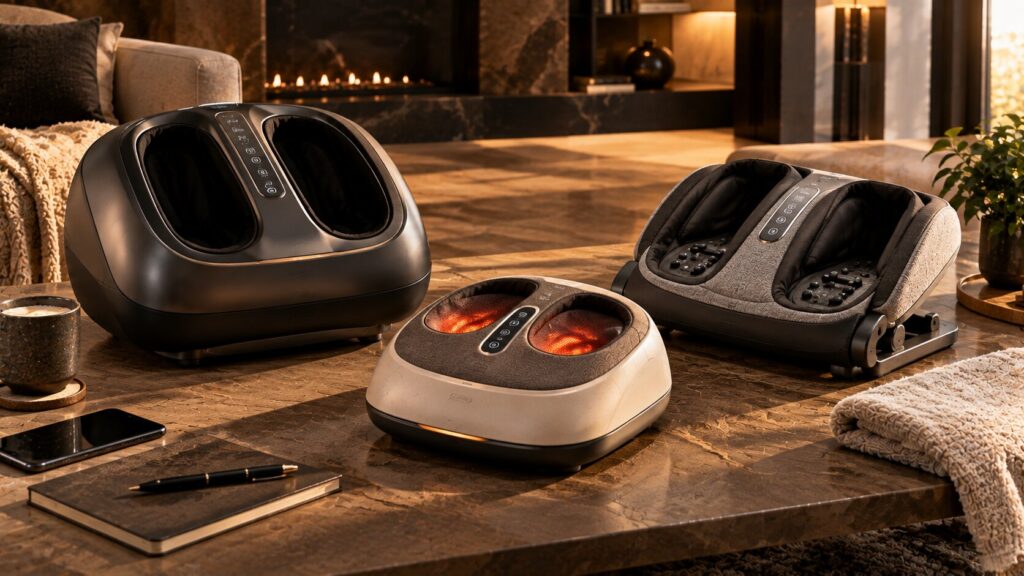
The underlying massage mechanism is one of the most important things to consider because it directly affects the sensation you’ll experience.
Common approaches include:
- Shiatsu-style kneading
- Rolling
- Vibration
- Compression
- Combination systems
If you already know that you prefer one particular sensation, this can be more important than many secondary features.
A beautifully designed foot massager with extensive controls isn’t necessarily a good choice if you dislike the way its primary massage mechanism feels.
For that reason, massage type is usually one of the first specifications worth investigating.
Coverage: Worth Paying For If You Want It
Coverage can also justify a higher price when it meaningfully changes the experience.
A basic device may concentrate on the soles.
A more comprehensive design might include the heel, arch, toes, sides of the feet or areas around the ankles.
If broader coverage is important to you, paying more for it can make sense.
But don’t assume you need maximum coverage simply because a product offers it.
If your priority is straightforward sole massage, paying substantially more for extensive enclosure may not provide much additional value.
Adjustable Intensity: A Very Practical Feature
Adjustable intensity is one of those features that can be useful without being particularly glamorous.
It gives you the ability to change the experience rather than being locked into one fixed level.
That’s valuable because preferences aren’t always consistent.
You may want a gentler session one evening and a more pronounced sensation another time.
It can also be useful when a device is shared between people.
For most buyers, a few meaningful intensity levels are likely to be more useful than an enormous number of settings that feel almost identical.
Heat: Worth Considering If Warmth Matters to You
Heat can be a worthwhile addition if you specifically enjoy warmth alongside massage.
The important thing is to look at how the heat works, not just whether the product description says “heated.”
Useful things to investigate include:
- Whether heat can be switched on or off independently
- Whether the temperature can be adjusted
- How the manufacturer describes the heating system
- What customers say about the warmth in actual use
- Whether the heat function can be used without unwanted massage settings
If you rarely want heat, however, there may be little reason to pay substantially more for a premium heating system.
Compression: Potentially Valuable for the Right Buyer
Compression can provide a very different sensation from kneading, rolling or vibration.
For buyers who specifically enjoy that feeling, it can be an important feature.
But it shouldn’t automatically be treated as an upgrade that everyone needs.
If you don’t particularly care for compression, paying extra to get it may not improve your experience.
This is another example of why feature lists should be interpreted rather than counted.
Fit and Foot Size: Absolutely Worth Prioritising
This is one feature category where you shouldn’t compromise simply to get a longer list of specifications.
If the device doesn’t fit your feet comfortably, many of its other features become irrelevant.
Check the manufacturer’s stated foot-size range and look carefully at the physical design.
Consider:
- Maximum supported foot size
- Foot chamber dimensions
- Toe space
- Overall enclosure
- Foot positioning
- Whether the design feels restrictive
If you’re near the upper end of the stated size range, customer feedback can be especially useful.
A few extra massage modes aren’t much consolation if the basic fit isn’t comfortable.
Independent Controls: Often Worth More Than Extra Modes
A feature can become considerably more useful when you can control it independently.
For example, being able to use heat without changing the massage setting gives you more flexibility.
Likewise, being able to adjust intensity separately from another function can make the device easier to customise.
This is why it’s useful to look at the control system, not simply the number of advertised features.
A device with six well-designed controls may be more practical than one with fifteen features that are difficult to manage.
Timer and Automatic Shutoff: Small Feature, Useful Convenience
Timers aren’t necessarily exciting, but they can be useful.
An automatic shutoff can make the device easier to incorporate into a routine and can prevent it from simply continuing to operate after you’ve stopped paying attention to it.
Many foot massagers include some form of timed session or automatic shutoff, but the exact implementation varies.
It’s worth checking the manufacturer’s instructions rather than assuming all models work the same way.
This is a good example of a feature that doesn’t necessarily justify a large price premium by itself, but can contribute to the overall convenience of a product.
Ease of Cleaning: An Underrated Feature
Cleaning isn’t usually what gets highlighted in advertisements.
It should still be part of your buying decision.
Foot massagers can have different materials, interior surfaces and maintenance requirements.
Look for designs that make routine cleaning reasonably straightforward.
Depending on the product, that could mean removable liners, washable components or surfaces that can be wiped according to the manufacturer’s care instructions.
If you’re expecting to use the device frequently, easy maintenance can be much more valuable than another decorative feature or extra mode.
Noise: Worth Considering Based on Your Routine
Noise matters most when you plan to use the massager in quiet environments.
If you intend to use it while watching television, a moderate operating sound may not bother you.
If you want to read, work or relax in a quiet room, it could matter considerably more.
Rather than assuming that a higher price means quieter operation, look for actual product information and recurring customer feedback about noise.
Portability: Worth Paying For If You’ll Move It
Portability is another highly personal feature.
If the device will stay beside your sofa, portability may barely matter.
If you expect to move it between rooms or store it after every session, weight and size become much more important.
Cordless operation can also be useful in some situations, but remember that rechargeable designs introduce another thing to manage: charging.
A feature is valuable when it removes a real inconvenience from your routine.
A Rechargeable Battery: Convenient, But Not Automatically Better
Cordless operation can sound like an obvious upgrade.
For some buyers, it is.
For others, a corded device that stays in one location may actually be simpler.
Consider where you’ll use the massager and whether access to a power outlet is a genuine problem.
If you want to use the device in different locations without worrying about a cable, rechargeable operation may justify the additional cost.
If you will always use it in the same place, the benefit may be much smaller.
Remote Controls and Extra Accessories: Nice to Have, Not Essential
Remote controls, carrying bags and other accessories can make a product feel more premium.
They can also be genuinely useful in the right situation.
But they shouldn’t carry too much weight in your decision unless you know you’ll use them.
A carrying case matters more if you’re actually going to transport the device.
A remote matters more if the built-in controls are difficult to reach once your feet are positioned.
Accessories should therefore be treated as convenience features, rather than evidence that a product is inherently better.
More Modes: Useful Until They Aren’t
One of the easiest traps in this category is getting distracted by the number of modes.
A product with three useful modes can be excellent.
A product with twelve modes isn’t automatically four times better.
What matters is whether the modes create meaningfully different experiences and whether you’ll actually use them.
When comparing products, try to identify the functions that matter most to you rather than counting every mode listed on the product page.
A Better Way to Compare Features
One of the simplest ways to evaluate features is to divide them into three groups.
Worth prioritizing
Features that directly affect the experience you want.
Examples might include massage type, coverage, fit and adjustable intensity.
Worth considering
Features that could improve convenience or flexibility depending on your routine.
These might include heat, compression, portability, independent controls and cleaning design.
Mostly optional
Features that may be nice to have but shouldn’t determine the purchase by themselves.
These could include extra accessories, decorative controls or a large number of barely differentiated modes.
This approach helps prevent the specification sheet from making the buying decision for you.
The Features Worth Paying For Are the Ones You’ll Use
Ultimately, there is no universal list of features that every buyer should pay extra for.
Someone who wants a powerful shiatsu experience may prioritise massage mechanism and intensity.
Someone who wants gentle evening relaxation may care more about comfort, heat and simple controls.
Someone with limited storage may prioritise a compact design.
Someone buying for several people may value adjustability and versatility.
And someone who simply wants basic foot massage may have no reason to pay for an elaborate device at all.
The best feature isn’t the one that sounds most impressive.
It’s the one that improves the experience enough that you’re glad you paid for it.
That is the standard worth using when comparing foot massagers.
If you’ve decided that a foot massager may be worthwhile but aren’t sure which characteristics to prioritize, our guide on How to Choose a Foot Massager walks through massage type, coverage, intensity, heat, fit, cleaning and other factors in more detail.
Shiatsu vs. Vibration vs. Rolling vs. Compression: Which Type Is Better?
One of the first things you’ll notice when comparing foot massagers is how different the underlying massage mechanisms can be.
Some use shiatsu-style kneading.
Others rely primarily on vibration.
Some use moving rollers.
Others use air compression.
Combination devices may use several of these approaches together.
So which type is better?
The honest answer is that there isn’t one mechanism that is universally best.
Each creates a different experience, and your preference matters more than the label on the product page.
Shiatsu Foot Massagers
Shiatsu-style foot massagers are designed to create a more pronounced kneading or pressing sensation.
Depending on the design, moving nodes or rollers may work against different areas of the foot while you sit with your feet positioned inside the device.
This can create a more substantial massage experience than simple vibration.
Shiatsu-style models may appeal to people who specifically enjoy a stronger, more noticeable kneading sensation.
However, stronger doesn’t automatically mean better.
Some people may find an aggressive massage uncomfortable, particularly if they’re expecting something gentler.
That’s why adjustable intensity and the ability to control the experience can be important.
Best suited to: people who enjoy a pronounced kneading or rolling sensation and want a more substantial massage experience.
Vibration Foot Massagers
Vibration-based devices use rapid movement to create a vibrating sensation rather than the more pronounced kneading associated with shiatsu mechanisms.
The experience can feel simpler and, depending on the design, potentially gentler.
This may appeal to someone who doesn’t want an intense kneading sensation or who prefers a straightforward device with fewer moving components.
The exact experience varies considerably between products, however.
“Vibration” is a broad category, and different devices can produce noticeably different sensations.
If you’re considering one, customer feedback can be useful for understanding whether buyers describe the experience as gentle, strong, relaxing or something else.
Best suited to: people who prefer a simpler vibrating sensation or don’t particularly want pronounced kneading.
Rolling Foot Massagers
Rolling mechanisms use moving rollers to create a sensation that travels across parts of the foot.
Some devices combine rolling with other mechanisms, while others make it a more central part of the experience.
The appeal is largely about the sensation.
If you enjoy the feeling of a moving massage across the soles or arches, a rolling mechanism may be attractive.
But again, the design matters.
The position, movement and intensity of the rollers can vary significantly between products.
Two foot massagers described as using “rolling” may therefore feel quite different in actual use.
Best suited to: people who like a moving, rolling sensation across the feet and want something different from basic vibration.
Compression Foot Massagers
Compression systems work differently from mechanical kneading or vibration.
Rather than relying primarily on moving nodes or rollers, they use air pressure to create a squeezing sensation around parts of the foot.
This can provide a very different experience from shiatsu.
Some buyers may particularly enjoy the feeling of gentle pressure surrounding the foot, while others may prefer the more active sensation of kneading or rolling.
Compression can therefore be an important feature for the right buyer, but it isn’t something everyone needs.
Best suited to: people who specifically enjoy a surrounding, squeezing sensation and want something different from mechanical massage.
Combination Foot Massagers
Some of the more feature-rich devices combine several mechanisms.
You might find a product that offers shiatsu-style kneading alongside heat and compression, for example.
This can provide greater flexibility and allow users to customise the experience.
But combination designs also tend to introduce more complexity.
They can be larger, more expensive and more complicated to operate.
If you know that you enjoy several different sensations, that flexibility may be worth paying for.
If you only want one particular type of massage, however, you may be better served by a simpler design.
Is Shiatsu Better Than Vibration?
Not necessarily.
This is one of those comparisons where the answer depends heavily on personal preference.
If you enjoy pronounced kneading, shiatsu may feel more satisfying.
If you prefer a simpler or gentler sensation, vibration may be more appealing.
Neither description tells you which experience you’ll personally prefer.
The same principle applies to rolling and compression.
The mechanism is a starting point for comparison, not a guarantee of satisfaction.
Does Stronger Mean Better?
This is another assumption worth challenging.
A more powerful massage mechanism can sound attractive in a product description.
But intensity is subjective.
A sensation that feels pleasantly substantial to one person may feel excessive to another.
That’s why adjustable intensity can be more useful than simply looking for the strongest device available.
If you have never used a particular type of foot massager before, it can also be difficult to predict exactly how the sensation will feel from specifications alone.
Customer feedback, demonstrations and clear product descriptions can help, but your personal preference ultimately matters most.
Think About the Sensation You Want
Instead of starting with a product name, start with the experience.
Ask yourself:
Do I want kneading?
A shiatsu-style device may be worth investigating.
Do I want a simpler vibrating sensation?
A vibration-based model may be a better fit.
Do I like the feeling of rollers moving across the foot?
Look more closely at rolling designs.
Do I want surrounding pressure?
Compression may be worth considering.
Do I want several sensations in one device?
A combination model could make sense.
This approach makes the comparison much easier because you’re choosing based on the experience rather than the marketing label.
Coverage Still Matters
The massage mechanism isn’t the only thing that determines how a foot massager feels.
Coverage can make a major difference too.
A shiatsu device focused primarily on the soles will create a different overall experience from a shiatsu device that surrounds the sides of the feet and incorporates additional areas.
Likewise, compression can cover different parts of the foot depending on the design.
So don’t evaluate mechanism and coverage separately.
Consider them together.
What does the device do, and where does it do it?
That’s often more informative than the mechanism name alone.
The Same Type Can Feel Different From One Model to Another
This is particularly important when shopping online.
Two products may both be described as shiatsu foot massagers, yet one could feel considerably more intense than the other.
Differences in node placement, movement, coverage, foot positioning, intensity controls and overall design can change the experience.
The same applies to vibration, rolling and compression.
So category labels should help you narrow your options, not make the final decision for you.
Which Type Is Best for You?
There’s no universal winner.
Instead, think of the mechanisms as different tools for different preferences.
| Massage type | Typical experience | May suit people who want |
|---|---|---|
| Shiatsu | Kneading, pressing, rolling-style sensation | A more pronounced massage |
| Vibration | Rapid vibrating sensation | A simpler or potentially gentler experience |
| Rolling | Moving pressure across areas of the foot | A traveling massage sensation |
| Compression | Surrounding squeezing pressure | A different, enclosed pressure sensation |
| Combination | Multiple sensations | Greater variety and customization |
These descriptions are intentionally broad.
Actual experiences vary between products, so the best way to use this table is as a starting point for further comparison.
The Best Mechanism Is the One You Actually Prefer
Ultimately, the question isn’t whether shiatsu, vibration, rolling or compression is objectively superior.
It’s:
Which sensation do you actually want to experience?
Once you answer that, the rest of the buying process becomes easier.
You can then compare coverage, intensity, fit, heat, controls, cleaning, noise, portability and price within the category that already makes sense for you.
That’s a much more useful approach than assuming the most powerful or most expensive mechanism must be the best one.
Choose the experience first. Then choose the features around it.
How Often Would You Actually Use a Foot Massager?
One of the simplest ways to decide whether a foot massager is worth buying is to ask a question that has nothing to do with specifications:
How often will you actually use it?
It’s easy to imagine an ideal routine when you’re shopping.
You might picture yourself using the massager every evening, trying different settings and making it part of your daily wind-down.
But the reality may be different once the novelty wears off.
That’s why expected usage deserves just as much attention as massage type, heat or intensity.
Daily Use Isn’t Necessary
A foot massager doesn’t need to be used every day to provide value.
If you genuinely enjoy using it several times a week, that may already be enough to make the purchase worthwhile.
For example, someone who uses a $100 device three times a week could accumulate more than 150 sessions over a year.
Someone else might use a $200 device only a few times each month.
The cheaper device could provide considerably more practical value despite having a lower price and fewer features.
This is why purchase price alone doesn’t tell you much about value.
Usage changes the equation.
Think About Your Normal Week
Instead of imagining your perfect routine, think about your actual one.
When would you realistically use the massager?
Maybe you have a regular period in the evening when you sit down and watch television.
Maybe you spend long periods on your feet and naturally want some downtime when you get home.
Maybe weekends are when you have enough uninterrupted time to use one.
Maybe several people in your household would use it.
The specific answer doesn’t matter.
What matters is that you can identify a realistic opportunity for the device to become part of your existing routine.
The Easier It Is to Reach, the More Likely You’ll Use It
Convenience can have a surprisingly large effect on usage.
Imagine two foot massagers.
The first stays beside your favorite chair. You can switch it on immediately, use it for a short session and put your feet back up.
The second is large and heavy, stored at the back of a cupboard. Every time you want to use it, you have to take it out, find somewhere to put it and move it again afterward.
Even if the second device provides a better massage on paper, you may naturally use the first one more often.
This is why storage and accessibility belong in a value calculation.
Friction reduces usage.
And lower usage can reduce the value you get from the purchase.
A Short Session Can Still Be Useful
You don’t necessarily need a long session to justify owning a foot massager.
Some people may prefer shorter periods as part of a regular routine.
The appropriate session length depends on the specific product and its instructions, so follow the manufacturer’s guidance rather than assuming that longer use is automatically better.
The larger point is simply that a device doesn’t need to become a major time commitment.
If you can comfortably incorporate it into something you already do, regular use may happen naturally.
Don’t Buy Based on Your “Best Self”
This is one of the easiest mistakes to make with almost any lifestyle product.
You aren’t buying for the person you imagine you’ll become.
You’re buying for the way you actually live.
If you’re someone who loves routines and regularly spends time relaxing at home, a foot massager may fit naturally.
If you’re constantly moving, rarely sit down and dislike having extra devices around the house, it may be much harder to use one consistently.
Neither lifestyle is better.
They’re simply different.
The right question is:
Does this product fit the life I already have?
What About Occasional Use?
Occasional use doesn’t automatically mean a foot massager is a bad purchase.
You may only want one for weekends, particularly long days or certain periods when you want some extra comfort.
If the price is reasonable and you enjoy having the option available, that can still be perfectly valid.
The important thing is to recognise that occasional use should influence how much you’re willing to spend.
If you’re expecting to use the device once every few weeks, it may be difficult to justify paying a substantial premium for features you rarely experience.
A simpler model may make more sense.
Cost Per Use Can Be a Useful Thought Experiment
You don’t need to calculate an exact financial return to understand this concept.
But cost per use can help put the purchase into perspective.
Suppose you spend $120 on a foot massager.
If you use it 150 times, the initial purchase works out to less than $1 per session before considering electricity, maintenance or any other costs.
If you use it only ten times, the effective cost per session is much higher.
This doesn’t mean a product needs to reach a particular number of uses to be worthwhile.
It simply demonstrates why frequency matters so much when evaluating value.
A product you enjoy repeatedly can justify a higher upfront cost than something you barely use.
Shared Use Changes the Equation
If multiple people in your household would use the same foot massager, your expected usage can increase considerably.
That can make versatility more valuable.
Adjustable intensity, different massage modes, suitable fit and easy controls may become more important when different people have different preferences.
In this situation, a slightly more flexible device may make more sense than one designed around a single very specific experience.
What If You Stop Using It?
This is the possibility worth considering before buying.
Ask yourself why you might stop.
Would the device become annoying to store?
Would you find the massage too intense?
Would cleaning become a hassle?
Would you get tired of the same sensation?
Would you discover that you don’t actually enjoy using it while doing other activities?
Thinking about these possibilities doesn’t mean you should talk yourself out of buying one.
It simply gives you a chance to choose a design that reduces those risks.
For example, if storage is your biggest concern, prioritise a compact design.
If intensity worries you, look for adjustable controls.
If maintenance is the issue, pay attention to cleaning requirements.
Good buying decisions anticipate friction before it becomes a problem.
The Right Frequency Depends on the Person
There is no magic usage target.
Some people may use a foot massager almost every day.
Others may use one a few times a week.
Others may only reach for it occasionally.
All three can be reasonable.
What matters is whether your expected usage makes sense relative to the price and the features you’re paying for.
A device that becomes part of your routine can provide excellent practical value.
A device that spends most of its life in a cupboard probably won’t.
A Simple Pre-Purchase Test
Before buying, try answering these five questions:
When will I use it?
Where will I keep it?
How easy will it be to get started?
What might stop me from using it?
Would I still want it if the novelty disappeared?
If you can answer those questions realistically, you’ll have a much better idea of whether a foot massager belongs in your home.
And that brings us back to the central idea of this guide.
The value of a foot massager isn’t determined only by what happens when you turn it on.
It’s determined by how well the device fits into your life before, during and after each session.
If you genuinely enjoy the experience, can use it conveniently and reach for it regularly, the purchase may be very worthwhile.
If you can’t see yourself using it consistently, no amount of extra features can completely solve that problem.
Who Should Consider Buying a Foot Massager?
A foot massager makes the most sense when it solves a problem you actually have – not simply because the product looks appealing.
For some people, the appeal is straightforward. They enjoy massage, want an easy way to unwind at home or spend enough time on their feet that a dedicated foot massager feels like a useful addition to their routine.
For others, the value comes from convenience. Instead of arranging an appointment, leaving the house or relying on another person, an electric foot massager can be available whenever it fits into the day.
That doesn’t make it automatically worthwhile for everyone. But there are several situations where buying one can make considerably more sense.
You Already Enjoy Foot Massage
This is probably the simplest reason to consider one.
If you already know that you enjoy foot massage, an electric foot massager can turn something you already like into an easily accessible home routine.
You also have an advantage over someone buying purely out of curiosity: you already have some idea of the sensations you prefer.
Perhaps you like stronger kneading or rolling pressure. Maybe you prefer something gentler. You might enjoy heat, compression or a combination of different sensations.
That knowledge can make the buying decision much easier because you’re not trying to guess whether you’ll enjoy the basic experience.
You Want a Simple Relaxation Routine
A foot massager can also make sense if you’re looking for a small, repeatable relaxation ritual.
The important word here is repeatable.
A product doesn’t need to transform your routine to provide value. If sitting down for a short session while reading, watching television or winding down in the evening is something you genuinely enjoy, that repeated use can make the purchase worthwhile.
This is also why convenience matters so much.
A foot massager hidden in a cupboard that takes several minutes to unpack may be used far less than a model that can stay accessible and be ready within seconds.
You Spend a Lot of Time on Your Feet
People who spend much of their day standing or walking may naturally be more interested in foot comfort than someone who spends most of the day sitting.
That doesn’t mean a foot massager is necessarily the right solution for every type of foot discomfort. It simply means the potential use case is easier to identify.
If you regularly find yourself thinking, “I could really use some time to relax my feet,” an at-home foot massager may be worth considering as a comfort and relaxation product.
If discomfort is persistent, severe, unexplained or concerning, however, the buying decision should not replace appropriate professional advice.
You Know Which Features Matter to You
A particularly strong buying signal is knowing what you actually want from the device.
For example:
- You want a particular massage mechanism.
- You prefer adjustable intensity.
- You specifically want heat.
- You need a particular foot-size range.
- You want broader coverage.
- You prefer a compact model.
- You want something simple rather than a long list of settings.
This is much stronger than simply thinking, “I want the model with the most features.”
Once you know what matters to you, price becomes easier to evaluate because you can ask whether the additional cost is buying something you will genuinely use.
You Have a Convenient Place to Use It
This sounds minor, but it can make a major difference.
Think about where the foot massager will actually live.
If it can sit somewhere accessible and you can use it while watching television or relaxing, there is less friction between wanting a session and actually having one.
If it needs to be carried from storage, plugged in, positioned and packed away every time, usage may decline.
The best foot massager for your situation isn’t necessarily the one with the longest feature list. It may simply be the one that fits naturally into the space you already use.
You Can See Yourself Using It Regularly
Finally, consider whether you can picture the product surviving the novelty period.
Almost any interesting gadget can feel exciting when you first buy it.
The better question is what happens several weeks later.
Would you still use it on an ordinary Tuesday?
Would you reach for it when you have 15 or 20 minutes available?
Would you use it often enough that the purchase feels justified?
If the answer is yes, the value proposition becomes considerably stronger.
A foot massager doesn’t need to be used every day to be worthwhile. But the more naturally it fits into your normal routine, the easier it is to justify spending money on one.
Who Probably Shouldn’t Buy a Foot Massager?
Just as there are good reasons to consider a foot massager, there are also situations where buying one may not make much sense.
Recognising those situations can save you money and prevent a product from becoming another gadget that gets used a few times before being forgotten.
You Don’t Actually Enjoy Massage
This may sound obvious, but it is one of the easiest things to overlook when shopping.
A foot massager can have impressive specifications, multiple massage modes, heat, compression and adjustable intensity, but none of those features matter much if you simply don’t enjoy the sensation.
If you’ve tried foot massage before and generally dislike pressure, kneading, vibration or the enclosed feeling of certain designs, buying an electric model may not change that preference.
In that situation, spending more on a supposedly premium device probably won’t solve the underlying problem.
You Rarely Have Time to Use One
A foot massager needs to fit into your actual life.
If your schedule is already packed and you struggle to find even a few minutes to sit down, a foot massager may end up being another item competing for your attention.
This doesn’t mean you need a dedicated relaxation routine before buying one. You simply want a realistic answer to:
When would I actually use this?
If you can’t identify a likely time or situation, that’s useful information.
You Don’t Have Somewhere Convenient to Keep It
Foot massagers can take up more space than their online photographs suggest.
Some models are relatively compact, while others have enclosed designs and larger footprints that need a dedicated storage area.
If you have limited space, think about where the device will live before buying it.
A product that has to be dragged out of a cupboard every time you want to use it may see considerably less use than one that can remain accessible.
You Dislike Enclosed Designs or Strong Pressure
Some foot massagers surround much of the foot and can produce a fairly pronounced sensation.
That won’t appeal to everyone.
If you prefer an open design, lighter contact or more direct control over where pressure is applied, an enclosed model with aggressive massage may be a poor fit regardless of its specifications.
This is another reason not to treat “strongest” as synonymous with “best.”
The right intensity is the one you actually enjoy.
You Don’t Want the Cleaning or Maintenance
Even a relatively simple foot massager can require some basic care.
Depending on the design, you may need to clean contact surfaces, remove washable liners or follow particular maintenance instructions.
That isn’t necessarily a significant burden, but it is part of ownership.
If you know you’ll resent anything that requires additional cleaning or care, look for a design where those tasks are straightforward rather than buying based purely on massage features.
You’re Mainly Being Persuaded by the Feature List
This is one of the biggest reasons to pause.
A long specification list can make a product appear like exceptional value:
- Multiple massage modes
- Several intensity levels
- Heat
- Compression
- Rolling
- Vibration
- Remote controls
- Timers
- Different programs
- Multiple settings
But a feature only creates value if you actually want or use it.
If you find yourself paying extra for ten features because one of them sounds useful, take another look.
Ask:
Which features would I genuinely use?
Then ask:
Would I still buy this product if the other features weren’t included?
That can quickly separate useful functionality from specification-sheet noise.
You’re Buying One Without a Clear Reason
Perhaps the strongest reason to pause is simply not knowing why you want one.
If the motivation is mainly that foot massagers are currently popular, an advertisement looked convincing or a particular model has thousands of features, there may not be enough of a use case to justify the purchase.
You don’t need a dramatic reason to buy a foot massager.
“It’s relaxing and I enjoy using it” is perfectly valid.
But you should be able to identify some genuine reason why the product belongs in your home.
Your Budget Is Better Spent Elsewhere
Finally, even a genuinely useful product isn’t worth buying if it puts unnecessary pressure on your budget.
A foot massager is a discretionary comfort purchase for most people. It shouldn’t compete with essential expenses simply because a particular model looks appealing.
If spending the money would create financial strain, waiting is usually the better decision.
There will always be another model, another sale and another opportunity to buy later.
The Simple Test
Before purchasing, try finishing this sentence:
“I’ll use my foot massager when ______.”
If you can fill that blank with a realistic situation that is likely to happen regularly, that’s a positive sign.
If you struggle to complete it, consider waiting.
The goal isn’t to talk yourself into owning a foot massager.
It’s to determine whether the product has a genuine place in your life.
And if it does, the next question becomes much more useful:
Which type and model gives you the right combination of experience, features, fit and price?
How We Evaluate Foot Massagers
When evaluating foot massagers, we don’t treat the longest specification list or highest price as evidence that a product is better.
The more useful question is whether a foot massager delivers a combination of useful features, suitable design, practical usability and reasonable value for the person buying it.
Our evaluation focuses on the factors that are most likely to affect the real-world buying decision.
Massage Type and Experience
We look at the type of massage a model is designed to provide, including shiatsu-style kneading, rolling, vibration, compression and combination systems.
The goal isn’t to declare one mechanism universally superior.
Different people prefer different sensations, and even two products using the same basic mechanism can provide noticeably different experiences.
Coverage
We consider which areas of the foot the design actually reaches.
Depending on the model, this can include the soles, heels, arches, toes, forefoot, sides of the feet or areas around the ankles.
Coverage matters because a device can have an impressive massage mechanism but still feel unsuitable if it doesn’t contact the areas the buyer cares about.
Intensity and Controls
Adjustability can make a significant difference.
We look for useful control over intensity, massage modes, heat and other major functions where those controls are provided.
More settings aren’t automatically better. The important question is whether the controls make the experience easier to customise.
Fit and Foot Size
A foot massager needs to accommodate the intended user properly.
We pay attention to stated foot-size ranges, available space and the physical design of the foot chambers or contact areas.
This is particularly important with enclosed models, where a poor fit can affect both comfort and the overall experience.
Heat and Other Features
Heat can be a valuable comfort feature for someone who enjoys it, but it shouldn’t be treated as an automatic reason to pay more.
We consider whether features such as heat, compression, timers, independent controls, removable liners, remote controls or rechargeable operation provide meaningful practical value.
The guiding principle is simple:
Useful functionality matters more than feature count.
Ease of Use
A foot massager can have excellent specifications and still be inconvenient to own.
We therefore consider factors such as controls, setup, storage, cleaning requirements, cord placement and how easily the product can fit into a normal routine.
Convenience matters because a product that is easy to use is more likely to actually be used.
Noise and Physical Design
Noise can be an important consideration, particularly for someone who wants to use a foot massager while watching television, reading or relaxing.
We also consider the overall physical design, including size, weight, portability and whether the product appears suited to the space where it will be used.
Value for Money
Finally, we look beyond the headline price.
A more expensive foot massager may justify its cost if it provides meaningful improvements in areas the buyer actually values.
Likewise, a less expensive model may offer better value if it provides the essential experience without charging for unnecessary extras.
We therefore ask:
What does the buyer actually get for the additional money?
That question is often more useful than simply comparing the number of features.
Research vs. Hands-On Testing
It’s also important to distinguish between product research and hands-on testing.
Unless we specifically state that a product has been physically tested by us, our evaluation is based on available product information, specifications, manufacturer information, retailer information, customer feedback and comparative research.
We don’t describe a product as personally tested when it hasn’t been.
Where hands-on testing or original measurements are available, that evidence can provide additional insight into things such as actual noise, controls, comfort, fit and real-world performance.
This distinction matters because a specification sheet can tell you what a product is designed to do. It cannot always tell you exactly how that experience will feel in your home.
Our goal is therefore to separate what the product claims to offer from what can reasonably be concluded from the available evidence.
That keeps the buying advice useful without pretending to know something we haven’t actually established.
Our Bottom Line
So, are foot massagers worth it?
They can be – but only when the product fits the person buying it.
A foot massager is most likely to feel worthwhile when you enjoy the sensation, have a realistic reason to use it, choose a design that suits your preferences and can afford the purchase comfortably.
The opposite is also true.
A premium model with dozens of settings isn’t necessarily good value if you dislike strong massage, rarely have time to use it or don’t have anywhere convenient to keep it.
The most important factors are therefore not simply price, power or feature count.
They’re:
- Massage type – Does the sensation suit your preference?
- Coverage – Does it reach the areas you actually want massaged?
- Intensity and control – Can you adjust the experience comfortably?
- Fit – Does the design accommodate your foot size and shape?
- Features – Are heat, compression or additional settings genuinely useful to you?
- Convenience – Will you actually want to use it regularly?
- Cleaning and storage – Are the ownership requirements reasonable?
- Value – Does the price make sense relative to what you’ll realistically get from the device?
Ultimately, the best foot massager isn’t necessarily the strongest, most expensive or most feature-packed model.
It’s the one you’re comfortable using, actually enjoy using and can see yourself continuing to use after the novelty has disappeared.
So, Should You Buy One?
If you’ve decided that a foot massager genuinely fits your routine, the next step isn’t simply to find the model with the most impressive specifications.
It’s to compare the options based on the things that matter most to you.
For one person, that might mean a strong shiatsu-style massage and broad coverage.
For another, it could mean gentler vibration, heat and a compact design.
Someone else may prioritise compression, adjustable intensity or a simple model without unnecessary extras.
There isn’t one perfect foot massager for everyone.
There is, however, a better fit for your particular preferences, routine and budget.
Where to Start Comparing
We’ve put together our Best Foot Massager 2026 guide to make that comparison easier.
Rather than treating every feature as equally important, the guide focuses on the differences that can actually affect the buying decision – including massage type, coverage, intensity, heat, fit, design, features and overall value.
If you’ve worked through this guide and decided that a foot massager is worth considering, that’s the logical next step:
Explore the best foot massagers and compare the options that fit what you’re actually looking for.