
Introduction
Buying a foot massager sounds simple until you start comparing them.
In this buying guide, we’re going to break down everything you need to know about how to choose a foot massager – from massage type and coverage to fit, heat, comfort and value.
Some devices knead the feet with rotating nodes. Others use vibration, compression, rolling mechanisms, heat, or combinations of several features.
Some are designed mainly for the soles, while others cover the heels, arches, toes and sides of the feet. Prices can also vary dramatically, and a longer feature list does not necessarily mean a better experience.
The right choice depends less on how many features a foot massager has and more on how you want to use it, what type of massage you prefer, how much control you need, and whether the design actually fits your feet and routine.
This guide explains what to look for before buying a foot massager, including massage type, coverage, intensity, heat, fit, controls, cleaning, noise, portability and everyday usability.
It also covers considerations for people searching for a foot massager for plantar fasciitis or heel discomfort, while keeping the distinction between comfort-oriented massage and medical treatment clear.
The goal isn’t to identify the device with the most impressive specification sheet. It’s to help you understand which features are genuinely useful for your situation – and which ones may simply increase the price.
What Type of Foot Massager Should You Choose?
The first decision is the type of massage you actually want.
Foot massagers aren’t all doing the same thing. A device built around rotating kneading nodes can feel very different from one that primarily vibrates, rolls the soles, or uses air compression around the feet.
Some combine several mechanisms, which can make them more versatile but also more expensive and potentially more complicated to use.
Rather than choosing based on the number of massage modes listed on the box, start with the sensation and coverage you prefer.
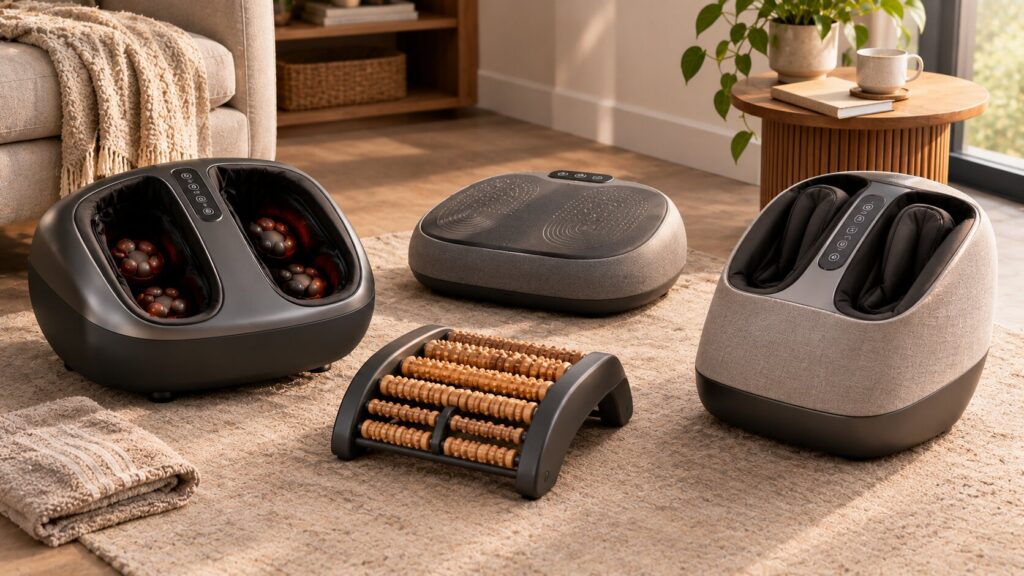
Shiatsu Foot Massagers
Shiatsu-style devices typically use rotating or kneading nodes to create a more pronounced pressure-based massage.
Depending on the design, the nodes may work underneath the soles, around the heels, along the arches, or across other parts of the foot.
This type can appeal to people who enjoy a stronger, more mechanical massage and want something that feels more substantial than simple vibration.
However, stronger isn’t automatically better.
A massage that feels pleasantly intense to one person may feel uncomfortable to another. This is particularly important if you’re looking for a foot massager because of sensitive feet, existing foot discomfort, or concerns such as plantar fasciitis.
A foot massager shouldn’t be treated as a medical treatment for plantar fasciitis, and intense pressure isn’t necessarily appropriate simply because it feels more powerful.
Look for adjustable intensity or other ways to control the experience if you’re unsure how much pressure you’ll enjoy.
Vibration Foot Massagers
Vibration-based models use rapid movement rather than pronounced kneading nodes. The sensation is generally less focused on deep mechanical pressure and can be preferable for people who find aggressive kneading uncomfortable.
The tradeoff is that vibration may not provide the same feeling of targeted pressure as a traditional shiatsu mechanism.
This makes vibration particularly worth considering if your priority is a gentler, simpler massage experience rather than maximum intensity.
Rolling Foot Massagers
Rolling mechanisms use moving rollers beneath the feet to create a different type of pressure and movement. Some massagers combine rolling with kneading or other massage actions.
The appeal is straightforward: the moving mechanism can provide a more continuous sensation across the sole rather than concentrating pressure in a small number of fixed points.
As with shiatsu, though, the actual experience depends heavily on the device’s design. Roller placement, movement range, speed and foot positioning can all affect how comfortable the massage feels.
Compression Foot Massagers
Compression models use air chambers that inflate and deflate around parts of the feet, and sometimes the ankles or lower legs.
Instead of relying primarily on mechanical kneading, they create a squeezing sensation around the covered areas.
Compression can be an interesting choice for someone who wants a different experience from traditional foot massage, particularly if broader coverage is more important than concentrated pressure on the soles.
But coverage varies considerably between products. One model may focus mostly on the feet, while another extends farther around the ankles or calves. Check exactly which areas are covered rather than assuming that every compression foot massager works the same way.
Combination Foot Massagers
Many of the more feature-rich devices combine several mechanisms, such as kneading, rolling, vibration, compression and heat.
That can sound like the obvious choice, but more mechanisms don’t automatically create a better product.
If you only enjoy one type of massage, paying extra for four additional modes may add very little value.
On the other hand, if you’re buying a massager for regular household use and multiple people prefer different sensations, adjustability and multiple massage types could make the additional cost worthwhile.
The important question is therefore not:
“How many massage modes does it have?”
It’s:
“Will I actually use the modes it has?”
Which Type Is Right for You?
A simple starting point is:
- Prefer pronounced pressure and kneading? Look at shiatsu-style models.
- Prefer a gentler mechanical sensation? Vibration may be worth considering.
- Want moving pressure across the soles? Consider rolling mechanisms.
- Prefer a squeezing sensation and broader coverage? Look at compression models.
- Want several experiences in one device? A combination model may make sense, provided you will actually use the additional features.
There is no universally best foot massager mechanism.
The best type is the one that produces a comfortable experience you are likely to use regularly.
Once you’ve narrowed down the massage mechanism, the next question becomes just as important: where does the massager actually massage?
Foot Massager Types at a Glance
| Type | Main sensation | Often best for | Potential tradeoff |
|---|---|---|---|
| Shiatsu | Kneading and focused pressure | People who enjoy a stronger massage | May feel too intense for some users |
| Vibration | Rapid, lighter movement | People who prefer gentler stimulation | Less focused pressure |
| Rolling | Moving pressure across the soles | People who like continuous sole massage | Experience depends heavily on roller design |
| Compression | Squeezing around covered areas | People who prefer compression and broader coverage | May provide less direct sole pressure |
| Combination | Multiple massage sensations | Households or users wanting versatility | More features can mean higher cost and complexity |
This table is a starting point, not a ranking. A more expensive combination massager isn’t automatically a better choice than a simple vibration or shiatsu model.
The right mechanism is the one that matches the experience you actually want.
Why Foot Massager Coverage Matters
A foot massager can have an impressive list of massage modes and still disappoint if it doesn’t massage the parts of your feet you actually care about.
Coverage is one of those specifications that’s easy to overlook when comparing products.
Two massagers may both be described as shiatsu foot massagers, for example, while one concentrates almost entirely on the soles and another also reaches the heels, arches, toes and sides of the feet.
That difference can matter more than having an extra massage mode.
Sole Coverage
The soles are the primary contact point for many foot massagers, particularly models that use rollers or rotating kneading nodes.
If your main goal is general relaxation after a long day, broad sole coverage may be enough. But look at where the mechanism actually makes contact, rather than assuming the entire bottom of the foot receives equal attention.
Some devices concentrate their massage in specific zones. Others move across a larger portion of the sole.
For people specifically searching for a foot massager for arch pain, this distinction can be particularly relevant.
A massager that provides strong pressure directly through the center of the sole may feel very different from one that primarily works toward the heel or forefoot.
Heel and Arch Coverage
The heel and arch aren’t necessarily treated equally by every foot massager.
Some designs have dedicated areas or mechanisms that reach toward the heel. Others focus more heavily on the central sole or forefoot.
This is worth checking if your reason for buying is more specific than simply wanting a relaxing massage.
For example, someone researching a foot massager for plantar fasciitis may be particularly interested in how a device interacts with the heel and arch.
But this shouldn’t be interpreted as evidence that a particular device treats plantar fasciitis.
Plantar fasciitis is a medical condition, and a foot massage device shouldn’t replace appropriate medical advice or treatment.
Instead, consider coverage as a comfort and usability question:
Does the device massage the area you actually want it to massage, and does that sensation feel comfortable to you?
Toes and Forefoot Coverage
The front of the foot can be overlooked entirely by some designs.
If toe or forefoot coverage matters to you, check the internal dimensions and product design carefully.
A foot massager that looks large from the outside may still position its massage mechanism primarily underneath the middle of the foot.
This is another reason photographs can sometimes be more useful than a specification list.
Look at the internal shape, massage-node placement and user positioning rather than relying solely on phrases such as “full-foot massage.”
Sides of the Feet and Ankles
Some enclosed foot massagers extend upward around the sides of the feet and ankles, while others leave these areas mostly uncovered.
Enclosed designs can provide a more immersive experience and may combine mechanical massage with air compression or heat.
Open designs are often simpler to put on and remove and may feel less restrictive.
Neither approach is automatically better.
If you dislike having your feet enclosed, extensive coverage could actually make a product less comfortable to use. Conversely, someone who wants broader massage may consider an open platform too limited.
Foot Size and Internal Fit
Coverage isn’t just about which parts of the foot a massager claims to massage. Fit matters.
If your feet are near the upper end of the manufacturer’s recommended size range, the position of your heels, arches and toes inside the device may change the experience.
Pay attention to:
- The manufacturer’s maximum foot size
- Whether the massage area accommodates your foot length
- How wide the foot compartments are
- Whether the design accommodates different foot shapes
- Whether your heel sits where the device expects it to
- Whether the controls allow you to adjust positioning or intensity
A device can technically fit your feet while still providing an uncomfortable or poorly positioned massage.
Coverage vs. Intensity
More coverage isn’t automatically better either.
A foot massager that massages the entire foot may sound superior to one that focuses on the sole, but the broader design could sacrifice some intensity or precision.
Conversely, a highly focused mechanism may feel excellent if you specifically enjoy pressure in one area but less useful if you want an all-around experience.
Think of coverage and intensity as separate questions:
Coverage: Where does it massage?
Intensity: How strongly does it massage?
You want the combination that suits your preferences.
If You Have a Specific Foot Concern
Searches such as “best foot massager for plantar fasciitis”, “foot massager for heel pain”, and “foot massager for arch pain” can make it tempting to choose whichever product promises the strongest pressure in the relevant area.
That’s not necessarily the best approach.
When a specific foot condition or persistent pain is involved, the priority should be understanding whether a massage is appropriate for you rather than assuming a foot massager will solve the underlying problem.
If a healthcare professional has advised you that massage is appropriate, the useful product questions become much more practical:
Can you control the pressure? Can you stop the massage easily? Does the device fit properly? Can you avoid areas that feel uncomfortable?
For general comfort, meanwhile, you have considerably more freedom to choose based on massage preference and coverage.
The best foot massager isn’t necessarily the one that covers the most surface area. It’s the one that covers the areas you want, fits your feet properly, and provides a sensation you can comfortably tolerate.
How Much Intensity and Control Do You Need?
A foot massager can have an excellent mechanism and still be the wrong choice if you can’t control how that mechanism feels.
This is particularly important with devices that use rotating kneading nodes, rollers or compression.
A massage that feels relaxing at one setting can become uncomfortable at a higher setting, and your preferred intensity may change depending on whether you’re using the massager for a few minutes of relaxation or a longer session.
That’s why adjustability is often more valuable than raw power.
More Powerful Isn’t Necessarily Better
Product descriptions often make powerful massage sound like a benefit. But the strongest setting isn’t automatically the most useful setting.
If the pressure is too aggressive, you may simply turn the device’s power down or stop using it.
A moderately powerful device with several comfortable intensity levels can therefore be more useful than an extremely forceful model with limited control.
Think about the experience you want rather than trying to maximize intensity.
If you enjoy firm pressure, a stronger shiatsu mechanism may be appealing.
If you prefer something gentler, a vibration or lower-intensity setting may be more appropriate.
Look for Multiple Intensity Levels
Several intensity settings give you room to adjust the experience.
For example, three useful levels may allow you to start gently and increase the pressure if you want more. This is generally more practical than a device with one fixed intensity.
Multiple settings can also make a foot massager easier to share. One person might prefer a strong massage while another wants something considerably lighter.
But don’t assume that a product offering five or ten levels is automatically better than one offering three.
The difference between the actual settings matters more than the number printed on the product page.
Speed and Intensity Aren’t Always the Same
Some foot massagers allow you to change speed, while others change the strength of the mechanism itself. These controls can feel quite different.
A faster rolling or kneading motion isn’t necessarily equivalent to stronger pressure. Similarly, a slower setting may still apply substantial pressure.
When comparing products, look for descriptions that explain what the control actually changes rather than simply counting the available modes.
Direction and Massage Pattern
Some rotating mechanisms allow the direction of movement to change.
This can alter the sensation without necessarily making the massage more intense. If you enjoy kneading mechanisms, directional control can therefore be a useful feature, particularly if you find one movement pattern more comfortable than another.
Again, it’s a preference feature rather than a specification you need to maximize.
A simple foot massager with one movement pattern that you love can be a better purchase than a complicated device with several patterns you rarely use.
Manual Controls Are Valuable
Controls should be easy to reach and understand.
Ideally, you shouldn’t have to stop the massage or awkwardly reposition yourself just to change intensity, turn on heat, switch modes or stop the device.
Look for straightforward controls that let you:
- Start and stop the massage easily
- Change intensity or speed
- Turn heat on or off independently
- Change massage modes where available
- Adjust compression separately if the device supports it
- Stop the device when necessary
A remote control can be convenient on some models, while others put controls directly on the massager.
Neither is universally better, accessibility is what matters.
Heat Should Be Adjustable Too
Heat can be a pleasant addition, but it shouldn’t be treated as a reason to buy a particular device by itself.
If you’re interested in a heated foot massager, look for the ability to turn the heat on and off independently from the massage.
That gives you more flexibility than a design where heat is permanently tied to one particular program.
If multiple heat levels are offered, consider whether they represent meaningful differences or simply add another number to the feature list.
Also pay attention to how the manufacturer describes the heating system and any built-in safety features.
A foot massager should be used according to its instructions rather than assuming that more heat or longer use is better.
Adjustable Compression Can Matter
For foot massagers that use air compression, adjustable compression strength is particularly useful.
Compression is inherently different from kneading or rolling, and some users may prefer a light squeezing sensation while others want something firmer.
If the compression cannot be adjusted, you have less ability to personalize the experience.
For shared households, adjustable compression can also make the massager more versatile because different users can choose their preferred level.
What About Programs and Massage Modes?
Preset programs can make a device easier to use, especially if you don’t want to manually adjust every setting.
But program count is another specification that’s easy to overvalue.
A device advertising eight programs isn’t necessarily eight times better than one with three. What matters is whether the programs create genuinely useful differences in massage intensity, movement, heat or compression.
Before paying extra for a long list of presets, ask:
Would I actually choose between these programs?
If the answer is probably not, simpler controls may be perfectly adequate.
A Good Rule for Comparing Adjustability
When comparing two foot massagers, don’t ask which one has the longest feature list.
Ask which one gives you the most useful control over the experience.
A practical hierarchy might look like this:
- Can I comfortably tolerate the massage?
- Can I adjust the intensity if I need to?
- Can I control heat independently?
- Can I easily stop or change the device while using it?
- Are additional modes genuinely useful to me?
That’s especially important if you’re buying a foot massager for a specific comfort concern. More pressure isn’t automatically more beneficial, and a device shouldn’t be chosen solely because its marketing describes the massage as “deep” or “powerful.”
Control gives you options. Raw intensity doesn’t.
For most buyers, a foot massager that can comfortably adapt to different preferences is likely to be more useful than one designed around a single, extremely strong experience.
Is Heat Worth Paying For in a Foot Massager?
Heat is one of the most common features you’ll see when comparing foot massagers.
It also tends to be one of the easiest features to overvalue.
A heated foot massager can make the experience feel more comfortable and relaxing, particularly if you enjoy warmth while sitting down at the end of the day.
But heat alone isn’t a reason to choose one device over another.
The useful question is whether the heating function actually improves the experience for you and whether you can control it properly.
Why People Like Heated Foot Massagers
Warmth can make a massage session feel more relaxing, especially when your feet are cold or you’ve been on them for hours.
This is one reason heat can be a worthwhile feature for people who plan to use a foot massager as part of an evening routine.
If you’re already sitting down watching television or reading, adding warmth to the massage may make the device feel more enjoyable and encourage regular use.
That’s an important consideration because a feature only has value if it contributes to an experience you’ll actually use.
A foot massager with heat that you use several times a week may provide considerably more practical value than a feature-packed model that stays in the closet.
Look for Independent Heat Control
One of the most useful things to check is whether the heat can be switched on and off separately from the massage.
This gives you more flexibility.
You might want:
- Massage without heat
- Heat without an intensive massage
- Both together
- Neither while adjusting the other settings
If heat is permanently tied to a particular massage program, you have less control over the experience.
Multiple heat settings can also be useful, although don’t assume that a product with three temperature levels is automatically better than one with a single comfortable setting.
How Warm Does It Actually Get?
Manufacturers sometimes advertise a specific temperature range, but the number alone doesn’t tell you what using the massager will feel like.
The way warmth is distributed matters. So does where the heating elements are located, how enclosed the foot compartment is, and whether your feet remain in close contact with the heated surfaces.
If you’re comparing products, consider the design rather than simply choosing the highest advertised temperature.
More heat isn’t necessarily better.
A comfortably warm experience is usually more useful than a device designed to maximize the temperature specification.
Heat and Plantar Fasciitis: What Should You Consider?
People searching for a foot massager for plantar fasciitis will often encounter heated models marketed around foot comfort.
It’s important to separate general comfort from medical treatment.
Plantar fasciitis is a specific condition involving the plantar fascia, and a foot massager should not be treated as a cure or substitute for professional medical advice. Heat or massage may feel comfortable to some people, but individual responses can differ.
If you have plantar fasciitis or persistent heel pain and are considering a heated foot massager, the more useful product questions are practical ones:
- Can you control the massage intensity?
- Can you use the heat independently?
- Can you stop the massage easily?
- Does the device fit your feet properly?
- Can you choose a gentler setting if stronger pressure feels uncomfortable?
If a healthcare professional has advised you that massage or heat is appropriate, those controls can make it easier to tailor the experience.
If you’re experiencing unexplained, severe or persistent foot pain, buying a more powerful massager shouldn’t be the first assumption.
The underlying cause matters.
Don’t Confuse Heat With Effectiveness
A product can have excellent heating and mediocre massage.
It can also have a relatively simple heating system while providing an experience you prefer.
When comparing foot massagers, think of heat as a supporting feature, not the foundation of the purchase decision.
Massage mechanism, coverage, comfort, adjustability and fit generally deserve attention first. Once those fundamentals are right, heat can be a worthwhile addition if you enjoy it.
When Is Heat Worth Paying Extra For?
Heat is more likely to be worth paying for if:
- You regularly enjoy warm foot treatments
- Your feet often feel cold
- You plan to use the massager during relaxing evening routines
- You want warmth alongside your preferred massage mechanism
- You value having independent heat controls
It may be less important if:
- You rarely enjoy heat
- You tend to get warm easily
- You mainly want mechanical massage
- The heated model costs substantially more without improving other important features
- Heat cannot be controlled independently
The best heated foot massager isn’t necessarily the one with the highest temperature specification.
It’s the one where the heat complements an already comfortable massage experience.
Fit, Sizing and Comfort Matter More Than You Think
A foot massager can have the right massage mechanism, plenty of settings and a reasonable price – and still be a poor purchase if it doesn’t fit comfortably.
This is especially important with enclosed foot massagers. Your feet need to sit in the intended position for the massage mechanism to contact the areas the manufacturer designed it to reach.
If your feet are too large, too small or positioned awkwardly inside the device, the experience may be very different from what you expected.
Check the fit before you check the feature count.
Start With the Maximum Foot Size
Most enclosed foot massagers specify a maximum shoe or foot size.
Don’t treat this as a minor specification.
If you’re near the upper limit, the device may technically accommodate your feet while leaving little room for comfortable positioning.
If you’re well below the recommended range, the massage mechanisms may not contact your feet in quite the same way.
Check the manufacturer’s sizing information before buying, particularly if you’re shopping online.
Also remember that shoe size isn’t perfectly standardized between brands. If you’re close to the stated limit, looking at the actual dimensions can provide additional context.
Open vs. Enclosed Designs
Foot massagers generally fall somewhere between open platforms and fully enclosed compartments.
Open designs leave more of the foot exposed. They can be easier to get into and out of, and they may feel less restrictive. They’re also often easier to clean because there are fewer enclosed surfaces.
Enclosed designs can provide more extensive coverage. Depending on the product, they may massage the soles, heels, sides, toes and parts of the ankles while combining several mechanisms.
The tradeoff is that an enclosed device can feel bulkier and may require more attention to fit and cleaning.
Neither design is automatically superior.
Ask yourself which experience you’d actually prefer to use regularly.
Foot Shape Matters Too
Length isn’t the only consideration.
Feet vary in width, arch shape and overall proportions. Two people with the same shoe size may therefore experience the same foot massager differently.
This is difficult to capture in a simple product specification, which is why customer feedback can be useful when researching a particular model.
Look for recurring comments about:
- Tight or cramped foot compartments
- Uncomfortable pressure points
- Difficulty positioning the heel
- The massage reaching the wrong areas
- The toes being squeezed
- The massager working better for smaller or larger feet
- Difficulty getting the feet in or out
One isolated complaint doesn’t necessarily mean a product has a fit problem. Repeated feedback about the same issue is much more useful.
Comfort During the Massage
Think beyond whether you can physically fit your feet inside.
Can you sit comfortably while using it?
Can you relax your legs without having to constantly reposition yourself?
Does the device hold your feet in a natural position?
Are the controls easy to reach?
These details can determine whether a foot massager becomes part of your routine or ends up stored in a cupboard.
This is particularly relevant for people who expect to use one after work, after exercising, or following a day spent standing. If getting the massager out and positioning yourself feels like a chore, convenience disappears quickly.
Think About Your Whole Body Position
A foot massager doesn’t operate in isolation.
Consider where you’ll actually use it.
If you’re planning to sit on a sofa, does the massager fit comfortably in front of you? If you’re using it at a desk, can your legs sit naturally while your feet are inside it? If you’ll store it between sessions, is it small enough that you’re willing to move it?
A technically excellent device can be impractical if its physical design doesn’t suit the space where you intend to use it.
Weight and Portability
Size and weight become especially important if you don’t have a permanent place for the device.
Some foot massagers are designed to stay in one location. Others include handles or are compact enough to move around the house.
If you expect to use your device in multiple rooms, consider:
- Overall weight
- Carry handles
- Cable length
- Storage requirements
- Whether it can be easily placed on the floor and put away
- Whether the design is stable during use
Don’t pay extra for portability if you’re going to use the massager in the same chair every evening.
But if you live in a smaller space or share the room with other people, portability can be surprisingly valuable.
Fit Matters Even More With Strong Massage
The stronger the mechanism, the more important positioning can become.
If a rotating node or roller applies significant pressure to one part of the foot, being positioned slightly differently can change where that pressure is felt.
This is another reason not to assume that maximum intensity is desirable.
If you’re researching a foot massager for plantar fasciitis or heel discomfort, for example, don’t choose solely on the basis of how aggressively the device massages the heel or arch.
Fit, controllability and your ability to stop or reduce the massage are more useful buying considerations.
And if a particular setting causes pain or significant discomfort, that is not a signal that you simply need to “push through” it.
The Best Fit Is the One You’ll Actually Use
When comparing models, it’s easy to focus on specifications such as:
6 modes. 3 speeds. Heat. Compression. Rolling. Shiatsu.
But a much simpler question can be more valuable:
Can I comfortably put my feet in this device and imagine using it several times a week?
If the answer is yes, you’ve already solved one of the most important parts of the buying decision.
A foot massager doesn’t need to be the most technologically impressive model available. It needs to fit your feet, fit your body position, fit your space and fit your routine.
Don’t Overlook Noise, Cleaning and Everyday Maintenance
The experience of using a foot massager doesn’t end with the massage mechanism.
Noise, cleaning, cables, storage and general maintenance can have a surprisingly large effect on whether a massager becomes something you use regularly or something that eventually gets pushed into a closet.
These aren’t particularly exciting features to advertise, but they’re worth considering before you buy.
How Noisy Is the Foot Massager?
Every powered foot massager produces some level of mechanical noise.
Rotating nodes, rollers, vibration motors and air pumps all have moving parts, so expecting complete silence isn’t realistic. The more useful question is whether the noise is acceptable where and when you plan to use the device.
If you’re using it while watching television, listening to music or scrolling on your phone, moderate background noise may not matter much.
If you want to use it while reading, working, meditating or having a quiet conversation, noise may become more important.
Customer feedback can be useful here. Rather than looking for a single review saying “quiet,” look for recurring comments about whether the device is noticeable during normal use.
Mechanical Noise vs. Air-Pump Noise
Different mechanisms can produce different sounds.
A rotating or rolling mechanism may create a repetitive mechanical sound. A vibration motor may produce a steady hum. Compression systems can introduce the sound of an air pump activating and releasing pressure.
This doesn’t mean one technology is universally quieter.
The actual construction of the device matters, so don’t assume that a particular massage type guarantees a particular noise level.
If low noise is important to you, research the specific model rather than relying on the category.
Cleaning Matters More With Enclosed Designs
Your feet naturally bring sweat, skin oils, dust and other debris into contact with a foot massager.
That makes cleanability worth considering before buying, particularly with massagers that completely enclose the feet.
Look for practical details such as:
- Removable and washable liners
- Materials that can be wiped clean
- Accessible foot compartments
- Instructions explaining how the interior should be cleaned
- Covers or sleeves that can be removed when applicable
A device that is difficult to clean may become less appealing over time, even if the massage itself is excellent.
Don’t Assume Every Part Can Be Washed
This is especially important with powered devices.
Never assume that an enclosed foot massager can simply be rinsed or submerged because the interior looks washable.
Follow the manufacturer’s cleaning instructions and pay attention to which components, if any, are removable and washable.
The distinction between “easy to wipe clean” and “machine washable” matters.
Storage Is Part of the Buying Decision
Foot massagers can be surprisingly large.
Before purchasing one, decide where it will live between sessions.
If it stays permanently beside your favorite chair, size may not matter much. If it needs to be stored in a cupboard after every use, a bulky design could become frustrating.
Consider:
- Overall dimensions
- Weight
- Carry handles
- Cable storage
- Whether the power adapter is bulky
- How easily the device fits into your available storage space
Convenience isn’t just about how easy the massage is to start.
If the massager is annoying to retrieve and put away, you’ll probably use it less.
Corded vs. Cordless
Most powerful foot massagers require a wall outlet, but some portable or rechargeable designs are available.
Corded models generally make sense when the device will live in one place. You don’t need to remember to charge them, and continuous access to mains power can be useful for longer sessions.
Cordless models can offer more flexibility, particularly if you want to move the device between rooms or don’t have a convenient outlet nearby.
The tradeoff is another battery to charge and another component that can affect long-term ownership.
Don’t automatically pay more for cordless operation if the device will spend its entire life beside the same outlet.
Pay Attention to the Power Cable
Even with a corded model, cable length can matter.
A short cable may limit where you can comfortably use the massager. A long cable can make positioning easier but may create additional clutter.
If the product will sit far from a wall outlet, check the cable and power-adapter arrangement before buying rather than discovering the limitation afterward.
Auto Shutoff Is a Useful Practical Feature
Automatic shutoff can make a foot massager easier to use as part of a routine.
It means the device doesn’t continue operating indefinitely if you become distracted or fall asleep.
The exact shutoff period varies between products, so check the manufacturer’s specifications rather than assuming every model behaves the same way.
A built-in shutoff doesn’t mean you should ignore the manufacturer’s recommended usage instructions, but it can be a useful additional layer of convenience.
Maintenance Is Part of Value
When comparing two similarly priced foot massagers, the one that’s easier to clean, store and operate may provide more real-world value even if its specification sheet looks less impressive.
This is an important part of evaluating any home-comfort product.
You’re not just buying the massage.
You’re buying the ownership experience.
A foot massager that feels good but is awkward to clean, difficult to store, excessively noisy or inconvenient to set up may see considerably less use than expected.
Before buying, ask yourself:
Would I still enjoy owning this six months from now?
That’s a much better question than simply asking which product has the longest list of features.
Safety and What to Consider Before Using a Foot Massager
A foot massager is a comfort device, but that doesn’t mean every setting or usage pattern is appropriate for everyone.
Before using one, read the manufacturer’s instructions and understand how the massage, heat, compression and automatic shutoff functions work. Start conservatively rather than assuming that the strongest setting will produce the best experience.
The goal should be comfortable, controlled use – not simply maximum pressure or maximum heat.
Start With a Lower Setting
If you’re using a particular foot massager for the first time, there’s little reason to begin at its most intense setting.
Start with a lower intensity and see how the sensation feels. You can increase it if you find that more pressure is comfortable, but you can’t undo an uncomfortable session after the fact.
This is particularly relevant with devices that use strong kneading nodes, rollers or compression. Different people can respond very differently to the same mechanism.
Don’t Treat Pain as a Sign That the Massage Is Working
A common mistake with massage products is assuming that an uncomfortable or painful sensation means the device is being more effective.
It doesn’t.
A foot massager is designed to provide a massage experience. If a particular setting causes significant pain, sharp discomfort, numbness or another concerning sensation, stop using it rather than increasing the intensity.
Comfort and tolerance should guide the experience.
Be Careful With Heat
Heat can make a foot massager more enjoyable, but more heat isn’t necessarily better.
Follow the manufacturer’s instructions for the heating function and use the available controls appropriately. If the device allows independent heat control, you can choose whether warmth is actually useful during a particular session.
Avoid assuming that a high temperature or longer exposure will provide additional benefits simply because the device can produce it.
Pay Attention to Your Own Circumstances
People have different levels of sensitivity and different reasons for using a foot massager.
If you have a diagnosed medical condition, significant foot problems, reduced sensation, circulation concerns, recent injury or persistent unexplained pain, it’s sensible to seek appropriate professional guidance before relying on a massage device.
The same applies if you’re unsure whether massage, heat or compression is appropriate for your particular situation.
This doesn’t mean that everyone needs medical clearance before using a foot massager. It simply means that a product designed for general comfort shouldn’t be assumed to be appropriate for every medical circumstance.
Plantar Fasciitis and Foot Pain
Plantar fasciitis is one reason people search for terms such as “best foot massager for plantar fasciitis” or “foot massager for heel pain.”
If that’s why you’re researching foot massagers, avoid choosing solely according to which product promises the strongest massage.
A more sensible buying approach is to look at:
- Adjustable intensity
- Comfortable pressure
- Ability to stop the massage easily
- Heat control
- Fit and positioning
- Whether the device allows you to choose a gentler setting
Most importantly, a foot massager should not be presented as a treatment or cure for plantar fasciitis. If you have persistent heel or foot pain, the underlying cause and appropriate management matter more than buying the most powerful device available.
Follow the Manufacturer’s Instructions
This sounds obvious, but it’s easy to overlook when a device appears simple to operate.
Check the manufacturer’s guidance for:
- Recommended session length
- Cleaning
- Heat settings
- Maximum operating time
- Automatic shutoff
- Appropriate surfaces for use
- Charging requirements, if applicable
- Any listed warnings or restrictions
Different devices can have substantially different designs, so advice that applies to one foot massager shouldn’t automatically be transferred to another.
Give Yourself an Easy Stop
A good foot massager should make it straightforward to stop the session.
Look for accessible controls and, where applicable, automatic shutoff. If you need to reach awkwardly behind the device or remove your feet completely before you can stop it, that can become inconvenient.
This matters even more when using stronger massage mechanisms or heat.
The Simple Rule
You don’t need to overcomplicate safe everyday use.
Start gently. Follow the instructions. Use only settings that feel comfortable. Don’t ignore significant pain or unusual symptoms.
And if you’re considering a foot massager because of a persistent medical problem rather than simply wanting a relaxing massage, get appropriate professional advice instead of assuming the device is the solution.
The best foot massager is not the one that pushes your tolerance the furthest.
It’s the one you can use comfortably, predictably and responsibly.
Choose Features Based on How You Will Actually Use the Massager
By this point, it should be clear that there isn’t one universally best foot massager.
The better question is:
Which combination of features makes sense for the way you will actually use it?
A person who wants ten minutes of relaxation after work has different priorities from someone who spends all day standing, someone who wants a portable device, or someone researching a foot massager because they experience recurring foot discomfort.
Instead of starting with the product and trying to justify its features, start with your routine.
If You Mainly Want Relaxation
If your primary goal is simply to sit down and enjoy a foot massage, you probably don’t need every feature available.
Prioritize:
- A massage mechanism you actually enjoy
- Comfortable foot coverage
- Adjustable intensity
- Straightforward controls
- Optional heat if you like warmth
- A design that’s easy to use and store
You may not need extensive compression, multiple preset programs or a rechargeable battery.
A simpler device that feels good and is easy to use can provide more value than a highly complicated model.
If You Spend All Day Standing
People who spend long periods on their feet may place more emphasis on coverage and comfort.
A broader massage area could be appealing if you want to address more than just the center of the soles. Heat may also be a desirable comfort feature if you enjoy using it at the end of the day.
But don’t automatically assume that the strongest massage is the best choice.
If you’re going to use the massager regularly, a comfortable experience that you look forward to using is likely to be more valuable than an extremely aggressive one.
If You Work at a Desk
Desk workers have a slightly different consideration: where will the device actually live?
If you’re imagining using it under your desk while working, check the dimensions, controls, noise level and cable arrangement carefully.
A large enclosed foot massager may be excellent in a living room but impractical beneath a desk.
A compact platform-style model may sacrifice some coverage while being considerably easier to keep nearby.
Think about the environment first.
A product that fits naturally into your routine has a much better chance of being used consistently.
If You’re Looking for a Foot Massager for Plantar Fasciitis
If plantar fasciitis is the reason you’re researching foot massagers, avoid reducing the decision to a search for the strongest pressure.
Instead, pay particular attention to:
- Intensity control
- Pressure comfort
- Heel and arch coverage
- Foot positioning
- Ability to stop the foot massager quickly
- Independent heat control
- Fit for your foot size
Most importantly, treat the device as a comfort product rather than assuming it treats the condition.
If you have persistent heel pain or a diagnosed condition, appropriate professional guidance should take priority over choosing a more powerful massage setting.
If You Want Something for Multiple People
Shared household use changes the priorities.
One person may prefer strong shiatsu pressure while another may want gentle vibration. One may enjoy heat while another never uses it.
In that situation, adjustability becomes particularly valuable.
Look for:
- Multiple intensity levels
- Different massage modes
- Independent heat control
- Adjustable compression where applicable
- A foot compartment that accommodates the intended users
- Controls that are easy for everyone to understand
A flexible device can be worth paying more for if several people will genuinely use the additional functionality.
If You Want Portability
If you plan to move the device between rooms or take it with you, physical design becomes more important.
Consider:
- Weight
- Carry handles
- Dimensions
- Cord length
- Rechargeable operation
- Storage requirements
Cordless operation can be useful, but don’t pay a premium simply because the product is rechargeable if you’re going to use it beside the same outlet every evening.
If You Have Limited Storage
This is one of the easiest considerations to overlook before buying.
Look at the actual dimensions and think about where the device will go when you’re not using it.
A foot massager that’s awkward to store may gradually become something you use less often.
If storage space is limited, a compact design may be worth choosing even if it has fewer features.
If You Care About Ease of Cleaning
This becomes especially relevant with enclosed devices.
Prioritize removable or washable liners where available, wipeable surfaces and a design that doesn’t make basic maintenance unnecessarily difficult.
A device that’s easy to clean is easier to keep in your regular routine.
If You Want the Simplest Possible Experience
You may not need a feature-rich device at all.
A straightforward foot massager with a comfortable mechanism, a few intensity options and easy controls can be enough.
There’s nothing inherently better about owning a foot massager with twelve programs if you always use the same one.
In fact, unnecessary complexity can work against convenience.
A Simple Buyer Checklist
Before buying, ask yourself these questions:
1. What kind of massage do I actually enjoy?
Kneading, rolling, vibration, compression or a combination?
2. Which parts of my feet do I want covered?
Soles only, or heels, arches, toes, sides and ankles too?
3. How much control do I need?
Can I adjust intensity, heat and other settings?
4. Does it fit my feet?
Check the manufacturer’s dimensions and recommended foot size.
5. Where will I use it?
Sofa, bedroom, home office or another permanent location?
6. Where will I store it?
Consider dimensions and weight before buying.
7. How important is heat?
A useful bonus if you enjoy it, but not automatically worth paying more for.
8. How easy is it to clean?
Especially important for enclosed designs.
9. How noisy is it?
Consider what you’ll be doing while using it.
10. Will I actually use the features I’m paying for?
This may be the most important question of all.
The Feature List Should Come Last
The easiest way to overspend on a foot massager is to start with the specification sheet.
Six massage modes sound better than three. Ten intensity levels sound better than four. A longer feature list sounds more impressive.
But specifications don’t tell you whether the experience will be comfortable, whether the device fits your feet, whether you’ll enjoy the massage or whether you’ll actually use it six months from now.
Start with your routine.
Then choose the features that solve a real problem within that routine.
That’s how you buy a foot massager based on value rather than simply buying the longest feature list.
If you spend much of your day standing or walking, you can also see our guide to Best Foot Massagers for People Who Stand All Day for a closer look at the features and tradeoffs that matter for this type of use.
What Should You Actually Pay for in a Foot Massager?
Price is useful, but it shouldn’t be the starting point of the decision.
Foot massagers can range from relatively simple devices to expensive devices with multiple massage mechanisms, heat, compression, remote controls and extensive coverage.
The difference in price can be justified in some cases, but a higher price doesn’t automatically mean a better massage.
The goal is to understand what you’re paying for.
Pay for a Better Massage Experience
The most important reason to spend more should be a meaningful improvement in the experience.
That might mean:
- A massage mechanism you prefer
- Better pressure control
- More useful coverage
- A more comfortable foot compartment
- Smoother or more adjustable operation
- A combination of mechanisms you will genuinely use
If the more expensive device simply adds features you don’t care about, the additional cost may not be worthwhile.
Pay for Useful Adjustability
Adjustability can be one of the better reasons to move up a price bracket.
If a more expensive model lets you control intensity, heat, compression or massage patterns independently, those controls may make it more adaptable to different users and situations.
But again, usefulness matters more than quantity.
Three genuinely useful settings can be worth more than ten nearly identical presets.
Pay for Better Construction When It Matters
Build quality can also justify a higher price.
A massager that’s used several times a week places more demands on its mechanisms, controls, cables, foot compartments and moving parts than one that’s rarely used.
Look beyond the exterior appearance.
Consider the manufacturer’s warranty, construction details, customer feedback about reliability and whether recurring complaints suggest problems with particular components.
No product is guaranteed to last forever, but ownership history can provide useful context when comparing similarly positioned devices.
Don’t Pay Extra Just for “Powerful”
This is one of the easiest traps to fall into.
A product marketed as extremely powerful may sound more capable, but intensity is highly subjective.
If you prefer a moderate massage, additional power doesn’t necessarily improve your experience.
For someone researching a foot massager because of plantar fasciitis, heel discomfort or another specific concern, this becomes even more important. The strongest available pressure shouldn’t automatically be treated as the most desirable option.
Control is usually more useful than maximum intensity.
Don’t Pay Extra for Features You Won’t Use
This sounds obvious, but feature-heavy products make it easy to rationalize spending more.
If you don’t care about:
- Multiple preset programs
- Remote controls
- Bluetooth
- Rechargeable operation
- Extensive compression
- Multiple massage mechanisms
- Additional coverage
then those features may have little practical value to you.
There’s nothing wrong with buying them if you want them. The mistake is assuming that owning more functionality automatically means getting more value.
Consider Cost Per Use
One useful way to think about price is to consider how frequently you’ll use the device.
A $150 foot massager used three times a week for a year is providing a very different ownership experience from a $250 device used twice before being stored away.
You don’t need to calculate an exact financial return.
Just ask:
How likely am I to use this regularly?
Convenience, comfort, fit and simplicity all influence that answer.
The Cheapest Option Isn’t Always the Best Value
Saving money is useful only if you’re still buying something that meets your needs.
A very cheap device may look attractive initially but offer limited adjustability, poor fit, uncomfortable pressure or an ownership experience that makes you stop using it.
Likewise, the most expensive model isn’t automatically the best value.
The sweet spot is usually the product that provides the features and experience you actually value without charging you for a long list of extras you don’t need.
A Better Way to Think About Price
Instead of asking:
“What’s the best foot massager under $X?”
try asking:
“What do I need this device to do, and what am I willing to pay for those specific capabilities?”
That changes the buying process.
You might discover that a relatively simple massager meets your needs perfectly. Or you might discover that spending more on better coverage, adjustability or construction is justified because you’ll use those improvements regularly.
Either outcome is useful.
The right price is the price that makes sense for the experience and ownership you expect to get.
If you’re still unsure whether buying a foot massager makes sense in the first place, our guide to Are Foot Massagers Worth It? What to Know Before You Buy looks more closely at value, usage, features and the tradeoffs involved.
How We Evaluate Foot Massagers
A foot massager can look impressive on a product page without necessarily being the right fit for the person buying it.
That is why we don’t judge foot massagers by feature count alone. A device with more massage modes, stronger pressure, more heat settings and a longer list of specifications isn’t automatically a better purchase.
Instead, we look at the parts of the experience that are most likely to affect whether you’ll actually enjoy using the product and feel that you spent your money well.
Massage Type
We first look at how the massager actually works.
Shiatsu, rolling, vibration, compression and combination systems create noticeably different sensations. Some people may prefer focused kneading pressure, while others may want something gentler or more continuous.
The important question isn’t simply whether a product has a particular massage mechanism. It’s whether that mechanism matches the experience you’re looking for.
Coverage
We consider which parts of the foot the device is designed to reach.
That can include:
- The soles
- The heels
- The arches
- The toes and forefoot
- The sides of the feet
- The ankles
- The lower legs on larger models
Coverage matters because two products can both be described as “foot massagers” while providing very different experiences.
A buyer looking primarily for sole coverage may have different priorities from someone who wants a more enclosed design that also reaches around the heel and sides of the foot.
Intensity and Control
We look at how much control the user actually has.
Useful controls can include:
- Multiple intensity levels
- Different massage modes
- Speed adjustments
- Direction controls
- Separate heat controls
- Adjustable compression
- Simple manual controls rather than relying entirely on presets
More intensity isn’t automatically better. A massager that allows you to find a comfortable setting can be more useful than one that simply produces a stronger sensation.
Fit and Sizing
A foot massager has to physically work for the person using it.
We pay attention to:
- Maximum supported foot size
- Enclosed versus open designs
- Foot opening dimensions
- Interior shape
- How easy it is to position your feet
- Whether the design accommodates different foot shapes
- Whether the controls remain accessible during use
Fit is particularly important with enclosed models. A device can have excellent specifications and still be a poor choice if your feet don’t sit comfortably inside it.
Heat
Heat is evaluated as a comfort feature, not as a reason to assume the product provides a medical benefit.
We look for useful details such as:
- Whether heat can be controlled independently
- Whether there are multiple heat settings
- Whether the manufacturer clearly explains the heating feature
- Whether the product includes automatic shutoff or other relevant safety features
- Whether the heat can be used separately from massage, where applicable
For buyers searching specifically for a heated foot massager or a foot massager with heat, these details can matter more than a headline temperature number.
Ease of Use
A complicated device isn’t necessarily a better device.
We consider how easy it is to:
- Start and stop a session
- Change intensity
- Adjust heat
- Switch massage modes
- Reach the controls
- Understand what each setting does
- Put the device away after use
If a massager is intended to become part of an everyday routine, simplicity can be a meaningful advantage.
Cleaning and Maintenance
Anything that comes into regular contact with your feet should be reasonably straightforward to maintain.
We look for details such as:
- Removable or washable liners
- Wipeable surfaces
- Accessible foot chambers
- Manufacturer cleaning instructions
- Storage requirements
- Cord management
- Whether the design appears likely to collect dust or debris in difficult-to-reach areas
These aren’t exciting specifications, but they’re part of the ownership experience.
Noise and Practicality
A massager can be perfectly functional and still become annoying if it is excessively noisy in the environment where you intend to use it.
We consider the type of mechanical or pump noise a product may produce and whether that matters for its intended setting.
We also look at practical factors such as:
- Weight
- Portability
- Cord length
- Storage
- Power requirements
- Auto shutoff
- Whether the device is designed primarily for home use
A large, heavy device may make sense if it stays beside your favorite chair. A smaller model may be preferable if you need to put it away after every session.
Value
Finally, we consider what you’re actually getting for the money.
A more expensive foot massager may justify its price through better construction, more useful adjustability, broader coverage or a more comfortable overall experience.
But additional features only add value when they’re features you’ll actually use.
Our goal isn’t to identify the product with the longest specification sheet. It’s to help you understand what you’re paying for, what you may actually use, and what tradeoffs come with the design.
That’s the difference between comparing foot massagers and simply repeating their product listings.
Bottom Line
Choosing a foot massager is less about finding the device with the most features and more about finding one that fits your feet, your preferred massage style and the way you will actually use it.
Start with the experience you want.
If you prefer stronger, focused pressure, a shiatsu design may be worth considering.
If you want something gentler, vibration may make more sense.
Rolling can provide a different type of moving pressure, while compression adds a squeezing sensation.
Combination models can offer more variety, but they may also cost more and take up more space.
Then look at coverage and fit.
A foot massager that doesn’t comfortably accommodate your feet is unlikely to become a useful part of your routine, regardless of how impressive its specification sheet looks.
Check the supported foot size, the areas it reaches and whether the design feels practical for the position in which you’ll actually use it.
After that, consider the features that genuinely matter to you.
Heat can be useful if you enjoy a warmer massage experience. Adjustable intensity can make a device easier to personalize.
Different modes can add variety. Easy-to-clean surfaces, sensible controls, reasonable noise levels and convenient storage can all make a difference over months of ownership.
And don’t automatically assume that more powerful means better.
A massager that gives you useful control may be more practical than one that simply delivers maximum intensity.
Likewise, paying extra for ten settings doesn’t necessarily make sense if you are likely to use two of them.
The same principle applies when you’re searching for something specific, such as a foot massager for people who stand all day, a heated foot massager, a shiatsu foot massager, or a foot massager for plantar fasciitis and heel pain.
These search terms can help you find relevant products, but it shouldn’t make the buying decision for you.
Look at the actual design.
Look at the fit.
Look at the controls.
Look at what the device covers.
Look at what you’ll realistically use.
And consider whether the price makes sense for the experience you’re expecting to get.
For anyone dealing with persistent, severe or unexplained foot pain, a foot massager should not be treated as a substitute for appropriate professional advice.
If you’ve been advised that massage or heat is appropriate for your particular circumstances, the practical considerations in this guide can help you compare the available designs more carefully.
Ultimately, the best foot massager isn’t necessarily the most expensive, the strongest or the one with the longest feature list.
It’s the one whose design makes sense for you.
Ready to Compare Specific Foot Massagers?
Once you know what matters to you, the next step is much easier: compare actual products against those criteria.
Our Best Foot Massager 2026 guide brings the comparison down to specific models, so you can look at the different designs, features, use cases and tradeoffs side by side.
Instead of starting with a product and trying to work out whether it suits you, you can start with what you need and see which options come closest.
→ See our Best Foot Massager 2026 guide
The goal isn’t to tell you what you have to buy.
It’s to make the decision clearer before you spend the money.