
Introduction
If you spend hours working at a computer, studying, gaming, or simply sitting at a desk, you may notice that your neck and shoulders don’t feel the same by the end of the day.
That makes choosing a neck massager slightly different from choosing one for occasional relaxation.
For desk workers, the most useful features may be comfortable neck and shoulder coverage, an adjustable massage intensity, a mechanism you actually enjoy using, easy controls, and enough comfort to make regular use practical.
But there isn’t one neck massager that’s automatically best for everyone who sits at a desk.
The right choice depends on where you want the massage, how much pressure you prefer, whether you want heat, and how you expect to use the device.
This post may contain affiliate links. If you click and make a purchase, we may earn a small commission at no extra cost to you.
Quick Answer: What’s the Best Type of Neck Massager for Desk Workers?
For most people who spend long periods at a desk, we’d start by looking at electric neck and shoulder massagers with adjustable intensity and comfortable coverage.
A shiatsu-style model can be a good option if you prefer a more pronounced kneading sensation, while a vibration-focused model may suit someone who wants something simpler or gentler.
If you plan to use the massager primarily at home after work, a plug-in model can be perfectly practical. If you want to move it between rooms or take it to different locations, a rechargeable design may be more convenient.
Here’s the simplest way to narrow it down:
| If you want… | Look for… |
|---|---|
| Neck + shoulder coverage | A broader neck & shoulder design |
| More pronounced kneading | Shiatsu-style rotating nodes |
| Adjustable pressure | Multiple intensity levels |
| A warmer massage experience | A model with controllable heat |
| Simple home use | A comfortable plug-in model |
| Portability | A rechargeable electric model |
| Frequent use | Comfortable ergonomics and easy controls |
The most important point is that desk workers don’t necessarily need a special type of massager.
Instead, you’re looking for a combination of features that makes sense for your routine.
If you sit at a desk for several hours and want something you can use regularly, comfort, fit and ease of use may matter more than having the longest feature list.
In this guide, we’ll look at what actually matters when choosing a neck massager for desk work, which features are worth prioritizing, and the specific models worth considering in 2026.
Why Desk Work Changes What to Look For
A neck massager can be useful in many situations, but people who spend much of the day at a desk have a few practical considerations that are especially worth paying attention to.
The biggest one is repeat use.
If you’re sitting at a computer for several hours every day, a device that is uncomfortable, awkward to position, or frustrating to operate is unlikely to become part of your routine – even if its specifications look impressive.
You’re More Likely to Use It Regularly
Desk work often means repeating the same setup day after day.
That makes convenience surprisingly important.
A massager that takes seconds to position and has straightforward controls may be more useful in practice than one with a much longer feature list but a complicated setup.
Think about where you’d realistically use it:
- On the sofa after work
- In a desk chair during a break
- In a home office
- While reading or watching television
- Before or after a long computer session
The best device is one that fits naturally into that routine.
Positioning Matters
Desk workers should also pay attention to where the massage heads actually make contact.
A product may be marketed as a neck massager, but different designs can concentrate their massage in very different areas.
Some focus primarily on the sides and back of the neck. Others extend onto the upper shoulders. Some rely on handles or straps so you can control how firmly the massage heads press against your body.
That’s why product dimensions and design can tell you more than the product name alone.
Comfort Becomes More Important With Frequent Use
If you’re considering using a massager regularly, don’t automatically choose the strongest model you can find.
A very intense massage may sound appealing in a product description, but what matters is whether you actually enjoy using it.
Look for:
- Adjustable intensity
- Comfortable contact points
- A shape that doesn’t require excessive effort to hold in position
- Controls you can operate easily
- A timer or automatic shutoff
- A weight that feels manageable for your intended use
These details may seem minor when you’re comparing specifications, but they can become much more important when you’re using the device repeatedly.
Your Desk Setup Isn’t Necessarily Where You’ll Use It
There’s also a common misconception that a massager for desk workers needs to be something you use while sitting at your desk.
Not necessarily.
For many people, the more practical routine may be to finish a workday, move to the sofa or another comfortable chair, and use the massager there.
That means you should choose based on your actual routine, rather than buying something simply because it is marketed toward office workers.
The Main Takeaway
For desk workers, the question isn’t simply:
“Which neck massager is strongest?”
It’s:
“Which one would I actually be comfortable using regularly?”
That shifts the buying decision toward fit, coverage, adjustability, controls and everyday convenience – alongside the quality of the massage itself.
And those are the factors we’ll use when comparing the options later in this guide.
What to Look For in a Neck Massager for Desk Work
Once you know that desk work changes the buying decision, the next question is: which features actually matter when a massager is going to become part of your routine?
You don’t necessarily need the most powerful model or the one with the longest list of features. For regular use, the better choice is usually the one that combines useful massage action with comfortable positioning, simple controls and enough adjustability to suit different days.
Here are the features worth paying attention to.
Comfortable Neck and Shoulder Coverage
For someone who spends hours at a computer, coverage can matter more than raw intensity.
A neck-only massager may concentrate its contact around the sides or back of the neck, while a broader neck-and-shoulder design can extend farther down toward the upper shoulders and trapezius area.
That broader coverage can be useful if you tend to feel tension beyond the neck itself.
However, bigger isn’t automatically better. A larger device can also be heavier, bulkier or more difficult to position comfortably.
Look for:
- Contact points that sit naturally around your neck
- Shoulder coverage that matches where you actually want the massage
- A shape that doesn’t require constant repositioning
- Padding or fabric that feels comfortable against the skin or clothing
- Enough support to keep the device in position during a typical session
For desk workers, the best coverage is ultimately the coverage you can use comfortably and consistently.
Adjustable Intensity
Intensity is one of the most useful features for frequent users.
Some days you may want a stronger, more pronounced massage. Other times, especially after a long day at a computer, a gentler setting may be more comfortable.
A device with several intensity levels gives you more room to adjust rather than forcing you into a single massage experience.
Don’t assume that maximum intensity is automatically the better setting. A massager that feels impressive for thirty seconds isn’t necessarily the one you’ll want to use regularly.
More useful question: can you comfortably find a setting that feels right for you?
Massage Mechanism
The type of massage mechanism can dramatically change the experience.
Shiatsu-style rotating nodes are designed to create a more pronounced kneading sensation and are often a good fit for buyers who specifically want a deeper-feeling mechanical massage.
Vibration-based models tend to offer a simpler sensation and may appeal to people who prefer something gentler or less mechanically intense.
Other designs use combinations of movement, pressure or different contact patterns.
This is one reason product descriptions can be confusing. Terms such as electric, shiatsu, heated and neck-and-shoulder describe different aspects of a product rather than competing categories.
If you’re unsure about the terminology, our guide to how to choose an electric neck massager breaks down the major features and trade-offs in more detail.
Heat: Useful, But Not Essential
Heat can make a neck massager feel more relaxing, particularly when you’re using it at the end of a long workday.
But it shouldn’t automatically determine which model you buy.
Consider heat as an additional feature rather than the main reason to choose a particular device. What matters more is whether the heat setting is controllable and whether you can use the massager comfortably without it.
A good setup gives you the option to use heat when you want it rather than making it central to every session.
Easy Controls
This sounds minor until you’re actually using the device.
If you have to stop what you’re doing, search for tiny buttons or repeatedly adjust the device just to change the intensity, the experience becomes less convenient.
For regular desk-worker use, look for controls that are:
- Easy to identify
- Simple to operate
- Reachable while the device is positioned
- Clearly associated with functions such as intensity, heat or direction
- Unlikely to be pressed accidentally
Simple controls can make a surprisingly large difference to whether a product becomes something you use regularly or something that ends up in a cupboard.
Weight and Ergonomics
A neck massager can have excellent massage mechanics and still be a poor choice if it’s uncomfortable to wear.
This is particularly important for people who expect to use a device frequently.
Pay attention to the overall shape and weight, as well as how the massager distributes that weight around the neck and shoulders.
A device that feels manageable during a short session may become noticeably less comfortable during longer sessions.
If possible, look for reviews that specifically mention:
- Weight
- Fit
- Pressure from the device itself
- Whether it stays in position
- Whether the user needs to hold or brace it
- Comfort during longer sessions
These details can reveal things that a specification sheet doesn’t.
Auto Shutoff and Session Length
An automatic shutoff can be a useful convenience feature, particularly if you’re using a massager while relaxing after work.
It removes the need to keep checking the clock and can help make sessions more consistent.
The exact timer isn’t necessarily the deciding factor. What’s more important is knowing how the device behaves during normal use and whether its operating cycle fits your routine.
Power Source
Think about where you’ll actually use the massager.
A plug-in model can make perfect sense if you’re primarily using it at home after work. You don’t have to remember to charge it, and there’s no concern about the battery running down halfway through a session.
A rechargeable model offers more flexibility if you want to move between rooms or use the device away from an outlet.
Neither is universally better.
For a fixed home-office routine, plug-in simplicity may win. For people who value portability, rechargeable power can be worth paying for.
Noise
Noise is another feature that can be easy to overlook.
A massager with moving mechanical components may produce some operating noise. Whether that matters depends on how you plan to use it.
If you’re watching television or relaxing at home, a moderate amount of noise may not bother you. If you’re trying to use it during a quiet work break, video call or shared office environment, it becomes much more relevant.
Check customer reviews for comments about operating noise rather than relying solely on a manufacturer’s description.
Ease of Storage
Finally, consider what happens when you’re not using the massager.
A bulky neck-and-shoulder device can take up considerably more space than a compact handheld or neck-only design.
If you’re buying something for frequent use, convenient storage can make the difference between keeping it within reach and leaving it buried in a cupboard.
A simple rule works well here:
The easier it is to take out, position, use and put away, the more likely it is to become part of your routine.
The Desk-Worker Priority List
If you don’t want to compare twenty different specifications, start with these:
- Comfortable fit – you should actually enjoy using it.
- Useful coverage – neck-only or neck-and-shoulder depending on where you want the massage.
- Adjustable intensity – more flexibility for different preferences.
- A massage mechanism you actually like – particularly shiatsu versus vibration.
- Simple controls – less fiddling, more using.
- Heat if you want it – useful, but not essential.
- Appropriate power source – plug-in for fixed home use, rechargeable for flexibility.
- Reasonable noise and weight – especially important for frequent sessions.
- Practical storage – because convenience affects how often you’ll use it.
The big takeaway is that desk workers shouldn’t necessarily shop for the strongest neck massager they can find.
They should shop for the one that fits naturally into their routine.
A slightly less aggressive massager that is comfortable, adjustable and easy to use may ultimately provide more value than a powerful model that feels awkward or cumbersome.
If you want a broader framework for comparing neck massagers, our guide on how to choose an electric neck massager covers massage type, heat, intensity, coverage, power, ergonomics, controls, safety and other buying considerations in more detail.
Shiatsu vs. Vibration vs. Other Massage Types for Desk Workers
Once you’ve narrowed down the features you want, there’s another important question:
What should the massage actually feel like?
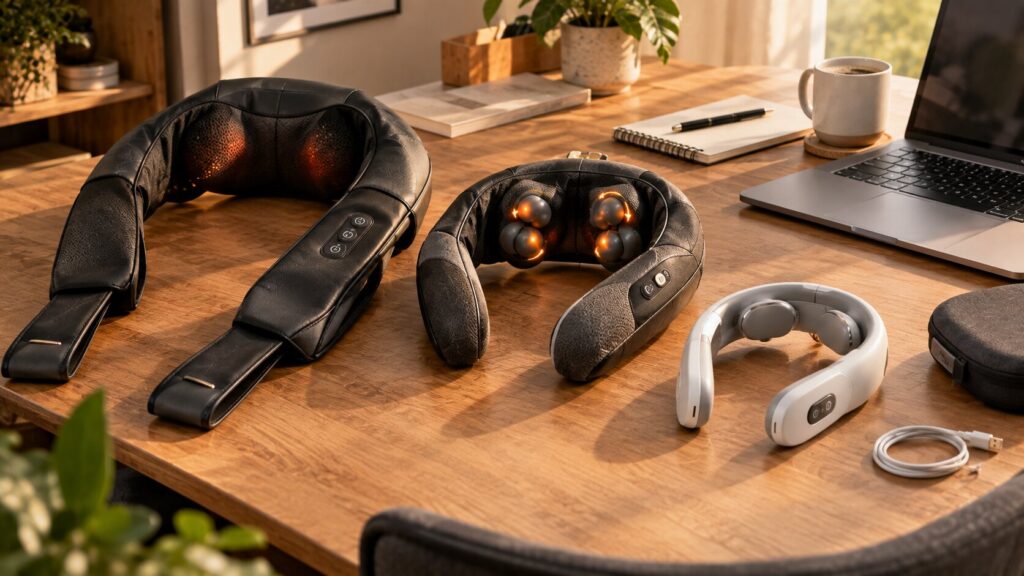
Neck massagers use different mechanisms and massage styles, and the difference can be significant. A desk worker who wants a pronounced kneading sensation may have very different preferences from someone looking for a simpler, gentler experience.
Here’s how the main options compare.
Shiatsu-Style Massage
Shiatsu-style neck massagers typically use rotating nodes designed to create a kneading or pressing sensation.
For desk workers who prefer a more pronounced mechanical massage, this is often the first type worth considering.
The main advantage is the sensation itself. Rather than simply vibrating against the skin, rotating nodes can create a more active, targeted-feeling massage.
Shiatsu-style may suit you if you:
- Prefer a stronger, more noticeable massage
- Like kneading sensations
- Want more targeted contact around the neck and shoulders
- Don’t mind a larger or heavier device
- Plan to use the massager primarily while relaxing at home
The trade-off is that some shiatsu devices can feel intense, particularly around sensitive areas or when too much body weight is applied against the nodes.
More intensity isn’t automatically better. Fit, positioning and adjustability still matter.
Vibration Massage
Vibration-based massagers use rapid movement to create a vibrating or pulsing sensation rather than the rotating kneading action associated with shiatsu designs.
They can appeal to users who want something simpler and potentially less aggressive.
Vibration may suit you if you:
- Prefer a lighter massage sensation
- Don’t particularly enjoy deep-feeling mechanical kneading
- Want a simpler device
- Prefer a smaller or more portable design
- Want something that can be used for shorter sessions
The trade-off is that vibration may not provide the same pronounced kneading sensation that attracts buyers to shiatsu-style products.
Again, this isn’t about one mechanism being objectively better.
It’s about what kind of massage you actually prefer.
Percussion-Style Massage
Some products use rapid percussive movement rather than rotating nodes or simple vibration.
This category is more commonly associated with handheld massage guns, although there are products that incorporate percussion-like movement into other designs.
For desk workers, percussion can be useful when you want to manually target a particular area, but it generally requires more involvement from the user.
A handheld device also means you have to position and hold it yourself.
That can be an advantage if you want precise control, but a disadvantage if your priority is simply sitting back and relaxing.
Kneading, Compression and Hybrid Designs
Not every neck massager fits neatly into a single category.
Some products combine multiple sensations or mechanisms, while others use compression, moving contact points or flexible designs to create a different experience.
This is where product descriptions can become particularly misleading.
A device may advertise several technologies at once, but the important question remains:
What does the device actually do when you put it on?
Look beyond the marketing terminology and check:
- How the contact points move
- Which areas they reach
- Whether intensity can be adjusted
- Whether the massage pattern changes
- Whether heat can be controlled independently
- What customers say the sensation actually feels like
Customer reviews can be particularly useful here because shoppers often describe the experience in much more practical language than manufacturers do.
So Which Massage Type Is Best for Desk Workers?
There’s no universal winner.
For many desk workers, shiatsu-style massage is the most compelling option if they specifically want pronounced kneading around the neck and shoulders.
Vibration may make more sense for someone who prefers a simpler or gentler sensation, while a handheld percussion-style device can be more appropriate for someone who wants precise control over where the massage is applied.
A simple way to think about it:
| If you want… | Consider… |
|---|---|
| Pronounced kneading | Shiatsu-style |
| A simpler sensation | Vibration |
| Manual targeting | Handheld/percussion |
| Broader coverage | Neck & shoulder design |
| A relaxing end-of-day experience | Shiatsu + optional heat |
| Portability | Compact/rechargeable design |
And remember: these categories can overlap.
An electric neck-and-shoulder massager can also use shiatsu nodes and heat. A rechargeable model can use vibration. A product can therefore belong to several categories at once.
That’s why choosing by one marketing label isn’t enough.
For a desk worker, the better approach is to start with the experience you want, then work backward into the product’s mechanism, coverage, controls and power source.
If you’re still comparing the different categories, our guide to electric vs. shiatsu vs. neck & shoulder massagers explains how these labels differ and why they can overlap.
The Bottom Line
If you sit at a computer for hours and want a massager primarily for relaxing afterward, a comfortable neck-and-shoulder shiatsu model with adjustable intensity is a strong starting point.
If you dislike strong kneading, don’t assume you need to buy one simply because it appears frequently in “best neck massager” lists. A vibration-based or lighter design may be a better match.
The best mechanism isn’t the one with the most impressive specification.
It’s the one you’ll actually want to use.
Neck-Only vs. Neck & Shoulder Coverage
One of the easiest mistakes when shopping for a neck massager is assuming that every model is designed to massage the same area.
They aren’t.
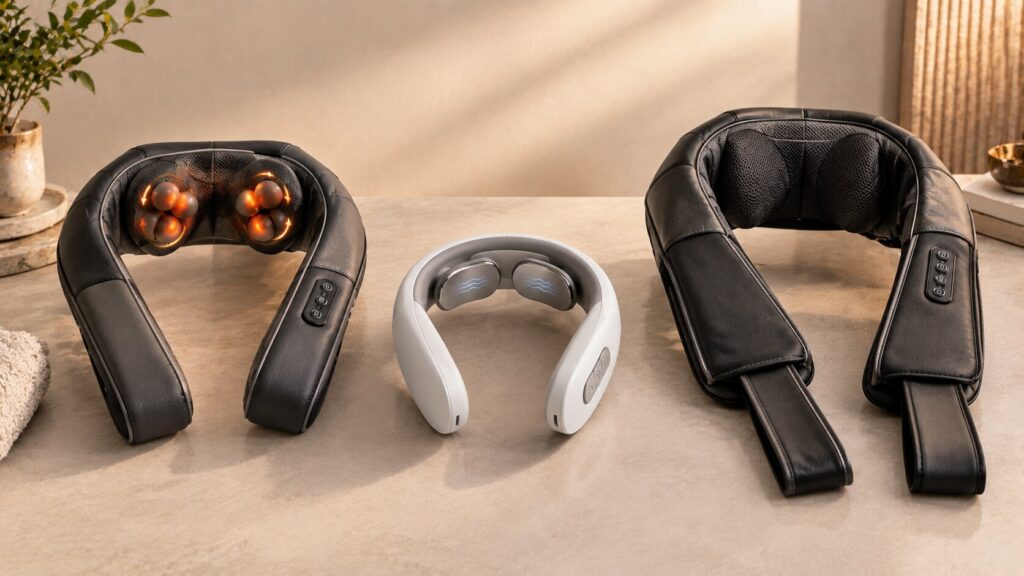
Some products concentrate primarily around the neck, while others extend downward and outward to cover the shoulders as well. For someone who spends hours sitting at a desk, that distinction can make a meaningful difference in how useful the device feels.
Neck-Only Massagers
Neck-focused designs are generally more compact and concentrate their contact around the neck area.
This can be a good choice if you want something relatively simple and don’t need broader coverage.
A neck-only design may make sense if you:
- Primarily want massage around the neck
- Prefer a smaller device
- Value portability
- Don’t want a large shoulder wrap
- Plan to use the massager for shorter sessions
The main advantage is focus and, often, a more compact form factor.
The trade-off is obvious: if you regularly want to massage the upper shoulders as well, a neck-only device may leave you wanting more coverage.
Neck & Shoulder Massagers
Neck-and-shoulder designs extend farther down from the neck, with contact areas intended to reach portions of the upper shoulders.
For people who spend much of the day sitting at a desk, this broader design can be particularly appealing because your preferred massage area may not stop at the base of your neck.
A neck-and-shoulder design may make sense if you:
- Want broader coverage
- Prefer massaging the neck and upper shoulders together
- Spend long periods sitting at a computer
- Want a device primarily for relaxing at home
- Don’t mind a somewhat larger design
The trade-off is that broader coverage often means a larger, heavier or less portable product.
That’s not necessarily a problem – especially if you’re going to use it on the sofa or in a home office – but it’s worth considering before buying.
Which Coverage Is Better for Desk Workers?
For many desk workers, neck-and-shoulder coverage is the more versatile option.
That’s particularly true if you don’t want to think of the product as a strictly “neck” device. If you’re looking for something to use after several hours at a computer, broader coverage gives you more flexibility in where the massage is applied.
But bigger coverage shouldn’t automatically win.
If you find a large massager uncomfortable, difficult to position or inconvenient to store, its theoretical coverage doesn’t matter much.
A smaller neck-focused product that you enjoy using may ultimately be the better purchase.
Don’t Judge Coverage by the Product Name
This is one area where product photography and customer reviews can be especially useful.
A product called a “neck massager” may have substantial shoulder coverage. Another may technically be marketed as a “neck and shoulder massager” but concentrate most of its contact around the neck.
Before buying, look at:
- The physical shape – where does the device actually sit?
- The contact points – where are the massage nodes or vibrating elements positioned?
- The dimensions – how large is the overall device?
- Product photographs – do they show realistic positioning on a person?
- Customer reviews – do buyers mention the shoulders, upper back or only the neck?
- Adjustability – can you change how the device sits against your body?
This is a good example of why specifications alone don’t always tell the whole story.
What About Shoulder Coverage for Computer Users?
If you’re sitting at a desk for several hours, you may naturally be interested in broader coverage rather than concentrating exclusively on the neck.
But don’t interpret that as meaning a neck-and-shoulder massager is automatically necessary.
Think about your actual routine.
If you typically finish work and relax on the sofa, a larger neck-and-shoulder device may fit that routine very well.
If you want something small enough to move between rooms or take with you, a compact neck-focused or rechargeable design may be more practical.
The right coverage depends on both your preferred massage area and how you’re going to use the product.
Neck vs. Neck & Shoulder: Quick Comparison
| Feature | Neck-Only | Neck & Shoulder |
|---|---|---|
| Main coverage | Neck | Neck + upper shoulders |
| Typical size | More compact | Usually larger |
| Portability | Often easier | Can be bulkier |
| Broader massage area | Limited | Better suited |
| Home relaxation | Good | Often excellent |
| Desk-worker appeal | Good | Often higher |
| Storage | Usually easier | May require more space |
The Bottom Line
If your goal is simply to massage your neck, a neck-focused device can be perfectly reasonable.
If you want a more versatile device for relaxing after long periods at a computer, a comfortable neck-and-shoulder design is often the more flexible choice.
Just don’t sacrifice comfort for coverage.
A massager that reaches more of your body isn’t necessarily a better massager if it’s awkward to position, too heavy or unpleasant to use.
Choose the coverage that matches your routine – not simply the product with the biggest footprint.
Heat, Intensity and Comfort
Three features appear again and again when shopping for an electric neck massager: heat, intensity and comfort.
They can all affect the experience, but they’re not equally important for every buyer.
For someone using a massager regularly after long hours at a computer, the goal shouldn’t be to find the device with the highest intensity or hottest heating element.
The goal is to find a combination that feels comfortable enough to use consistently.
Is Heat Worth It?
Heat is one of the most common extra features on electric neck massagers.
For many people, warmth simply makes the experience feel more relaxing, particularly when using a massager at the end of the day.
But heat shouldn’t be treated as a requirement.
If two otherwise similar products are available and one includes controllable heat, it may be a worthwhile bonus. But a massager with excellent fit and massage action can still be a better choice without heat.
If you do want heat, look for:
- A clearly defined heat setting
- The ability to turn heat off independently
- Customer feedback about how warm it actually feels
- A comfortable surface between the heating element and your skin
- Controls that make the heat setting easy to adjust
Marketing descriptions can make “heated” sound like a major performance feature. In practice, what matters is whether the warmth is comfortable and useful to you.
How Much Intensity Do You Need?
Intensity is highly personal.
A strong setting may appeal to someone who enjoys a pronounced shiatsu-style massage, while another person may find the same setting uncomfortable.
This is why adjustability is generally more valuable than maximum intensity.
Multiple settings give you the ability to change the experience depending on what you want from the session.
For example:
Lower intensity: useful when you want a lighter, more relaxing experience.
Medium intensity: a potential everyday setting for someone who prefers noticeable massage without going straight to the strongest option.
Higher intensity: may appeal to users who specifically enjoy a more pronounced mechanical sensation.
The important point is that these aren’t universal rules. One person’s comfortable setting can be another person’s “too much.”
Comfort Is More Important Than Maximum Power
This is especially true for desk workers.
If you’re buying a massager because you expect to use it frequently, you need to consider the device itself as part of the experience.
A massager can have impressive specifications and still be disappointing if:
- It presses awkwardly against your neck
- The weight becomes uncomfortable
- The massage nodes are poorly positioned for you
- You have to constantly adjust its position
- The controls are difficult to reach
- The device becomes unpleasant during longer sessions
This is why customer reviews can be valuable.
Look beyond comments such as “very powerful” and search for practical observations about fit, positioning, pressure, weight and comfort over time.
Those details can tell you much more about whether a product is suitable for regular use.
Heat + Intensity Should Work Together
Another useful consideration is whether the features can be controlled independently.
For example, you might like the massage action but not want heat every time. Or you might prefer a lower massage intensity when using the heating function.
A product that allows these settings to be adjusted separately gives you more flexibility.
Again, this isn’t necessarily a reason to reject a simpler model. It’s simply something worth considering if you know you’ll use the device frequently.
Think About Your Actual Routine
Imagine how you’ll use the massager on a normal weekday.
You finish several hours of computer work. You don’t necessarily want to sit down and spend ten minutes fighting with a complicated device.
You want to:
- Pick it up.
- Position it comfortably.
- Choose your preferred intensity.
- Turn heat on or leave it off.
- Relax.
That’s the standard to use when comparing products.
The best feature set is the one that makes regular use easier – not the one that makes the product description longest.
A Simple Priority Order
For most desk workers, we’d prioritize these features roughly like this:
1. Comfort and fit
If the device isn’t comfortable, the rest doesn’t matter much.
2. Adjustable intensity
Useful for accommodating different preferences and different days.
3. Appropriate coverage
Choose neck-only or neck-and-shoulder coverage based on where you want the massage.
4. Massage mechanism
Decide whether you prefer shiatsu-style kneading, vibration or another approach.
5. Heat
A useful bonus if you enjoy warmth, but not essential.
6. Convenience
Controls, power source, noise, storage and session controls can all affect how practical the device is.
That priority order is deliberately different from simply choosing the product with the most features.
For frequent users, comfort and usability usually deserve more attention than impressive specifications.
Corded vs. Rechargeable Neck Massagers
Another decision that can have a surprisingly large effect on how useful a neck massager becomes is how it gets its power.
For desk workers, the choice usually comes down to two options:
- Corded/plug-in: designed to operate from a power outlet
- Rechargeable: uses an internal battery and can be used without being connected to an outlet
Neither is automatically better. The right choice depends largely on where and how you expect to use the massager.
Corded Neck Massagers
A corded model can be an excellent fit if you’re primarily going to use your massager at home.
If your routine looks something like finish work → sit on the sofa → use the massager, there’s little practical benefit to being completely wireless.
You simply plug it in and use it.
Potential advantages include:
- No battery to recharge
- Consistent power during use
- No concern about battery capacity
- Well suited to fixed home locations
- Often convenient for longer relaxation sessions
The obvious trade-off is mobility.
You’ll need to stay within reach of a suitable outlet, and the cable can make moving around more cumbersome.
For a massager that lives beside your sofa or home-office chair, however, that may barely matter.
Rechargeable Neck Massagers
Rechargeable models make more sense when portability is a priority.
Without a power cable attached during use, you have more freedom to move between rooms or use the device away from a convenient outlet.
Potential advantages include:
- Greater freedom of movement
- Easier portability
- No cable during use
- Convenient for moving between rooms
- Useful when an outlet isn’t nearby
The trade-off is that the battery eventually needs to be charged.
That means battery capacity and charging convenience become part of the buying decision.
If you’re considering a rechargeable model, look for customer feedback mentioning actual battery life, rather than relying entirely on the manufacturer’s advertised runtime.
Which Is Better for Desk Workers?
For someone who works at a desk all day, the answer depends on where the massager will actually be used.
Choose corded if:
- You primarily use it at home
- It will live near a sofa or chair
- You don’t mind staying near an outlet
- You want to avoid battery management
- Portability isn’t important
Choose rechargeable if:
- You want to move around while using it
- You use it in multiple locations
- You value portability
- You don’t always have an outlet nearby
- You prefer a completely cable-free experience
There’s also an important distinction between working at a desk and using a massager at your desk.
You might spend eight hours at a computer but never intend to use the massager while working. Instead, your preferred routine might be using it after work while watching television or reading.
In that situation, a corded model could be perfectly practical.
Don’t Overlook the Cable
If you choose a corded massager, consider the cable itself.
A short cable can limit where you can comfortably use the device. A longer cable may give you more flexibility, particularly if your preferred chair isn’t directly beside an outlet.
This is a small specification, but it can become a daily convenience issue.
Customer reviews can help reveal whether the supplied cable is long enough for normal use.
Battery Life Matters More Than “Rechargeable”
“Rechargeable” sounds convenient, but it doesn’t tell you how convenient the product actually is.
For a battery-powered massager, consider:
- Advertised operating time
- Charging time
- Charging connection
- Whether the device can operate while charging
- How frequently you’ll need to recharge it
- What customers report about real-world battery performance
If you only use the massager for short sessions a few times per week, battery capacity may not be particularly important.
If you’re using it frequently, it becomes much more relevant.
The Simple Decision
If you’re buying a neck massager primarily for home relaxation after desk work, don’t dismiss corded models simply because rechargeable products sound more modern.
A plug-in device can be wonderfully simple: keep it where you use it, connect it to power and go.
If portability is genuinely important, however, rechargeable power can be worth the extra consideration.
Choose based on your routine, not the assumption that wireless automatically means better.
| Your priority | Better fit |
|---|---|
| Home use near an outlet | Corded |
| No battery management | Corded |
| Consistent power | Corded |
| Moving between locations | Rechargeable |
| Maximum portability | Rechargeable |
| No cable during use | Rechargeable |
| Fixed sofa/home-office routine | Either |
Ultimately, power source is a convenience decision.
The best option is the one that removes friction from the way you already live.
Recommended Neck Massagers for Desk Workers
After looking at the features that matter for desk workers, we narrowed the field to four products that offer meaningfully different strengths.
Rather than simply ranking them by star rating, we looked at massage type, coverage, power source, adjustability, convenience and recurring customer feedback.
We also paid attention to the complaints.
A product can have thousands of positive reviews and still have a recurring weakness worth knowing about before you buy.
1. Nekteck Shiatsu Neck and Back Massager with Heat – Best Overall
The Nekteck Shiatsu Neck and Back Massager with Heat is our strongest all-around pick for a desk worker who wants a traditional, more pronounced shiatsu-style massage at home.
It has 16 deep-kneading massage nodes, three speed levels, independently controllable heat and a 15-minute automatic shutoff. It’s also designed for use beyond the neck, including the shoulders, back, body and calves.
At around 3 pounds, it’s not the lightest option on this list, and it is corded rather than cordless. That makes it better suited to a home-office, sofa or other fixed location than someone looking for maximum portability.
Why we picked it
- 16 shiatsu-style massage nodes
- Three adjustable speed levels
- Heat can be switched independently
- 15-minute auto shutoff and overheat protection
- Neck, shoulder and broader body use
- Long handle straps for adjusting pressure and positioning
- PU leather and breathable mesh construction
- Included AC adapter
At the time of our research, the Nekteck listing showed 4.3 stars from more than 65,000 reviews, with 4,000+ purchases in the previous month.
Customer feedback is particularly interesting.
Positive review themes include quality, pain relief, effectiveness, value for money, heat and massage. However, there are also recurring complaints around reliability and durability, including reports from some customers that their units stopped working after relatively short periods.
That doesn’t mean every unit will fail, but the consistency of those complaints is something we’d want a buyer to know.
The product is also part of the Global Recycled Standard (GRS) program, with the listing stating that it contains at least 50% recycled material and that the supply chain is independently verified. That’s a useful secondary consideration, although it doesn’t determine our massage recommendation.
Best for: Desk workers who want a strong, traditional heated shiatsu experience and primarily plan to use the massager at home.
Main trade-off: Excellent feature set and very strong overall customer response, but reliability and durability complaints prevent us from treating it as flawless.
Check the Nekteck on Amazon → (ad)
2. RESTECK Shiatsu Massager – Best for Portability & Versatility
The RESTECK Shiatsu Massager takes a slightly different approach.
It’s still a corded shiatsu-style massager with heat, but its relatively light 14.1-ounce weight, included carrying pouch and car adapter make it particularly interesting for anyone who doesn’t want their massager permanently tied to one room.
It’s designed for whole-body use, including the neck, shoulders, back, legs, glutes, calves and feet.
For a desk worker, that versatility can be valuable. You can use it after work at home, take it into the office, or bring it along when traveling.
Why we picked it
- Shiatsu massage mechanism
- Heat adjustment
- Bidirectional kneading nodes
- Four-button control system
- Neck, shoulder, back and broader body use
- Regular power adapter plus car adapter
- Carrying pouch for storage and transport
- Much lighter than the larger pillow-style models on this list
The listing currently shows 4.5 stars from more than 53,000 reviews, with 2,000+ purchases in the previous month.
Its customer feedback is particularly strong around pain relief, effectiveness, value for money, enjoyment, heat, portability and adjustability.
Customers also specifically mention being able to control the intensity and massage direction.
Durability is more mixed. Some buyers report continued use without problems, while others say their units eventually stopped working.
That makes durability a consideration, but unlike the more pronounced reliability complaints seen with some competing models, the overall customer feedback here is notably positive.
Best for: Desk workers who want a versatile shiatsu massager that is easier to transport between home, office, car and other locations.
Main trade-off: The product is still corded during operation, and durability feedback isn’t uniformly positive.
Check the RESTECK on Amazon → (ad)
3. Etekcity FSA Cordless Neck Massager – Best Cordless Option
If not having a cable is one of your priorities, the Etekcity FSA is the most distinctive option in this group.
Unlike the traditional corded models above, it’s battery powered and rechargeable, with the manufacturer listing up to 350 minutes of use per charge.
It’s also designed specifically around the neck and shoulders, with an auto-adaptive system that detects neck width and adjusts head spacing and pressure. The stated compatible neck range is 11.8 to 16.5 inches.
There are three massage modes:
- Gentle – full-coverage relaxation
- Moderate – neck-focused comfort
- Deep – trapezius-targeted massage
It also combines the massage mechanism with heated massage heads, with the manufacturer stating a temperature range of approximately 104–113°F.
Why we picked it
- Cordless and rechargeable
- Up to 350 minutes of claimed use per charge
- Auto-adaptive fit
- Three massage modes
- Neck-and-shoulder coverage
- Heated massage heads
- Carrying bag
- Designed for use away from an outlet
The Etekcity listing shows 4.3 stars from nearly 9,000 reviews, with 800+ purchases in the previous month.
Customer feedback is positive around effectiveness, relaxation, value for money and ease of use.
However, this is also where reading the negative feedback becomes particularly important.
Customer opinions on comfort, heat and battery life are mixed, while reliability is a recurring negative theme. Some buyers report that the device is too uncomfortable to use, that the heat is difficult to notice, or that the device stopped working or failed to charge after relatively short periods.
There’s therefore a genuine trade-off here:
The feature set is significantly more flexible than a conventional corded massager, but customer feedback suggests that the experience isn’t equally positive for everyone.
Best for: Desk workers who strongly value cordless operation, portability and adjustable massage modes.
Main trade-off: The cordless design is excellent for convenience, but comfort, heat, battery and reliability feedback is mixed.
Check the Etekcity on Amazon → (ad)
4. Mo Cuishle Shiatsu Back, Shoulder & Neck Massager – Best for Broad Coverage
The Mo Cuishle Shiatsu Back, Shoulder & Neck Massager is the broad-coverage choice.
It’s a 2.2-pound wrap-around neck massager with eight shiatsu kneading nodes, three speed settings, direction control and heat.
It’s also designed for whole-body use and comes with both a home power adapter and a car charger.
For someone who spends much of the day at a desk but wants a massager that can also be used on the back, shoulders and legs, that versatility is the main attraction.
Why we picked it
- Eight shiatsu kneading nodes
- Three adjustable speeds
- Direction control
- Automatic direction change
- 15-minute automatic shutoff
- Heat function
- Neck, shoulder and back use
- Home adapter and car charger
- Long cable
- 30-day money-back period and one-year replacement stated by the manufacturer
The Amazon listing shows 4.4 stars from more than 44,000 reviews, with 10,000+ purchases in the previous month, and it currently carries an Amazon’s Choice badge.
Customer feedback is particularly positive around quality, functionality, pain relief and value for money.
But there are two recurring areas worth knowing about.
Durability is a concern. Some customers report that their units stopped working after several months or around a year.
Comfort is also mixed. While many buyers enjoy the massage, some find the pressure too hard around the neck.
Heat feedback is similarly mixed: some customers appreciate it, while others report that the heat isn’t particularly noticeable.
The product is also part of the Global Recycled Standard (GRS) program according to the current listing, with the listing stating that it contains at least 50% recycled material and meets additional supply-chain criteria.
Best for: Desk workers who want broad neck, shoulder and back coverage from a traditional shiatsu design.
Main trade-off: Excellent versatility and strong overall customer reception, but some buyers find the massage too aggressive and durability feedback is a recurring concern.
Check the Mo Cuishle on Amazon → (ad)
Which One Should You Choose?
The easiest way to narrow these down is to start with how you actually intend to use the massager.
| If your priority is… | Our pick |
|---|---|
| Best all-around traditional option | Nekteck |
| Portability and versatility | RESTECK |
| Cordless operation | Etekcity |
| Broad neck, shoulder & back coverage | Mo Cuishle |
| Strong shiatsu-style massage | Nekteck / RESTECK |
| Moving between locations | Etekcity / RESTECK |
| Fixed home use after work | Nekteck / Mo Cuishle |
Our Short Take
Want the traditional all-rounder? Start with Nekteck.
Want something lighter and easier to carry? RESTECK is particularly interesting.
Hate being tethered to a power outlet? Etekcity is the obvious choice.
Want broad coverage and don’t mind a larger device? Mo Cuishle deserves a look.
And perhaps most importantly, none of these products is perfect.
That’s worth saying because thousands of positive reviews don’t eliminate recurring weaknesses. The purpose of this guide isn’t to tell you that every product is amazing.
It’s to help you understand which trade-offs you’re making before you spend your money.
If you’re still deciding whether buying one makes sense at all, our guide to whether a neck massager is worth buying looks more closely at value, usage, features and the tradeoffs involved.
How We Evaluate Products
Our recommendations are based on more than star ratings or the number of products sold.
When we evaluate products for One Page Picks, we look at the information a buyer can realistically use to make a better decision – including product specifications, stated features, customer feedback, recurring strengths and recurring complaints.
For this guide, we paid particular attention to the factors that matter when choosing a neck massager for regular use after long periods at a desk.
1. Product Design & Intended Use
First, we look at what the product is actually designed to do.
That includes:
- Massage type and mechanism
- Neck-only vs. broader coverage
- Intended body areas
- Corded vs. rechargeable operation
- Overall size and weight
- Heat and other major functions
This helps us determine whether a product actually fits the reader’s use case rather than simply having an impressive specification list.
2. Features That Affect Everyday Use
We then consider the features that can make a meaningful difference during normal use.
Depending on the product category, this can include:
- Intensity or speed adjustment
- Direction controls
- Heat controls
- Automatic shutoff
- Portability
- Controls and ease of operation
- Charging or power requirements
- Storage and handling
We don’t automatically treat a longer feature list as a better product.
A feature only matters if it provides a useful benefit to the person buying it.
3. Customer Review Patterns
Customer reviews are an important part of our research.
Rather than relying on a handful of individual reviews, we look for recurring themes across the available customer feedback.
For example, in this guide we found repeated positive themes around effectiveness, pain relief, value, heat and massage quality across several products.
We also found recurring concerns around areas such as durability, reliability and comfort.
When we report review themes, the numbers represent the review-theme counts provided by the retailer or product-review data available to us. They are not necessarily the number of unique customers reporting an issue, nor do they represent percentages of all buyers.
That distinction matters.
4. Strengths AND Weaknesses
A recommendation shouldn’t read like an advertisement.
If a product has thousands of positive reviews but also a recurring complaint about durability, that’s useful information for a buyer.
We therefore try to identify both:
What customers like
and
What customers don’t like.
A product can still be a good choice despite a weakness if that weakness isn’t important to the particular buyer.
Conversely, a highly rated product may be a poor choice for someone whose priorities conflict with its main limitations.
5. Evidence vs. Marketing Claims
We distinguish between what a manufacturer or retailer claims a product does and what the available customer feedback suggests about the actual ownership experience.
For example, a manufacturer may describe a massage mechanism as “human-like,” “professional” or “deep tissue.”
Those are product descriptions or marketing claims – not independent conclusions from our research.
Where possible, we focus our recommendations on tangible characteristics and recurring customer experiences rather than repeating promotional language as fact.
6. Matching Products to Different Buyers
We don’t believe every category has one universally best product.
Instead, we ask:
Who is this product actually best suited for?
One buyer may prioritize cordless operation.
Another may want broad coverage.
Another may care most about a stronger shiatsu-style massage.
Another may simply want an affordable option for occasional home use.
A good recommendation therefore considers fit, not just ranking.
7. Keeping the Decision Practical
Finally, we try to answer the question that matters most:
Would this product make sense for the person reading this article?
Specifications are useful, but they don’t tell the entire story.
Weight, comfort, portability, controls, recurring complaints and the way a product fits into someone’s routine can all matter just as much.
Our goal isn’t to identify the product with the most impressive specifications.
It’s to help you spend your money with a clearer understanding of what you’re getting – and what you’re giving up.
Ready to Compare More Electric Neck Massagers?
The best neck massager for a desk worker depends less on finding the “most powerful” device and more on finding the right combination of coverage, massage style, comfort, adjustability, heat, and convenience for your routine.
The four options above cover several different priorities, but they are only a starting point. If you want to compare a broader range of electric neck massagers – including different massage mechanisms, designs, features, and price points – see our full guide:
Best Electric Neck Massagers 2026
There, we take a wider look at the options available and break down what makes each model different, including the strengths, weaknesses, and trade-offs worth considering before you buy.
For desk workers in particular, remember: the “best” massager isn’t necessarily the one with the longest feature list.
It’s the one that fits your routine well enough that you’ll actually want to use it.