
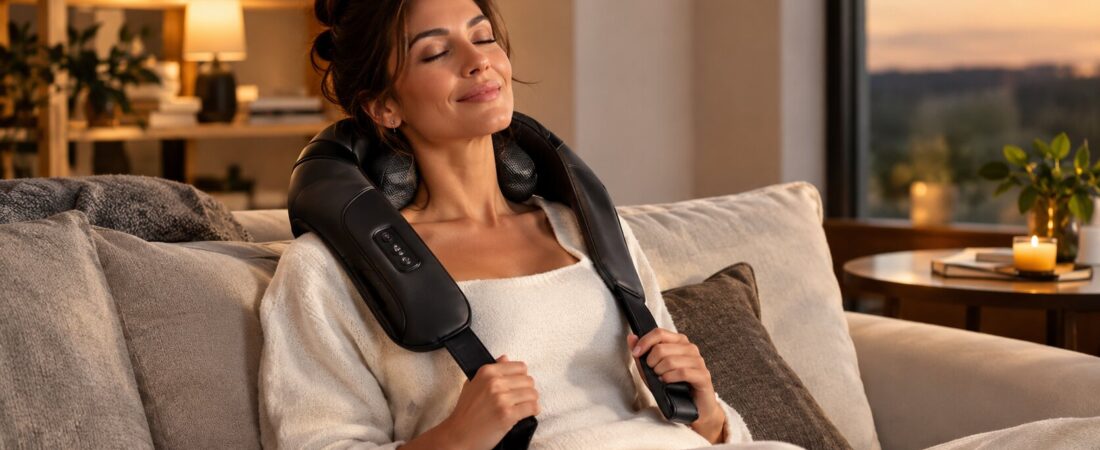
Quick Answer: What Should You Look For?
When choosing an electric neck massager, start by looking at how it massages, rather than simply counting features.
Different designs use kneading, vibration, rolling, percussion-style movements, or a combination of these, and they can feel quite different in use.
From there, consider the features that will affect how practical and comfortable the massager is for you:
- Massage type: Decide whether you prefer kneading, vibration, rolling, percussion-style massage, or a combination.
- Heat: Consider whether you actually want a warming function and whether the heat can be controlled or timed.
- Intensity and settings: More power is not necessarily better. Look for settings that give you a comfortable range of intensity.
- Coverage and fit: Check whether the design focuses on the neck or also reaches the shoulders, and whether the massage heads can sit comfortably where you need them.
- Power source: Corded models can be convenient at home, while rechargeable models offer more freedom to move around.
- Weight and ergonomics: A massager can have excellent specifications and still be unpleasant to use if it is too heavy, awkward, or difficult to position.
- Controls: Simple, accessible controls can be more useful than a complicated collection of modes you rarely use.
- Safety features: For models with heat or timed operation, check the manufacturer’s instructions and whether the device includes automatic shutoff.
- Customer reviews: Look for recurring comments about durability, noise, comfort, heat performance, battery life, fit, and reliability rather than relying on the star rating alone.
The most important point is that the best electric neck massager isn’t necessarily the one with the longest feature list or the highest intensity.
The better choice is the one whose massage style, design, settings, and features match how you actually intend to use it.
The sections below break down each of these factors so you can compare neck massagers more confidently before buying.
1. Start With the Type of Massage
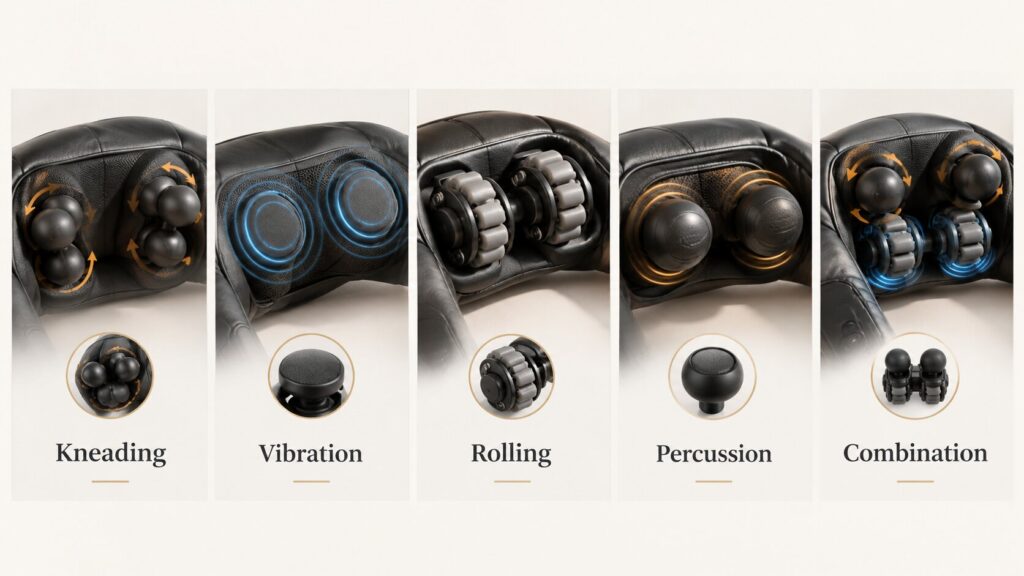
The first thing to compare when choosing an electric neck massager is the type of massage it provides. Two products can both be described as “neck massagers” while producing noticeably different sensations because their internal mechanisms work differently.
There isn’t one massage type that is automatically best for everyone. The right choice depends largely on the kind of sensation you find comfortable and how you plan to use the device.
Shiatsu and Kneading
Shiatsu-style and kneading massagers typically use rotating massage heads or nodes that move against the body. Depending on the design, the heads may rotate in different directions or apply pressure at multiple points.
This type of mechanism can provide a more pronounced, mechanical massage sensation compared with simple vibration. Some models are designed to mimic the general motion of kneading by hand, although the experience will naturally differ from a person providing a massage.
Consider a kneading-style massager if you prefer: a more noticeable, pressure-based massage sensation and a device that actively moves against the muscles rather than simply vibrating.
One thing to pay attention to is how the massage heads are positioned. A device with an impressive-looking number of massage nodes isn’t necessarily more comfortable or effective if those nodes don’t sit well against your neck and shoulders.
Vibration
Vibration massagers use rapid movements to create a vibrating or buzzing sensation rather than the rotating pressure associated with kneading mechanisms.
Vibration can feel less pronounced than mechanical kneading, although the experience varies considerably between products. Different devices can also use different vibration speeds or patterns.
If you’re comparing vibration-based models, look beyond the simple claim that a product has “multiple vibration modes.” Check whether the controls actually allow you to adjust the intensity or choose between noticeably different settings.
The key question is whether you prefer a vibrating sensation or the more active pressure of a kneading mechanism.
Rolling
Rolling massagers use moving massage components that travel or rotate along a defined path. Rather than concentrating entirely on a single point, the movement is intended to create a more continuous massage sensation.
The exact experience depends heavily on the product’s construction and the path of the rollers. As with other massage types, positioning matters: a rolling mechanism may sound appealing in a specification list but be less useful if the device doesn’t fit your body comfortably.
When comparing rolling models, look at where the rollers actually make contact, how much of the neck and shoulder area they cover, and whether the design allows you to maintain a comfortable position while using the device.
Percussion-Style
Percussion-style massagers use repeated tapping or pulsing movements rather than continuous kneading or vibration.
This mechanism is more commonly associated with handheld percussion devices, but some products marketed for the neck and shoulders incorporate a percussion-like action into their design.
Because the sensation can be more pronounced, comfort and intensity control are particularly important. A product described as “powerful” isn’t necessarily the better choice if its lowest setting is already more intense than you prefer.
When considering a percussion-style neck massager, pay close attention to the manufacturer’s instructions regarding where and how the device should be used.
Combination Systems
Some electric neck massagers combine several features or massage mechanisms in one device. For example, a product may offer kneading alongside heat, vibration, or multiple massage patterns.
Combination systems can be appealing if you want flexibility, but more features don’t automatically make a product better.
Think about which functions you would realistically use. If you only want a simple kneading massage, paying extra for several modes you never use may not provide much additional value.
It’s also worth distinguishing between different massage mechanisms and different settings of the same mechanism. A product advertising five “modes” may not necessarily provide five fundamentally different types of massage.
So Which Massage Type Is Best?
Rather than choosing based on a manufacturer’s claim that one mechanism is superior, start with your own preference.
If you like a more active, pressure-based sensation, you may want to explore kneading or rolling designs. If you prefer a simpler vibrating sensation, a vibration-based model may be more appropriate. Combination models offer greater variety, but they can also introduce additional controls, weight, or cost.
The goal isn’t to find the massager with the most impressive specification sheet. It’s to find the massage mechanism and design that you’ll actually find comfortable and useful.
If you’re still comparing the different types of electric neck massagers, our guide to Electric Neck Massager vs Shiatsu Neck Massager vs Neck & Shoulder Massager: Which Type Is Best? breaks down the main differences and what each design is intended to offer.
2. Consider Heat
Heat is one of the most common features you’ll see when comparing electric neck massagers, but it shouldn’t automatically be treated as a sign that one product is better than another.
A heating function adds a warming sensation alongside the massage, which some people may find more comfortable or relaxing. However, the usefulness of heat depends on personal preference and how you intend to use the massager.
What Does Heat Actually Add?
A heated neck massager uses an integrated heating element to warm part of the device during operation. The exact temperature, heating area, and heating time can vary considerably between models.
For some buyers, this is a major reason for choosing one product over another. Others may have little interest in heat and would rather have a simpler device.
It’s therefore worth treating heat as a feature to evaluate, not a box that must be ticked.
Look at How the Heat Is Controlled
If heat is important to you, don’t stop at the words “with heat” in the product title.
Check what the manufacturer actually specifies about the heating function. Depending on the model, you may find:
- A dedicated heat on/off control
- Different heat settings
- A fixed heating level
- A defined operating time
- Automatic shutoff
- Heat that can be used independently of the massage function
These differences can matter more than simply having a heating element.
For example, someone who wants occasional gentle warmth may value independent heat control, while another buyer may simply want a basic massage device and have no need for additional settings.
Don’t Assume More Heat Is Better
A common mistake when comparing products is assuming that a higher temperature or more powerful heating function automatically means a better experience.
It doesn’t.
Comfort matters, particularly because the device is being used around a relatively sensitive area of the body. The manufacturer’s stated operating instructions should always take priority over assumptions based on marketing descriptions.
Be particularly cautious with phrases such as “deep heat” or “professional heat.” These are descriptions used in product marketing and don’t, by themselves, tell you how useful or comfortable the heating function will be.
Heat and Automatic Shutoff
If a neck massager includes heating, automatic shutoff is a feature worth checking.
A timer can limit how long the device operates continuously and can be particularly useful if you tend to become distracted while using it.
Don’t assume that every model operates in the same way, though. Check the manufacturer’s specifications and instructions to determine whether the heat function, massage function, or both are subject to an automatic timer.
Is a Heated Neck Massager Worth It?
That depends on what you want from the device.
If you specifically enjoy a warming sensation alongside massage, heat may be a worthwhile feature to prioritize. If you’re primarily interested in the massage mechanism itself, there’s no reason to choose a product solely because it includes heating.
When comparing two otherwise similar neck massagers, consider whether you’ll actually use the heat often enough to justify paying more for it.
The best feature set is the one that fits your preferences—not necessarily the one with the longest list of extras.
3. Look at Intensity & Settings
When comparing electric neck massagers, it’s easy to assume that a product with more intensity levels or a more powerful motor must be the better choice. In practice, having more power is only useful if you can control it comfortably.
A good range of settings can make a massager more versatile, particularly when you don’t always want the same level of intensity.
Why Intensity Matters
Different people have different preferences when it comes to massage pressure and sensation. One person may prefer a gentle setting, while another may want a more pronounced mechanical massage.
This is why a single fixed intensity can be limiting.
If a massager offers adjustable intensity, you can potentially choose a setting that suits you rather than being stuck with whatever level the manufacturer selected.
When comparing products, look for the actual range of adjustment, rather than simply counting the number of settings.
More Settings Don’t Necessarily Mean More Choice
A product advertising six or eight massage modes may sound more versatile than one with three settings, but the numbers don’t tell the whole story.
Several settings may produce only minor variations in sensation. Conversely, a simpler device with a well-designed low, medium, and high setting may provide all the adjustment you actually need.
Don’t confuse quantity of settings with quality of control.
The useful question is:
Can I easily find a setting that feels comfortable for me?
Look at the Lowest Setting Too
When manufacturers emphasize power, they tend to highlight the strongest setting. For many buyers, however, the lower settings may be just as important.
A massager that can operate gently gives you more flexibility than one that starts at an intensity you find uncomfortable.
This is particularly worth considering if you’re sensitive to pressure or simply prefer a lighter massage sensation.
If customer reviews repeatedly mention that a device is difficult to use comfortably even on its lowest setting, that’s potentially more useful information than a product listing describing its motor as “powerful.”
Consider How the Settings Work With the Massage Type
Intensity isn’t independent of the massage mechanism.
A strong vibration and strong kneading sensation won’t necessarily feel the same, even if both products are described as having a “high” setting.
Likewise, a device with rotating massage heads may feel more intense depending on how firmly it is positioned against the body.
This is another reason not to compare products using specifications alone. The same number on two different devices can represent very different experiences.
Don’t Chase Maximum Power
A powerful motor can be useful, but maximum intensity shouldn’t be the deciding factor unless you specifically want that type of experience.
A better approach is to look for usable adjustability.
Ask:
- Does it have a setting I find comfortable?
- Can I increase or decrease the intensity easily?
- Are the controls accessible while I’m using it?
- Does the device maintain its performance across different settings?
- Do recurring customer reviews mention uncomfortable intensity or weak settings?
The answers to those questions are more informative than a manufacturer’s claim that the device is exceptionally powerful.
Find the Range You’ll Actually Use
Ultimately, intensity settings are about flexibility.
If you expect to use your electric neck massager regularly, a useful range of comfortable settings is generally more valuable than a specification designed to make the product sound powerful.
Don’t ask which massager is the strongest. Ask which one gives you the level of intensity you actually want.
4. Check the Coverage
An electric neck massager can have an impressive list of features and still be a poor fit if it doesn’t reach the areas you actually want to massage.
Before comparing individual models, consider how much of the neck and shoulder area you want the device to cover and how its massage heads are positioned.
Neck-Only vs. Neck-and-Shoulder Designs
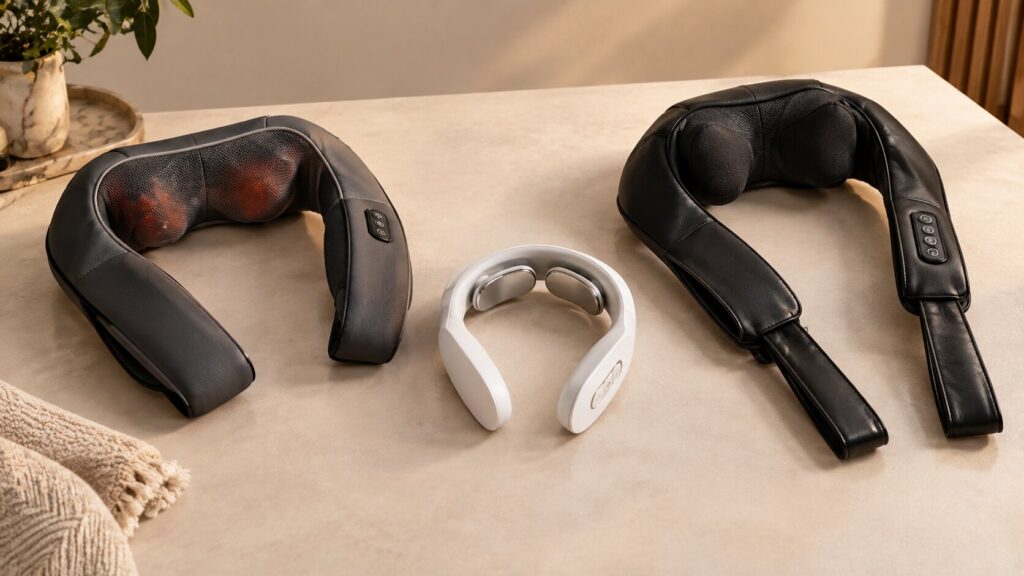
Some electric massagers are designed primarily around the neck, while others use a larger wraparound shape intended to make contact with the shoulders as well.
Neither design is automatically better.
A more compact neck-focused device may appeal to someone who wants a smaller, more targeted product. A larger design may be preferable if you specifically want the device to extend onto the upper shoulder area.
Look carefully at the product’s dimensions and design rather than relying solely on phrases such as “full coverage” or “360-degree massage.”
Pay Attention to Massage-Head Placement
The location of the massage heads can be just as important as the number of heads.
A product might advertise several massage nodes, but what matters is where those nodes actually make contact when the device is positioned around your neck.
Look for product images, diagrams, and specifications that show the intended contact areas. Customer reviews can also be useful here, particularly if multiple people mention that the massage heads sit too high, too low, too far apart, or otherwise don’t line up comfortably.
Fit Can Change the Massage Experience
Neck massagers aren’t one-size-fits-all in practice.
The shape of your neck and shoulders, the size of the device, and the way it sits against your body can all affect how the massage feels.
A device that fits one person comfortably may feel awkward to someone else.
This is especially relevant for wraparound designs. Check whether the product has handles, straps, adjustable positioning, or another way of controlling how firmly it sits against the body.
Consider How You Need to Position It
Think about how much effort is required to keep the massager in the right position.
Some designs can rest around the neck and shoulders, while others may require you to hold or reposition them during use.
If you expect to use the device while sitting at a desk, relaxing on a sofa, or reading, this can make a meaningful difference to how practical it is.
A product that provides the right coverage but constantly needs repositioning may become less appealing with regular use.
Look Beyond Marketing Terms
Terms such as “full body,” “360-degree,” “deep coverage,” and “shoulder massage” can sound impressive, but they don’t tell you exactly where the device makes contact.
Instead, look for concrete information:
- Where are the massage heads positioned?
- How wide is the device?
- Does it actually reach the shoulders?
- Can the position be adjusted?
- Does the manufacturer show the intended contact area?
- Do customer reviews consistently mention problems with fit or positioning?
These details give you a much clearer picture than a marketing label alone.
Choose Coverage Based on How You’ll Use It
The right amount of coverage ultimately depends on your priorities.
If you’re mainly interested in the neck, a compact design may be sufficient. If you want the device to reach the upper shoulders as well, a larger wraparound model may make more sense.
Don’t automatically choose the model with the widest advertised coverage. Choose the design that puts the massage where you actually want it and stays comfortable while you’re using it.
5. Think About How You’ll Power It
The power source is easy to overlook when comparing electric neck massagers, but it can have a surprisingly large effect on how convenient a device is to use.
Most models fall into one of two categories: corded or rechargeable. The better option depends less on the technology itself and more on where and how you expect to use the massager.
Corded Neck Massagers
Corded models need to remain connected to a power outlet while operating.
The main advantage is simplicity. You don’t need to remember to charge a battery, and you can continue using the device whenever a suitable power source is available.
The trade-off is that you’re restricted by the location of the outlet and the length of the power cable. This may not matter if you plan to use the massager in one place, such as on a sofa near a wall outlet.
When comparing corded models, consider whether the included cable is long enough for your intended setup and whether the power connection is positioned conveniently.
Rechargeable Neck Massagers
Rechargeable models contain a built-in battery that can be charged before use.
Their biggest advantage is freedom from a power cable during operation. This can make them more convenient if you want to move between rooms or use the massager somewhere without easy access to an outlet.
However, rechargeable models introduce another specification to consider: battery performance.
Look for information about:
- Charging time
- Claimed operating time
- Charging method
- Battery indicator or remaining-charge display
- Whether the massager can be used while charging, if this is important to you
Keep in mind that manufacturer battery-life figures are typically based on particular usage conditions. Real-world runtime can vary depending on factors such as intensity and whether other features, such as heat, are being used.
Think About Where You’ll Use It
The simplest way to decide between corded and rechargeable is to picture your normal routine.
If the massager will stay beside your sofa and there’s an outlet nearby, a corded model may be perfectly practical.
If you want to use it in different rooms or don’t want a cable running to an outlet, rechargeable operation may be more convenient.
Neither power source is inherently superior. Convenience comes from matching the power design to your actual use case.
Don’t Overvalue Battery Claims
A large battery number or impressive runtime claim can make a rechargeable product look attractive, but it’s worth putting the figure into context.
Ask how long you realistically need the device to operate between charges.
For example, if you typically use a massager for short sessions, an exceptionally long claimed runtime may not be particularly important. On the other hand, frequent users may place more value on battery capacity and charging convenience.
Customer reviews can also reveal whether the advertised battery performance seems consistent with people’s experiences.
Consider the Charging Experience
For rechargeable models, the charging process itself is part of the product experience.
A massager that takes a long time to charge may be inconvenient if you regularly forget to recharge it. Similarly, an unclear battery indicator can make it difficult to know when the device needs charging.
Small details such as these may not appear prominently in an Amazon product title, but they can become important when you’re using the product regularly.
Which Power Source Should You Choose?
Choose based on convenience rather than assuming one is better.
A corded model may suit you if:
- You’ll mainly use it in one location.
- There’s a convenient outlet nearby.
- You don’t want to manage battery charging.
- Portability isn’t particularly important.
A rechargeable model may suit you if:
- You want to use it away from an outlet.
- You prefer not to have a cable attached while using it.
- You move between different locations.
- You’re comfortable keeping the battery charged.
The best power source is ultimately the one that makes you more likely to use the massager regularly. A feature doesn’t add much value if it makes the product less convenient for the way you actually live.
6. Don’t Ignore Weight & Ergonomics
When comparing electric neck massagers, it’s natural to focus on the motor, massage modes, heat, and other headline features. But there’s another factor that can determine whether you actually enjoy using the device: how it feels to hold and position.
A neck massager is something you may wear around your shoulders, hold in place, or reposition during use. Even a feature-rich model can become frustrating if its weight or design makes it uncomfortable to use.
Check the Weight
Weight matters because the device is being supported by your body or your hands while it operates.
A heavier massager isn’t necessarily a better-built massager, just as a lighter one isn’t automatically better. The important question is whether the weight is distributed in a way that feels manageable.
Pay particular attention to:
- The overall weight of the device
- Where the motor and massage components are positioned
- Whether the device rests on your shoulders or needs to be held
- Whether you need to maintain a particular position while using it
A few extra ounces or grams may not seem significant on a product page, but they can become much more noticeable during a longer session.
Look at the Shape and Pressure Distribution
The shape of a neck massager can affect both comfort and how securely it stays in position.
Wraparound models, for example, may distribute their weight across the neck and shoulders, while other designs may concentrate more of their weight in one area.
Look at product photographs from several angles and consider how the device is intended to sit on the body.
If the manufacturer provides dimensions, compare them with the approximate size of the area where you expect to use the massager. This can help you identify products that may be unusually large or compact before purchasing.
Consider the Handles
Some neck massagers include handles that extend downward from the main body.
These can serve more than just an aesthetic purpose. Depending on the design, handles may allow you to:
- Adjust the position of the massage heads
- Control how firmly the device sits against the body
- Hold the massager more securely
- Reposition it without touching the massage components
If a device requires you to hold it continuously, consider whether the handles are positioned comfortably and whether you can operate them without putting unnecessary strain on your hands or arms.
Think About Long-Term Comfort
A product may feel perfectly manageable for a few minutes but become less comfortable during repeated or longer use.
This is where customer reviews can be particularly useful.
Rather than looking for one person’s opinion about whether a product is “lightweight,” look for recurring comments about:
- Shoulder or neck pressure from the device itself
- Awkward positioning
- Difficult-to-use handles
- The device slipping out of place
- Needing to hold it continuously
- Discomfort during longer sessions
Repeated comments are generally more informative than a single isolated review.
Ergonomics Matter More Than a Feature List
Ergonomics essentially comes down to how well the product works with the person using it.
A massager can have several intensity levels, multiple modes, heat, a rechargeable battery, and an impressive motor, but those features don’t matter much if the device is awkward to position.
This is particularly important when comparing products that look similar in specifications. A small difference in shape, weight distribution, or control placement may make one much easier to use regularly.
Ask How Much Effort the Device Requires
Before choosing a model, consider what you’ll actually have to do while it’s operating.
Can you simply place it around your neck and relax?
Do you need to hold it in position?
Will you need to adjust the pressure manually?
Can you reach the controls without removing it?
The less attention a well-designed device requires during normal operation, the easier it may be to incorporate into your routine.
Ultimately, comfort and usability should be considered alongside the technical specifications. The most powerful or feature-packed electric neck massager isn’t necessarily the one you’ll enjoy using most. A design that feels balanced, stays in position, and is easy to handle can be far more valuable in everyday use.
7. Look at the Controls
Controls might not seem like an important part of choosing an electric neck massager, but they’re something you’ll interact with every time you use the device.
A massager can have an impressive range of settings, but those settings aren’t particularly useful if they’re difficult to access or understand. Good controls should make the device easier to use, not turn a simple massage into a learning exercise.
Check What You Can Control
Start by looking at the functions the controls actually provide.
Depending on the model, you may be able to control:
- Power
- Massage intensity
- Massage mode
- Heat
- Direction or pattern of movement
- Timer or automatic shutoff
Not every device needs all of these controls. The important thing is whether the available controls give you enough flexibility for the way you intend to use the massager.
Simple Controls Can Be a Feature
More buttons and more modes can make a product look more sophisticated, but complexity doesn’t necessarily improve the experience.
If you mainly want to switch the device on, adjust the intensity, and turn the heat on or off, a straightforward control panel may be all you need.
A simpler interface can also make it easier to change settings without stopping the massage or reaching for a phone or remote.
Don’t confuse more controls with better controls.
Consider Where the Controls Are Located
The physical location of the controls matters just as much as what they do.
For a wearable or wraparound neck massager, controls located directly on the device may be convenient if they’re within easy reach. A remote can provide more flexibility, but it also introduces another item to keep nearby.
Think about whether you can comfortably:
- Turn the device on and off
- Adjust the intensity
- Change modes
- Control the heat
- Stop the device quickly
Ideally, you shouldn’t have to remove or reposition the massager simply to make a basic adjustment.
Look for Clearly Labeled Functions
Controls should be reasonably easy to understand.
Symbols, buttons, and labels that are unclear can become frustrating, particularly if you need to refer back to the instructions every time you want to change a setting.
When comparing products, look at photographs of the control panel and read the product description carefully. Customer reviews can also reveal whether buyers consistently find the controls intuitive or confusing.
Don’t Forget the Timer
If the device includes a timer or automatic shutoff, check how that function works.
Some products may operate for a predetermined period, while others may provide different timing options. The exact behavior varies between models, so check the manufacturer’s specifications rather than assuming all automatic shutoff systems work in the same way.
A timer can also be convenient if you don’t want to keep track of how long the device has been operating.
Think About Your Normal Use
The best control system is ultimately the one that fits naturally into your routine.
If you’ll use the massager while sitting on the sofa, controls on the device may be perfectly convenient. If you expect to use it while relaxing in bed or in another position where the buttons are difficult to reach, a remote or differently positioned controls may be more practical.
Before buying, ask yourself:
Can I operate the features I care about without interrupting what I’m doing?
If the answer is yes, the controls are probably doing their job.
A good electric neck massager doesn’t need a complicated interface. It needs controls that are accessible, understandable, and appropriate for the features the device actually offers.
8. Check Safety & Automatic Shutoff
Safety features aren’t usually the most exciting part of an electric neck massager, but they’re worth checking before you buy—particularly when the device includes heat, a rechargeable battery, or a motor that operates for an extended period.
Rather than assuming that every massager works in the same way, check the manufacturer’s instructions and specifications for the model you’re considering.
Look for Automatic Shutoff
Automatic shutoff is a useful feature to understand when comparing electric neck massagers.
A device with an automatic timer will stop operating after a specified period rather than continuing indefinitely. The exact timing varies between products, so check the manufacturer’s documentation rather than assuming every model uses the same operating cycle.
For a buyer, the main benefit is convenience: you don’t have to keep track of the operating time yourself.
Pay Particular Attention to Heated Models
If a neck massager includes heat, check how the heating function is controlled and whether it has its own timer or automatic shutoff.
Look for information about:
- Whether heat can be switched on and off independently
- Whether the heat level can be adjusted
- How long the heating function operates
- Whether the device automatically shuts off
- Any temperature or usage guidance provided by the manufacturer
A heating function should be treated as one component of the product rather than assuming that all heated massagers operate identically.
Follow the Manufacturer’s Instructions
Every electric neck massager has its own operating instructions, limitations, and warnings.
Read the manufacturer’s guidance before using the device, particularly if you’re unfamiliar with the design. Pay attention to instructions covering operating time, charging, cleaning, storage, heat, and any areas where the manufacturer says the product should or should not be used.
This is also a good reason to keep the instruction manual rather than immediately throwing it away after opening the box.
Check the Power and Charging Components
For corded models, inspect the power cable and connections before use. For rechargeable models, use the charging equipment and method specified by the manufacturer.
If a cable, charging port, battery housing, or other electrical component appears damaged, don’t assume it is safe to continue using the device.
For rechargeable products in particular, battery-related information can be worth checking before purchase. Customer reviews may also reveal recurring complaints about charging problems or batteries that stop functioning properly.
Don’t Confuse Safety Features With Medical Protection
An automatic shutoff is a useful product feature, but it doesn’t mean the device is appropriate for every person or situation.
Likewise, statements such as “therapeutic,” “professional,” or “pain relief” in a product listing shouldn’t be interpreted as a guarantee that the device is suitable for a particular health problem.
If you have an injury, persistent pain, a medical condition, or another health concern, don’t rely on a product listing to determine whether using a massager is appropriate. Follow the manufacturer’s safety guidance and seek advice from a qualified healthcare professional when appropriate.
What Should You Check Before Buying?
Before purchasing an electric neck massager, look for clear information about:
- Automatic shutoff or operating timers
- Heat controls and limitations
- Charging and power requirements
- Manufacturer safety instructions
- Any stated usage restrictions
- Battery or electrical specifications where applicable
You don’t need to choose the product with the longest list of safety-related features. You want clear instructions, sensible operating controls, and a design you understand how to use safely.
Safety isn’t a marketing feature to maximize. It’s a basic part of deciding whether a product is suitable for your intended use.
9. Read Reviews Properly
Customer reviews can tell you things a product specification sheet can’t – but only if you know how to read them.
A 4.5-star rating might make a neck massager look appealing at first glance, but the overall number doesn’t tell you why people like or dislike the product. A more useful approach is to look for recurring themes across the reviews.
Amazon itself provides tools that can help shoppers do this, including review highlights, star-rating filters, recent-review sorting, verified-purchase filters, and review search for specific topics.
Don’t Just Look at the Star Rating
The overall rating is a useful starting point, but it shouldn’t be the end of your research.
Two products with similar ratings can have very different strengths and weaknesses.
For example, one massager might receive praise for its comfortable design but criticism for battery life. Another might have excellent battery performance but repeated complaints about noise or uncomfortable pressure.
The star rating won’t necessarily make those differences obvious.
Instead, use the rating to decide whether a product deserves a closer look, then use the written reviews to understand what customers are actually experiencing.
Read the Negative Reviews
One of the quickest ways to identify potential problems is to look beyond the positive reviews.
You don’t need to assume that every one-star review represents a genuine product defect. Individual experiences can be affected by personal expectations, incorrect use, shipping problems, or circumstances that don’t apply to everyone.
What matters is whether the same complaint appears repeatedly.
If several unrelated customers mention that a massager is unusually loud, difficult to position, stops charging, or doesn’t produce much heat, that pattern deserves more attention than a single isolated complaint.
Negative reviews can therefore be useful not because they’re automatically more truthful, but because they can reveal potential failure points that aren’t obvious from the product description.
Look for Recurring Patterns
This is probably the most important rule when reading product reviews:
Look for patterns, not individual opinions.
Imagine you find the following:
- One person says the device is noisy.
- One person says the battery is poor.
- One person says the heat isn’t strong enough.
- One person says it stopped working after a month.
Those are individual complaints.
But if dozens of customers independently mention the same issue, the information becomes much more significant.
A recurring pattern might look like:
Durability: Multiple buyers report the device failing after several months.
Noise: Several reviewers describe the motor as louder than expected.
Heat: Multiple customers say the heating function is weaker or stronger than they anticipated.
Comfort: Several people mention uncomfortable pressure or awkward positioning.
Battery life: Rechargeable models receive repeated complaints about runtime or charging.
Fit: Buyers consistently report that the massage heads don’t sit comfortably in the intended position.
Reliability: Different customers describe similar problems with controls, motors, charging, or other components.
The goal isn’t to find a product with zero negative comments. The goal is to understand which problems appear repeatedly and whether those problems matter to you.
Pay Attention to Recent Reviews
A product’s current customer experience may not be identical to its experience a year or two ago.
Manufacturers can change components, suppliers, designs, packaging, or other aspects of a product over time. That’s why recent feedback can be particularly useful when you’re evaluating a product that has been available for a long time.
Amazon notes that recency is one of the factors considered in its overall star-rating system, and shoppers can sort reviews by “Most recent” to examine newer feedback directly.
This doesn’t mean older reviews should be ignored. Instead, compare the two.
If an older group of reviews repeatedly complained about a particular problem but recent reviews no longer mention it, that may be worth investigating further. Conversely, a problem appearing consistently in recent reviews deserves attention even if the product has thousands of older positive ratings.
Use Review Filters and Search
You don’t necessarily have to scroll through hundreds or thousands of reviews manually.
Use the tools available on the product page to narrow the information down.
For example, you can look separately at:
- 1-star and 2-star reviews
- 4-star and 5-star reviews
- Most recent reviews
- Verified-purchase reviews
- Reviews containing specific terms or topics
Amazon currently allows shoppers to filter reviews by star rating and verified purchase, sort by recent or top reviews, and search reviews for specific information.
For a neck massager, useful search terms might include:
“heat”
“battery”
“noise”
“comfortable”
“heavy”
“shoulder”
“neck”
“charging”
“stopped working”
“fit”
You can then see whether a particular issue appears occasionally or repeatedly.
Read Reviews for Context, Not Just Conclusions
A review saying “terrible product” doesn’t tell you very much.
A review explaining that the device was comfortable, but the battery lasted only a few sessions before requiring another charge, gives you considerably more useful information.
Amazon itself notes that specific reviews with context are more useful to shoppers than vague statements.
When reading a review, ask:
What happened?
How was the product being used?
What specifically did the customer like or dislike?
Is the complaint relevant to how I intend to use the product?
That last question is particularly important.
A buyer who dislikes a massager because it isn’t powerful enough may be describing a problem for them, while someone who prefers gentle massage might consider exactly the same characteristic a benefit.
Look at Photos and Videos When Available
Customer-uploaded photos and videos can provide another layer of information.
They may help you see:
- The actual size of the product
- How it sits around the neck
- The appearance of the materials
- How the controls are positioned
- How the device compares with the manufacturer’s promotional images
Visual evidence isn’t automatically proof that a product is good or bad, but it can provide useful context that a written specification doesn’t.
Be Careful With “Verified Purchase”
A verified-purchase indicator can be useful because it provides additional context about how the review was generated, and Amazon says its rating system gives greater weight to reviews from verified purchasers.
But don’t treat the label as a substitute for reading the review itself.
A verified purchase doesn’t tell you whether the reviewer used the product in the same way you intend to use it, whether their expectations were realistic, or whether their experience represents a broader pattern.
Use it as one piece of evidence, alongside the review’s detail, date, context, and relationship to other reviews.
Don’t Assume Every Complaint Means the Product Is Bad
This is an important distinction.
Almost any popular product will have some negative reviews. A customer may dislike something that another customer considers perfectly acceptable.
For example, complaints about strong massage pressure may actually indicate that a product is well suited to someone who prefers a more pronounced sensation.
Similarly, a complaint about a short battery life might be irrelevant if you plan to use the device beside an outlet.
Instead of asking:
“Does this product have negative reviews?”
ask:
“Are there recurring problems that would matter to me?”
That question produces a much more useful buying decision.
The Five-Minute Review Check
If you don’t want to spend an hour researching every product, use a simple process.
1. Check the overall rating.
Use it as a starting point, not a final verdict.
2. Read several recent reviews.
Look for what current customers are experiencing.
3. Check the lower-rated reviews.
Look for recurring complaints rather than isolated frustrations.
4. Search for the features you care about.
For a neck massager, that might include heat, noise, battery, comfort, fit, or durability.
5. Look for patterns.
If the same issue appears repeatedly across different reviews, take it seriously.
6. Decide whether the pattern matters to you.
A genuine weakness isn’t necessarily a deal-breaker if it doesn’t affect how you intend to use the product.
This approach takes much less time than reading every review, while giving you a much better understanding of the product than simply looking at its star rating.
What Should You Actually Be Looking For?
When comparing electric neck massagers, pay particular attention to recurring comments about:
- Durability: Does the device continue working reliably over time?
- Noise: Is the motor quiet enough for the intended environment?
- Heat performance: Do customers find the heating function useful and consistent?
- Comfort: Does the device remain comfortable during use?
- Battery life: Does real-world runtime seem reasonable for rechargeable models?
- Fit: Does the massager sit comfortably and position its massage heads appropriately?
- Reliability: Are there repeated complaints about charging, controls, motors, or other components?
You don’t need to find unanimous agreement. You’re looking for signal within the noise.
One negative review can be an individual experience. Ten or twenty customers describing the same problem in different words is a pattern worth investigating.
And that’s ultimately the most useful way to read product reviews: not as a collection of opinions, but as a source of recurring real-world information that helps you understand what the product is actually like to own.
10. Decide What Actually Matters to You
After comparing massage types, heat, intensity, coverage, power, ergonomics, controls, and reviews, it’s easy to end up with a long list of specifications without knowing which ones should actually influence your decision.
The simplest solution is to prioritize the features that match the way you intend to use the massager.
There is no universal checklist that makes one electric neck massager the right choice for everyone. A feature that matters enormously to one buyer may be completely unnecessary to another.
Start With Your Main Priority
Before comparing individual products, identify what you actually want from the device.
Are you primarily looking for:
- A particular type of massage?
- Adjustable intensity?
- A warming function?
- Neck and shoulder coverage?
- A compact design?
- Cordless convenience?
- Simple controls?
- Something you can use regularly without much setup?
Knowing your priority makes it much easier to ignore features that don’t contribute much to your decision.
Separate Must-Haves From Nice-to-Haves
A useful way to compare products is to divide features into two groups.
Must-haves are the characteristics you genuinely need.
Nice-to-haves are features that would be convenient but aren’t essential.
For example, you might decide that rechargeable operation and adjustable intensity are essential, while multiple massage modes and a remote control are merely nice extras.
This prevents a product from winning your attention simply because it has a longer feature list.
Consider How Often You’ll Use It
Think beyond the initial purchase.
If you expect to use an electric neck massager regularly, comfort, ease of use, durability, and convenient controls may deserve more weight in your decision.
If you’re buying one primarily for occasional use, you may place greater emphasis on price, simplicity, or portability.
The more frequently you’ll use a product, the more important its everyday usability becomes.
If you spend much of your day sitting at a desk, you may also want to see our guide to Best Neck Massagers for People Who Sit at a Desk All Day, which focuses on the features and practical considerations that matter for that particular use case.
Decide What You’re Willing to Pay More For
Higher-priced models often include additional features, but that doesn’t mean every extra feature represents good value for you.
Before comparing prices, decide which features you’re actually willing to pay for.
For example, you might be happy to spend more for:
- A rechargeable battery
- Better intensity adjustment
- A more comfortable design
- Heat
- Broader neck-and-shoulder coverage
But if you have no interest in a particular feature, there’s little reason to pay extra simply because another model includes it.
Value isn’t the same thing as having the most features.
Use Reviews to Confirm Your Priorities
Once you’ve identified your priorities, return to the customer reviews and look specifically for information about those areas.
If comfort is important, search for comments about weight, pressure, fit, and positioning.
If battery life matters, look for real-world comments about charging and runtime.
If heat is important, look for recurring feedback about whether customers find the heating function noticeable and comfortable.
This makes your research much more efficient because you’re no longer trying to understand every single thing people have said about the product.
You’re looking for evidence about the things that matter to you.
A Simple Electric Neck Massager Checklist
Before buying, run through this checklist:
Massage
- ☐ Do I prefer kneading, vibration, rolling, percussion-style massage, or a combination?
- ☐ Is the intensity range suitable for me?
Features
- ☐ Do I actually want heat?
- ☐ Do I need multiple massage modes?
- ☐ Are the controls easy to use?
Coverage & Comfort
- ☐ Do I want neck-only or neck-and-shoulder coverage?
- ☐ Does the design appear comfortable and appropriately sized?
- ☐ Is the weight manageable?
- ☐ Will I need to hold or reposition it during use?
Power
- ☐ Do I prefer corded or rechargeable operation?
- ☐ If rechargeable, is the claimed battery life suitable for my needs?
- ☐ Is the charging setup convenient?
Safety
- ☐ Does the manufacturer provide clear usage instructions?
- ☐ Is there an automatic shutoff or timer?
- ☐ If the device includes heat, have I checked how that function operates?
Reviews
- ☐ Have I checked recent customer feedback?
- ☐ Have I looked at lower-rated reviews?
- ☐ Have I searched for recurring comments about comfort, noise, heat, battery life, fit, durability, and reliability?
- ☐ Are any recurring problems significant for how I plan to use the product?
The Best Choice Is the Best Fit for You
Once you’ve worked through the checklist, you should have a much clearer idea of what you’re actually looking for.
You may discover that you don’t need the most powerful device, the most massage modes, or the longest list of features.
You may simply need a comfortable design with the right massage mechanism, a useful range of intensity, and the power source that fits your routine.
That’s why comparing electric neck massagers shouldn’t be about finding the product with the most features.
It’s about finding the product with the right features.
Prioritize what you’ll use, investigate what customers repeatedly experience, and treat the rest as optional extras.
If you’re still unsure whether buying an electric neck massager makes sense for you at all, our guide to Are Neck Massagers Worth It? What to Know Before You Buy looks at the broader question of value, usage, features and common tradeoffs.
How We Evaluate Products
Choosing a product is easier when you understand how the information behind a recommendation was gathered.
At One Page Picks, our approach is straightforward: start with verifiable product information, compare the features that actually matter, look for patterns in customer feedback, and separate facts from marketing claims.
We also believe in being clear about what we do and don’t know. We don’t present research as hands-on testing, and we don’t turn a manufacturer’s claims into facts simply because they appear on a product page.
Here’s what that means in practice.
We Start With the Specifications
We begin with the product’s published specifications and official information.
Depending on the product, that can include its dimensions, weight, power source, battery information, massage modes, heat settings, controls, included accessories, operating instructions, and other relevant details.
But specifications are only the starting point.
A feature is only useful if it actually matters to the person buying the product. A longer feature list doesn’t automatically make one neck massager better than another.
We Look Beyond the Feature List
Two products can have very similar specifications while offering very different experiences.
That’s why we look at how those features fit together.
For example, a rechargeable model may be convenient, but battery life and charging time can matter more than simply having a battery. Multiple intensity levels sound useful, but the range and how those settings interact with the massage mechanism may be more important.
The goal is to understand what a feature means for the buyer, rather than simply counting how many features a product has.
We Pay Attention to Customer Feedback
Specifications can’t tell you everything about owning a product.
Customer feedback can reveal recurring issues with things like comfort, durability, noise, battery performance, controls, fit, heat, or general reliability that may not be obvious from a product description.
We look for patterns rather than treating one unusually positive or negative review as definitive.
If the same issue appears repeatedly across different customers, it’s worth taking seriously. If opinions are mixed, that context matters too.
Customer feedback is evidence of real buyer experiences, but it isn’t treated as laboratory testing or universal proof.
We Separate Facts From Marketing Claims
Words such as “powerful,” “premium,” “professional,” “deep,” “advanced,” or “therapeutic” can sound impressive without telling you very much on their own.
Whenever possible, we look past the language and ask what can actually be established.
If something is a manufacturer-stated specification, we treat it as such.
If something is a customer-reported experience, we identify it as customer feedback.
And if something is our interpretation of the available information, we don’t present that interpretation as an independently measured fact.
That distinction helps keep a buying guide useful instead of turning it into another version of a product advertisement.
We Don’t Pretend to Have Tested Products We Haven’t
This one is simple.
If we haven’t physically tested a product ourselves, we won’t write as though we have.
We won’t say that a massager “felt powerful,” that the battery “lasted all day,” or that the controls were “easy to use” based on personal experience if we didn’t actually use the product.
Instead, we’ll tell you what the available specifications, documentation, customer feedback, and other relevant evidence can reasonably tell us.
That may sound like a small distinction, but it’s an important one when you’re deciding how to spend your money.
We Avoid Medical Promises
Products such as neck massagers are often marketed using language that can blur the line between general comfort and medical treatment.
We don’t want to make that line blurry.
A product can be described in terms of its design, features, settings, heat function, intended use, and reported customer experience without making unsupported claims about treating medical conditions or producing specific health outcomes.
If a claim requires medical evidence to support it, we won’t simply repeat it because it sounds convincing on a product page.
We Keep Product Information Current
Products change.
Specifications can be updated, models can be replaced, accessories can change, and products can eventually be discontinued.
That means a useful buying guide shouldn’t be treated as something that can be published once and forgotten.
When we update a guide, we aim to re-check important product information and make sure the recommendations still make sense based on the options currently available.
The goal is to keep the information useful rather than simply keeping an old article alive.
We Focus on the Buying Decision
Ultimately, we’re not trying to find the product with the longest specification sheet.
We’re trying to answer a more useful question:
Which product makes the most sense for this particular buyer?
That means considering the trade-offs.
A heavier model may offer features someone values, while another person may care much more about portability. One buyer may want strong kneading and heat, while another may prefer a lighter, simpler device. A rechargeable design may be ideal for one person and unnecessary for someone who will only use a massager beside an outlet.
There isn’t always one objectively “best” product for everyone.
Our job is to make those differences easier to understand so you can make a better decision for yourself.
The goal isn’t to tell you what to buy. It’s to give you enough reliable information to understand your options, recognize the trade-offs, and decide with confidence.
Ready to Compare Models?
Once you know what to look for, comparing electric neck massagers becomes much easier.
Instead of asking which model has the longest feature list, you can compare the things that actually affect your decision: massage type, heat, intensity, coverage, power, comfort, controls, safety features, and what customers consistently report after buying.
We’ve taken that same approach to create our comparison of the leading options.
If you’re ready to move from what to look for to which models are worth considering, take a look at:
Best Electric Neck Massagers of 2026
There, you can compare specific models side by side and see how they stack up across the features and considerations covered in this guide.
The right choice isn’t necessarily the most expensive or the most feature-packed.
It’s the one that fits how you actually plan to use it.