
Quick Answer: Which Type Should You Choose?
The short answer is that electric, shiatsu, and neck & shoulder aren’t necessarily competing categories.
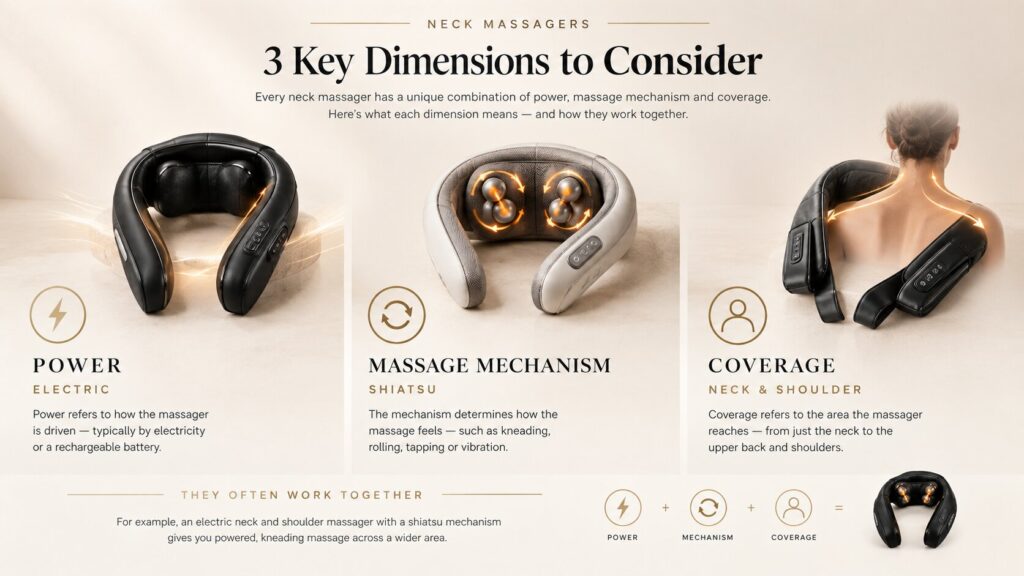
“Electric” describes how a massager operates. “Shiatsu” usually describes the type of mechanical massage, often involving rotating or kneading nodes. “Neck & shoulder” describes the area a particular design is intended to cover.
That means one product can be an electric shiatsu neck & shoulder massager all at the same time.
If you’re comparing the three terms because you’re trying to decide what to buy, here’s the simplest way to think about them:
| Type or Term | What It Tells You | Usually Best For |
|---|---|---|
| Electric neck massager | The device uses powered movement or stimulation | People who want automated massage |
| Shiatsu neck massager | The device uses a kneading/pressing-style mechanism | People who prefer a more pronounced kneading sensation |
| Neck & shoulder massager | The design extends beyond the neck to the shoulder area | People who want broader coverage |
The important part is that these labels overlap.
A shiatsu neck massager can be electric. An electric massager can cover both the neck and shoulders. And a neck & shoulder massager can use shiatsu, vibration, heat, or another mechanism.
So instead of choosing based on the label alone, look at how the device actually massages, where it makes contact, and what kind of experience you want.
We’ll break down each term below so you can see where the differences really matter.
What’s the Difference Between These Types?
The biggest source of confusion is that product listings often use several of these terms at the same time.
That’s because they describe different characteristics of a massager.
Electric generally tells you that the device is powered rather than manually operated. It doesn’t tell you exactly what the massage will feel like. An electric device might use kneading, vibration, rolling, percussion, electrical stimulation, or a combination of features.
Shiatsu is more specific. In massage products, the term is commonly used for mechanisms that create a rotating or kneading sensation with motorized massage nodes. The design is intended to reproduce some of the pressure and movement associated with hands-on shiatsu-style massage, although a device obviously cannot reproduce an entire practitioner-led session.
Neck & shoulder is different again. It primarily describes coverage. A neck & shoulder massager is designed to reach some combination of the neck, upper shoulders, trapezius area, or nearby upper back rather than concentrating exclusively on the neck.
This distinction matters because you shouldn’t automatically assume:
Electric = one type of massage
Shiatsu = one particular product shape
Neck & shoulder = one particular mechanism
They’re not that simple.
A useful way to think about it is:
Power → Electric or manual
Massage mechanism → Shiatsu/kneading, vibration, rolling, percussion, etc.
Coverage → Neck-only, neck & shoulder, upper back, or broader
Once you separate those three things, product comparisons become much easier.
Electric Neck Massagers: What Does “Electric” Actually Mean?
An electric neck massager is simply a neck-massage device that uses power to produce its massage function.
That power might drive rotating massage heads, create vibration, move rollers, operate percussion mechanisms, or provide another form of powered stimulation. The exact experience depends on the design.
This is why “electric” by itself isn’t enough information to tell you whether a massager is right for you.
Two electric neck massagers could feel completely different.
One might use rotating kneading nodes. Another might provide gentle vibration. A third might combine several mechanisms with heat and adjustable intensity.
What to Look At Instead
When a product is described simply as an electric neck massager, look at the actual specifications:
- Massage mechanism
- Intensity settings
- Heat function
- Coverage
- Power source
- Weight
- Controls
- Automatic shutoff
- Available modes
This is similar to the framework we covered in our guide on how to choose an electric neck massager.
The word “electric” tells you the device is powered.
It doesn’t tell you whether you’ll like the massage.
That’s determined by the mechanism, fit, intensity, coverage, and other design choices.
Shiatsu Neck Massagers: What Makes Them Different?
Shiatsu-style neck massagers are generally designed around a kneading or pressing sensation rather than simple vibration.
Many use rotating massage nodes that move against the neck and shoulder area, creating a rhythmic pressure that is intended to resemble some aspects of hands-on kneading. The exact movement, pressure, node shape, and positioning vary substantially between products.
This can make a shiatsu-style massager feel noticeably different from a simple vibrating device.
The Main Advantage: A More Defined Massage Sensation
If you like the feeling of firm, repetitive kneading, a shiatsu mechanism may be more appealing than a device that primarily vibrates.
But “shiatsu” shouldn’t automatically be interpreted as better or stronger.
The experience depends on the individual product.
Node placement, pressure, intensity controls, the shape of the device, and how firmly you position your body against the massage heads can all change how the massage feels.
Heat Is Often an Extra Feature
Many shiatsu-style neck massagers also offer heat.
That’s worth treating as a separate feature rather than assuming heat is part of what makes something shiatsu.
You can have:
Shiatsu + heat
Shiatsu without heat
Other massage mechanisms + heat
So if you’re specifically looking for a heated neck massager, check the actual specifications rather than relying on the word “shiatsu.”
Who Might Prefer Shiatsu?
A shiatsu-style design may make sense if you:
- Prefer kneading over simple vibration
- Want a more pronounced mechanical massage sensation
- Like the idea of rotating massage nodes
- Want a device that can often reach the upper shoulders as well as the neck
- Don’t mind a somewhat more substantial massager
The key takeaway is simple:
Shiatsu describes the massage experience more than the overall product category.
Neck & Shoulder Massagers: Who Are They For?
A neck & shoulder massager is primarily about coverage.
Instead of concentrating on a small area around the neck, these designs are intended to make contact with some combination of the neck, upper shoulders, trapezius area, or nearby upper back.
That can be useful if your main reason for buying a massager isn’t just the neck itself.
Coverage Can Matter More Than the Name
Look closely at the shape of the product.
Some designs sit around the neck with massage nodes positioned along the sides and back.
Others use integrated handles or straps that allow you to control how much pressure is applied.
Some extend farther across the shoulders, while others are essentially neck massagers with limited shoulder contact.
So two products can both be called “neck & shoulder massagers” while offering noticeably different coverage.
Think About Where You Actually Want the Massage
Ask yourself:
Do I mainly want my neck massaged?
A more compact neck-focused design may make more sense.
Do I want the upper shoulders included?
Look for massage heads or contact areas that actually reach those muscles.
Do I want something I can hold and reposition?
Handles or straps may be useful.
Do I want hands-free use?
A wearable or wraparound design may be more convenient.
The label gives you a starting point.
The physical design tells you much more.
Neck & Shoulder Doesn’t Automatically Mean Shiatsu
This is another common point of confusion.
A neck & shoulder massager can use shiatsu-style kneading, but it could also use vibration, heat, rolling, or another mechanism.
That’s why it’s useful to separate coverage from massage type when comparing products.
You can have:
Shiatsu + neck & shoulder coverage
or
Vibration + neck & shoulder coverage
or
Heat + neck & shoulder coverage
The best combination depends on what you actually want the device to do.
Electric vs Shiatsu vs Neck & Shoulder: Side-by-Side
Now that we’ve separated power source, massage mechanism, and coverage, it’s much easier to compare these terms without treating them as three completely different types of products.
The important thing to remember is that they can overlap. A single neck massager can be electric, use a shiatsu-style kneading mechanism, and cover both the neck and shoulders.
Here’s how the categories compare:
| Feature | Electric Neck Massager | Shiatsu Neck Massager | Neck & Shoulder Massager |
|---|---|---|---|
| What the term describes | Powered operation | Massage mechanism or style | Coverage area |
| How it works | Uses a motor or electrical system to provide massage | Typically uses rotating or kneading massage nodes | Designed to reach the neck and shoulder area |
| Typical sensation | Depends on the mechanism | More pronounced kneading or pressing sensation | Depends on the mechanism used |
| Coverage | Varies by design | Varies by design | Usually broader than a neck-only design |
| Heat | May or may not include heat | May or may not include heat | May or may not include heat |
| Best for | People who want automated massage | People who prefer kneading-style massage | People who want coverage beyond the neck |
| Main thing to check | Massage mechanism and controls | Node movement, pressure and fit | Actual coverage and positioning |
Electric: Best Thought of as the Power Category
If a product is described as an electric neck massager, the main information you’re getting is that the device provides its massage through powered operation.
That doesn’t tell you whether the massage will be gentle vibration, rotating kneading, rolling, percussion-style movement, or a combination of different mechanisms.
So if you’re comparing two electric neck massagers, don’t stop at the word electric. Look at how the massage is actually produced.
Shiatsu: Best Thought of as the Massage-Style Category
A shiatsu neck massager generally refers to a device that uses a kneading or pressing motion, often through rotating massage nodes.
This can create a more pronounced mechanical massage sensation than a simple vibration-based device. However, the word shiatsu by itself doesn’t tell you how intense, comfortable, or effective a particular model will feel.
Node placement, pressure, speed, fit and positioning can all make a substantial difference.
Neck & Shoulder: Best Thought of as the Coverage Category
A neck & shoulder massager is primarily describing where the device is designed to work.
That can be useful if you don’t want a device that concentrates only on the back or sides of the neck. Some designs extend across the upper shoulders, while others use handles or straps to help position the massage heads.
But coverage alone doesn’t tell you what type of massage you’ll receive. A neck & shoulder model can use kneading, vibration, heat, rolling or another mechanism.
So Which One Is Actually Different?
This is where product terminology can get confusing.
Electric tells you how the device is powered.
Shiatsu tells you something about the massage mechanism or intended massage experience.
Neck & shoulder tells you where the device is designed to provide coverage.
They’re describing different characteristics of the same product.
For example, a product could reasonably be described as an:
Electric shiatsu neck & shoulder massager
That isn’t three competing categories. It’s one product being described from three different angles.
The Better Way to Compare Them
Instead of asking:
“Should I buy electric, shiatsu or neck & shoulder?”
ask:
1. What type of massage do I want?
Kneading, vibration, rolling, percussion-style movement, or a combination?
2. Where do I want the massage?
Just the neck, or the neck and shoulders as well?
3. How much control do I want?
Consider intensity levels, modes, direction controls and timers.
4. Do I want heat?
If so, check whether it’s independently controlled and how the manufacturer describes its operation.
5. How does the device fit?
A technically impressive massager won’t be particularly useful if the massage heads don’t sit comfortably where you need them.
Once you look at products this way, the terminology becomes much less important.
The goal isn’t to find the product with the most impressive label. It’s to find the combination of massage mechanism, coverage, comfort and features that matches how you actually intend to use it.
What Do Customers Actually Say?
Product specifications can tell you what a neck massager is supposed to do. Customer reviews can tell you what people actually experience after buying one.
We looked at the recurring themes in customer feedback for the products being considered, paying particular attention to comments about massage quality, comfort, heat, value, and long-term reliability.
One pattern stood out immediately:
Customers tend to praise the massage experience much more consistently than they praise the product’s long-term durability.
The Strongest Positive Themes
Several themes appeared repeatedly in the customer feedback:
| Review theme | Mentions | Overall sentiment |
|---|---|---|
| Quality | 6.2K | ✅ Positive |
| Pain relief | 3K | ✅ Positive |
| Effectiveness | 2.9K | ✅ Positive |
| Value for money | 2.4K | ✅ Positive |
| Heat | 1.3K | ✅ Positive |
| Massage | 868 | ✅ Positive |
| Reliability | 1K | ❌ Negative |
| Durability | 875 | ❌ Negative |
The numbers above represent the review-theme counts available in the customer-feedback data; they should be interpreted as mentions of themes, not unique customers or percentages of all reviews.
Deep, Targeted Massage Is a Recurring Positive
One of the more interesting patterns is how specifically customers describe the massage.
Rather than simply saying that the product “feels good,” reviewers talk about being able to position it underneath the skull, along the neck, and across the tops of the shoulders.
One reviewer initially worried about the device being bulky, but ultimately said it could reach areas where they experienced knots and tightness. They also found that the lightest setting was already enough to work on tight areas, suggesting that maximum intensity isn’t necessarily the feature that matters most.
Another reviewer compared the experience favorably with massage chairs and massage guns, particularly when leaning against a wall to increase pressure.
That tells us something useful when comparing neck massagers:
Massage mechanism and positioning can matter just as much as the headline intensity rating.
A device that allows you to position its massage heads directly over the areas you want to target may be more useful than one that simply advertises a higher number of intensity levels.
Heat Gets Consistent Praise
Heat was another recurring positive theme.
Customers specifically mentioned appreciating the warmth during use, with one reviewer noting that the lower heat setting was already sufficient.
That’s a useful distinction when evaluating heated neck massagers. The existence of a heat function is one thing; whether the heat is comfortable, controllable, and actually adds something to the massage experience is another.
If heat matters to you, look beyond the simple “with heat” label and check how the feature is controlled.
Value Matters Too
Value for money was also a prominent positive theme.
Interestingly, customers didn’t necessarily describe the cheapest product as the best value. Instead, value often appeared to come from the perceived quality of the massage relative to the price.
One reviewer compared the product favorably with a much more expensive neck massager and felt the lower-priced option was the better purchase.
This is why price should be considered alongside massage quality, features, comfort, and expected longevity, rather than by itself.
But Reliability Is the Big Warning Sign
The positive feedback comes with an important caveat.
Reliability and durability were recurring negative themes, with customers reporting problems ranging from the device stopping during use to units failing after relatively short periods.
Some reviewers specifically reported the massager stopping after around 15 minutes, while others described units breaking within a few months.
That doesn’t mean every unit will fail, and individual reviews cannot establish a product-wide failure rate.
But when the same type of complaint appears repeatedly, it is worth taking seriously.
A neck massager can provide an excellent massage and still be a poor long-term purchase if its reliability doesn’t hold up.
That’s one reason we don’t recommend evaluating these products solely on their massage performance.
What This Means When Comparing Neck Massagers
The customer feedback points toward a broader lesson:
The best neck massager isn’t necessarily the one with the strongest massage.
Instead, several factors need to work together:
- Massage quality: Does the mechanism provide the type of sensation you actually prefer?
- Targeting: Can the massage heads reach the areas you want to work on?
- Comfort: Can you use the device without constantly repositioning yourself?
- Heat: If included, is it useful and comfortable?
- Controls: Can you easily adjust the settings while using it?
- Value: Does the overall experience justify the price?
- Reliability: Does the product continue working over time?
The customer feedback makes the trade-off particularly clear: strong massage performance can make a product highly appealing, but durability can determine whether that purchase remains worthwhile.
And that’s exactly why review analysis belongs alongside specifications when comparing these products.
A feature list tells you what a massager has. Customer feedback helps reveal what it’s actually like to live with.
Which Type Is Best for Different Buyers?
There isn’t one neck massager that’s automatically best for everyone.
The better question is which combination of massage style, coverage, comfort and convenience fits the way you plan to use it.
Because the categories overlap, you can often find one product that checks several boxes at once. A heated shiatsu neck & shoulder massager, for example, is simultaneously electric, shiatsu-style, designed for broader coverage, and equipped with heat.
So instead of choosing based on the label alone, start with what you want from the device.
Best for People Who Prefer Kneading: Shiatsu-Style Massagers
If you like the feeling of firm, mechanical kneading, a shiatsu-style massager is probably the most natural place to start.
These devices typically use rotating nodes to create a pressing and kneading sensation. The exact experience varies considerably between models, however, so don’t assume that every product marketed as “shiatsu” will feel the same.
Pay particular attention to:
- How the massage nodes are positioned
- Whether the intensity can be adjusted
- How much pressure you can apply through positioning or handles
- Whether the shape fits comfortably around your neck and shoulders
- Whether the device includes heat
Best suited to: buyers who specifically want a more pronounced kneading sensation rather than simple vibration.
Best for Neck + Shoulder Coverage: Neck & Shoulder Massagers
If your main priority is reaching both the neck and the tops of the shoulders, look for a design specifically built around that coverage.
This doesn’t necessarily mean choosing a particular massage mechanism. Neck & shoulder models can use kneading, vibration, rolling, heat or combinations of these.
The important thing is to look at the actual shape and positioning of the massage heads rather than relying entirely on the product name.
Best suited to: buyers who don’t want the massage concentrated on the neck alone.
Best for Maximum Flexibility: Multi-Mode Electric Massagers
If you’re not completely sure what type of massage you’ll prefer, a multi-function electric model can make sense.
Some products combine multiple features such as kneading, vibration, different intensity levels and heat. That gives you more ways to adjust the experience depending on how you want to use it.
But there’s an important catch:
More modes don’t automatically mean a better product.
A device with three useful settings can be more practical than one with ten modes that are difficult to understand or don’t feel meaningfully different.
Best suited to: buyers who value adjustability and want more than one way to use the device.
Best for People Who Want Heat: Heated Models
If warmth is an important part of the experience, focus on models where heat is a clearly defined feature rather than assuming that every heated massager will feel the same.
Check whether the heat can be turned on independently, whether there are different heat settings, and whether the device has an automatic shutoff.
Our review analysis also found heat to be a recurring positive theme, which suggests that this feature can meaningfully affect how customers perceive the overall experience.
Best suited to: buyers who enjoy warmth alongside massage and want it to be part of their normal routine.
Best for People Who Want Targeted Pressure: Kneading or Percussion-Style Designs
If you want to concentrate the sensation on particular areas rather than simply having a gentle massage spread across the neck, look closely at the mechanism and how the device is positioned.
Kneading-style devices can provide a more concentrated mechanical sensation, while handheld percussion designs can give the user more direct control over where the massage is applied.
The trade-off is that more control can also mean more effort. A hands-free wraparound massager lets the device do most of the work, while a handheld design requires you to position and operate it yourself.
Best suited to: buyers who care more about targeted control than complete hands-free convenience.
Best for Portability: Rechargeable Electric Models
If you want to move the massager between rooms, take it to the office, or travel with it, a rechargeable model may be more convenient than a permanently plugged-in device.
But portability usually involves trade-offs.
Check:
- Battery capacity and charging requirements
- Charging time
- Weight
- Whether the device can operate while charging
- How easy it is to store or pack
A rechargeable design isn’t automatically better if you primarily plan to use the massager in one place.
Best suited to: buyers who expect to use their massager in multiple locations.
Best for Simple Home Use: Plug-In Models
If your massager is going to live on the sofa or in one particular chair, a corded model can actually be the simpler choice.
You don’t have to remember to charge it, and there’s no battery capacity to monitor. The downside is obvious: you’re tied to an outlet.
This is a good example of why convenience depends on your routine.
Best suited to: buyers who mainly want a reliable at-home setup and don’t need portability.
The Best Type Depends on Your Priority
Here’s the simplest way to narrow it down:
| If your priority is… | Start by looking at… |
|---|---|
| Firm kneading | Shiatsu-style massagers |
| Neck + shoulder coverage | Neck & shoulder designs |
| More adjustment options | Multi-mode electric models |
| Warmth | Heated models |
| Targeted pressure | Kneading or percussion-style designs |
| Portability | Rechargeable models |
| Simple home use | Plug-in models |
These aren’t rigid categories. In fact, the product that best fits you may check several boxes at once.
A heated, rechargeable shiatsu neck & shoulder massager could cover kneading + heat + broader coverage + portability in one device.
That’s why the most useful comparison isn’t simply electric vs. shiatsu vs. neck & shoulder.
It’s:
What do you want the device to do, where do you want it to work, and how do you realistically plan to use it?
Once you’ve answered those questions, comparing individual models becomes much easier.
Your ideal type can also depend on how you actually use the device. If you spend much of your day sitting at a desk, see our guide to neck massagers for people who sit at a desk all day for a closer look at the features and tradeoffs that matter for that use case.
What We Recommend
After comparing the different types, the simplest conclusion is this:
Don’t choose a neck massager because the product label sounds impressive. Choose it because the underlying design matches what you actually want from it.
For most buyers, we’d prioritize the following in order:
1. Start With the Massage Mechanism
First decide what type of sensation you prefer.
If you like a more pronounced kneading feeling, a shiatsu-style design is worth considering. If you prefer something simpler or gentler, vibration-based models may make more sense.
The important thing is to understand what the device actually does, rather than assuming that terms like “shiatsu,” “deep massage,” or “professional” guarantee a particular experience.
2. Then Look at Coverage and Fit
A good massage mechanism isn’t much use if the massage heads don’t sit comfortably where you need them.
If you want your shoulders included, pay close attention to the actual shape and coverage of the device.
Also consider how you’ll position it. Some models work best when you’re sitting against a chair or sofa, while others give you more control through handles or straps.
Fit is easy to overlook when shopping online, but it can have a major effect on the experience.
3. Treat Heat as a Bonus, Not the Main Decision
Heat can be a valuable feature, particularly if you enjoy warmth during a massage.
But we’d choose the massage mechanism and fit first, then use heat as a deciding factor between otherwise suitable models.
Look for clear controls, sensible heat operation and an automatic shutoff rather than simply choosing the model with the most aggressive heat claims.
4. Don’t Pay for Features You Won’t Use
A long specification list can make a product look impressive without necessarily making it better.
More modes, higher intensity settings, multiple massage programs and extra controls only add value if they improve the way you intend to use the device.
A simpler massager that you enjoy using regularly can be a better purchase than a feature-packed model that ends up sitting in a cupboard.
5. Pay Attention to Long-Term Reliability
This is particularly important given what we found in the customer feedback.
Massage quality, effectiveness, heat and value generated strong positive feedback, but reliability and durability were recurring areas of concern.
That means we wouldn’t evaluate a neck massager on its first five minutes of use alone.
When comparing specific products, we’d want to know:
- What customers say about the massage
- Whether the device remains comfortable to use
- Whether the controls work well
- Whether heat performs as expected
- Whether customers report recurring faults
- Whether durability concerns appear repeatedly
- Whether the overall price still makes sense given those trade-offs
Our Bottom Line
If you want a simple decision framework, use this:
Choose the massage mechanism you prefer.
Make sure the coverage matches where you want the massage.
Check that the device is comfortable enough to use regularly.
Add features like heat, portability and extra modes according to your actual needs.
And don’t ignore what customers report after they’ve owned the product for a while.
There isn’t a single neck massager that’s perfect for everyone.
The best option is the one that gets the important things right for your particular use case – while avoiding the weaknesses you’re least willing to tolerate.
And once you’ve narrowed down the type you want, the next question becomes much easier:
Which specific models are actually worth considering?
If you’re still deciding whether buying one makes sense at all, our guide to whether a neck massager is worth buying looks more closely at value, usage, features and the tradeoffs involved.
How We Evaluate Products
When we compare neck massagers, we don’t rely on the product description alone.
We look at the specifications, design, features and available customer feedback to understand what each model offers – and where the trade-offs are.
We Start With the Specifications
We compare the fundamentals first:
- Massage mechanism
- Coverage
- Heat
- Intensity and settings
- Power source
- Controls
- Weight and ergonomics
- Automatic shutoff
- Other features that could affect everyday use
Specifications give us the starting point, but they aren’t the whole picture.
We Look at Customer Feedback
Customer reviews can reveal things that aren’t obvious from a specification sheet.
We look for recurring patterns in areas such as massage quality, comfort, heat, value, reliability and durability, rather than relying on a handful of unusually positive or negative reviews.
Where review data is available, we also look for repeated complaints and unexpected findings that could materially affect a buying decision.
We Separate Features From Claims
A product can advertise a feature without that feature necessarily being important to every buyer.
That’s why we focus on what a feature actually means in practical use and consider its trade-offs rather than simply counting how many features a product has.
We also avoid making medical claims that aren’t supported by appropriate evidence. A massage device should not be treated as a substitute for professional medical care.
We Don’t Pretend to Have Tested What We Haven’t
Transparency matters.
Unless we have personally tested a product, we don’t present our research as hands-on testing. Our recommendations are based on the available product information, specifications, customer feedback and other relevant evidence we can verify.
For a fuller explanation of how we research and evaluate products, see our How We Evaluate Products methodology.
Ultimately, the goal isn’t to find the product with the longest feature list.
It’s to identify the products that offer the most compelling combination of useful features, real-world feedback, value and fit for different buyers.
Ready to Compare Specific Models?
By now, you should have a clearer idea of what matters when choosing a neck massager.
You know the difference between electric, shiatsu and neck & shoulder designs, how massage mechanisms can differ, what features are worth paying attention to, and which trade-offs matter depending on how you plan to use the device.
The next step is comparing actual products.
We’ve taken the same approach to our hands-on research and customer-feedback analysis to evaluate specific models across the features that matter most – including massage performance, coverage, heat, comfort, controls, value and reliability.
If you’re ready to move from which type is right for me? to which specific model should I buy?, see our full comparison:
Best Electric Neck Massagers of 2026
There you’ll find specific models compared side by side, along with the key strengths, drawbacks and features worth knowing before you buy.
The goal isn’t to find the most expensive massager or the one with the longest feature list.
It’s to find the one that makes the most sense for you.