
Quick Answer: Are Neck Massagers Worth It?
Neck massagers can be worth buying if you enjoy massage-style pressure and want a convenient way to use it at home, but they’re not automatically a good purchase for everyone.
The biggest factor isn’t how many features a massager has. It’s whether the device’s massage style, intensity, coverage, comfort and convenience actually suit the way you plan to use it.
For example, someone who enjoys pronounced kneading may get much more value from a shiatsu-style neck massager than from a simple vibration device.
Someone who wants to move between rooms or use a massager without staying near an outlet may prefer a rechargeable model. And someone who plans to use one regularly may care more about comfortable positioning and adjustable intensity than maximum power.
Customer feedback also shows why it’s important to look beyond star ratings. Many buyers praise neck massagers for their massage experience, heat, convenience and perceived value, while recurring complaints can involve durability, reliability, comfort and intensity.
A product can therefore be highly rated overall while still having weaknesses that matter to a particular buyer.
When a Neck Massager May Be Worth It
A neck massager may make sense if you:
- Enjoy the feeling of kneading, pressure or vibration
- Want convenient at-home use
- Expect to use the device regularly
- Prefer controlling the intensity yourself
- Want neck-only or broader neck-and-shoulder coverage
- Value features such as optional heat or rechargeable operation
- Would rather have a reusable device than rely on occasional appointments or other solutions
When It May Not Be Worth It
It may be a poor purchase if you:
- Dislike strong or repetitive pressure
- Expect a device to replicate a professional massage
- Are unlikely to use it more than occasionally
- Find wraparound or heavier designs uncomfortable
- Need completely silent operation
- Are choosing based primarily on the number of features
- Are overlooking recurring reliability or durability complaints
The key question is therefore not simply “Do neck massagers work?”
It’s:
“Would this particular type of neck massager provide enough useful, comfortable use for me to justify the price?”
That’s the question this guide will help you answer.
What Are You Actually Paying For?
A neck massager can look deceptively simple. You put it around your neck, turn it on, and it massages.
But the price differences between models can be significant, and a higher price doesn’t necessarily mean a better experience.
What you’re really paying for is a combination of massage mechanism, coverage, adjustability, comfort, convenience, construction and additional features.
Understanding those differences makes it easier to decide whether a particular model is worth its asking price.
Massage Mechanism
The mechanism is one of the biggest factors affecting the experience.
Shiatsu-style models typically use rotating or kneading nodes to create a more pronounced massage sensation. Vibration-based devices use smaller, faster movements and can provide a different, often simpler experience.
Some newer designs combine multiple techniques or use compression and other forms of mechanical movement.
This matters because massage type is a preference, not simply a quality ranking.
A more aggressive mechanism isn’t necessarily better if you find it uncomfortable. Likewise, a gentler device may be perfectly suitable if that’s the experience you prefer.
Coverage
A neck-only device and a wraparound neck-and-shoulder massager aren’t necessarily competing on the same terms.
Broader designs may contact the shoulders and upper back as well as the neck, while smaller devices may concentrate their massage more narrowly.
If you’re paying extra for broader coverage, make sure the design actually fits the areas you want to use it on. Product photos, dimensions and customer feedback can tell you more than the product name alone.
Adjustability
Adjustability can have a major effect on value.
Multiple intensity levels, massage directions or operating modes give you more control over the experience. That’s particularly useful if you don’t always want the same level of pressure.
A device with three genuinely useful intensity settings may be more valuable to you than a device with ten features you’ll never use.
Comfort and Ergonomics
This is one of the easiest things to overlook when shopping online.
A massager can have an impressive motor, multiple modes and plenty of positive reviews, but if it’s awkward to position or uncomfortable to wear, you may stop using it.
Look at:
- Overall weight
- Shape and fit
- Handle or strap design
- Pressure points
- Neck and shoulder contact areas
- Material against the skin
- How easily you can change position
For something you intend to use repeatedly, comfort can matter more than raw power.
Heat
Heat is a common extra feature, but it shouldn’t automatically determine your purchase.
Some people enjoy the warmer experience, while others barely use the heat function. Adjustable or independently controlled heat can therefore be more useful than simply having “heat” listed among the specifications.
It’s also worth checking how customers describe the actual heat experience, because the presence of a heating element doesn’t tell you whether everyone finds it sufficiently noticeable.
Convenience
Convenience is another part of the value equation.
Depending on the model, you may be paying for:
- Rechargeable operation
- Longer cables
- Car adapters
- Carrying cases
- Simple controls
- Automatic shutoff
- Easy storage
- Multiple use positions
These features might seem minor individually, but they can determine whether a device becomes something you use regularly or something that ends up in a cupboard.
Construction and Reliability
This is where customer reviews become particularly important.
Specifications can tell you what a manufacturer says a product contains. They can’t fully tell you how that product holds up over time.
When assessing value, look for recurring feedback about:
- The device stopping unexpectedly
- Charging or battery problems
- Buttons or controls failing
- Massage nodes becoming unreliable
- Materials wearing down
- Heat performance changing
- General durability
A low purchase price isn’t necessarily good value if the product doesn’t provide the expected lifespan.
The Real Value Equation
Ultimately, the value of a neck massager comes down to more than its sticker price.
A useful way to think about it is:
Price × expected use × quality of experience = perceived value
A relatively inexpensive massager that you enjoy using several times a week can provide more practical value than a considerably more expensive model that spends most of its life unused.
That’s why the “best value” product isn’t necessarily the cheapest one.
It’s the one that gives you the combination of experience, convenience, comfort and reliability that makes the purchase worthwhile for your particular routine.
What People Like About Neck Massagers
One of the best ways to judge whether a neck massager is worth buying is to look beyond the specification sheet and examine what customers repeatedly mention after using one.
Individual reviews can be subjective, but recurring themes across large numbers of reviews can reveal useful patterns.
They can show which features people actually appreciate, what kinds of experiences they find valuable, and whether the product delivers on the expectations created by its listing.
Several themes appear repeatedly in customer feedback for popular neck massagers.
Massage Quality and Pressure
For many buyers, the main reason to purchase a neck massager is simple: they enjoy the massage experience.
Reviews frequently praise devices that provide noticeable kneading, pressure or movement around the neck and shoulders. Shiatsu-style models in particular tend to attract customers looking for a more pronounced mechanical massage rather than a very subtle sensation.
This is also where personal preference becomes important.
One person’s “deep” massage can be another person’s “too aggressive.” A strong motor isn’t automatically an advantage if the pressure makes the device uncomfortable to use.
Perceived Effectiveness
Effectiveness is another recurring positive theme in customer reviews.
People often describe a massager as useful when they feel that it provides the type of pressure or movement they were looking for. Some mention using their device after a long day, during periods of extended desk work, or as part of a regular relaxation routine.
These are individual customer experiences, not proof that a particular device produces a medical outcome.
That distinction matters. Customer reviews can tell you how people experience a product, but they shouldn’t be treated as controlled evidence that a massager can diagnose, treat or cure a health condition.
Heat
Heat receives considerable attention in many neck-massager reviews.
For buyers who enjoy a warmer massage experience, a heating function can make a device feel more comfortable or relaxing. Some customers specifically mention heat as one of the reasons they enjoy their purchase.
But heat feedback can also be highly personal.
Some users want noticeable warmth, while others prefer little or no heat. That’s why an independently controllable heat function can be more useful than simply seeing the word “heated” in a product title.
Convenience
Convenience is another major part of the appeal.
A neck massager can be available whenever you want to use it, without scheduling anything or leaving home. That makes the device particularly attractive to people who want something they can incorporate into an existing routine.
Depending on the model, customers may appreciate:
- Simple controls
- Multiple intensity settings
- Automatic shutoff
- Rechargeable operation
- A carrying case
- Car adapters
- The ability to use the device on different parts of the body
- Easy positioning with handles or straps
None of these features guarantees a better product, but they can increase the likelihood that someone will actually use it.
Value for Money
Value is another recurring positive theme.
Customers don’t necessarily judge value by the lowest purchase price. A product can feel like good value because it provides a satisfying massage experience, has useful features, works across multiple areas of the body, or becomes something the owner uses frequently.
That’s an important distinction:
Good value doesn’t necessarily mean cheap.
A device that costs more but gets used regularly may provide greater practical value than a cheaper product that rarely leaves the cupboard.
Portability and Flexibility
Portable designs can also receive praise, particularly when they make it easier to use a massager in different locations.
Rechargeable models have an obvious advantage here because they don’t need to remain connected to an outlet during use. However, some corded products compensate with long cables, car adapters or other accessories.
Versatility can matter too. A product designed for the neck and shoulders may also be usable on areas such as the back, legs or calves, depending on its construction and the manufacturer’s intended use.
That flexibility can increase the perceived value of a device – provided you actually want those additional uses.
What These Positive Themes Tell Us
The strongest pattern is that customers tend to value the experience of using the product, not simply the specification list.
Massage quality, perceived effectiveness, heat, convenience, adjustability and value repeatedly influence whether people feel positive about their purchase.
But there’s an important second half to the story.
A product can have thousands of positive reviews and still have meaningful weaknesses. Reliability, durability, comfort and long-term performance can tell a very different story from the headline star rating.
That’s why looking only at positive reviews isn’t enough.
To decide whether a neck massager is genuinely worth buying, you also need to understand what customers complain about.
What People Don’t Like About Neck Massagers
The easiest way to make a neck massager sound worthwhile is to list everything customers like about it.
The more useful question is what happens when the experience doesn’t live up to expectations.
Across customer feedback for popular neck massagers, several complaints appear repeatedly. They don’t mean that these products are bad overall, but they highlight the trade-offs that can determine whether a particular model feels like a good purchase or a waste of money.
Durability and Reliability
One of the biggest concerns to watch for is how consistently a device continues working over time.
Some customers report being very happy with their massager initially, only to encounter problems later. Complaints can include devices stopping unexpectedly, charging problems, controls becoming unreliable or the massage mechanism failing.
This is particularly important because a massager can receive thousands of positive reviews while still having a meaningful minority of reliability complaints.
A high overall rating tells you that many buyers were satisfied. It doesn’t tell you that every unit will have the same experience.
That’s why recurring reliability complaints deserve attention even when the headline rating looks excellent.
Pressure That Is Too Strong
More powerful isn’t always better.
Shiatsu-style neck massagers can create a fairly pronounced kneading sensation, and some users specifically appreciate that intensity. Others find the pressure uncomfortable, particularly around sensitive areas of the neck.
This is one reason adjustable intensity matters.
If you know that you prefer gentler massage, buying the most powerful model available simply because it has “deep tissue” in the description may not be a good decision.
Comfort and Positioning
A massager can feel completely different depending on how it sits against your body.
Some wraparound designs are relatively substantial, and customers may have different preferences regarding the amount of pressure, the position of the massage nodes or how the device rests on the shoulders.
This is difficult to judge from a product photograph alone.
Pay attention to reviews that discuss:
- Whether the device feels comfortable after several minutes
- Where the pressure is concentrated
- Whether the nodes reach the intended areas
- Whether handles or straps make positioning easier
- Whether the device feels heavy
- Whether users need to lean against something to achieve their preferred pressure
These details can matter more to your experience than an impressive specification list.
Heat Isn’t Universally Loved
Heat is another feature where customer experiences can vary considerably.
Some buyers specifically praise the warmth and consider it an important part of the massage experience. Others report that the heat feels too subtle, while some simply don’t find themselves using the feature very often.
The lesson isn’t that heated massagers are good or bad.
It’s that “has heat” doesn’t tell you how useful the heat will be to you.
If heat matters to your purchase, look for independent control and pay attention to recurring customer comments about the actual experience.
Battery and Power Limitations
Cordless models solve one problem – being tethered to an outlet – but introduce another consideration: battery management.
A rechargeable massager may be much easier to move around the house or take with you, but you’ll need to keep it charged. Battery performance can also become a concern over time.
Corded models have their own trade-off. They may provide straightforward, consistent operation, but you’re limited by access to an outlet and the length of the cable.
Neither approach is inherently better.
The better choice depends on how you expect to use the device.
Bulky Designs
Many neck massagers aren’t particularly small.
That isn’t necessarily a flaw. A larger design may allow for broader coverage, larger massage mechanisms or additional controls. But it can also make the device harder to store or less convenient to use.
This matters because convenience is part of value.
If a device is awkward to take out, position and put away, you may use it less often than you expected when you bought it.
The “Feels Good, But…” Problem
There’s another subtle issue worth considering.
A massager can feel excellent during a short session and still fail to become something you regularly use.
This is one of the biggest differences between liking a product and getting long-term value from it.
You might enjoy the first few sessions but eventually decide that the device is too bulky, too intense, too noisy, too awkward to position or simply not worth the setup.
That’s why reviews discussing repeated use can be more informative than a simple statement that a product “feels great.”
What These Complaints Tell Us
None of these drawbacks automatically makes neck massagers a bad purchase.
Instead, they reveal something more useful:
The best neck massager isn’t necessarily the strongest, most expensive or most feature-packed model.
It’s the one whose trade-offs match your preferences.
If you want powerful kneading, a stronger shiatsu model may make sense. If you prefer portability, cordless operation could matter more. If you’re sensitive to pressure, adjustable intensity and comfortable positioning may be much more important than maximum power.
And if durability is your biggest concern, customer feedback about long-term reliability deserves as much attention as the star rating.
That is ultimately what determines whether a neck massager feels worth it rather than merely impressive on paper.
When Is a Neck Massager Actually Worth Buying?
Whether a neck massager is worth the money depends heavily on how you expect to use it.
For someone who already enjoys massage and wants a convenient way to get that experience at home, the value proposition can be fairly straightforward. The device is available whenever you want it, requires no appointment, and can become part of an existing routine.
But the value becomes less obvious if you’re unlikely to use it regularly or if the design doesn’t suit your preferences.
A Neck Massager May Be Worth It If You:
Enjoy Massage-Style Pressure
If you already know that you like kneading, pressure or vibration, you’re starting with a significant advantage: you have a good idea of what experience you’re buying.
In that situation, choosing between different massage mechanisms becomes more important than deciding whether you want a massager at all.
Want Convenient At-Home Use
Convenience is one of the strongest arguments for owning a massager.
You don’t need to book anything, travel anywhere or wait for an appointment. A device can be stored at home and used whenever it fits your routine.
For someone who regularly wants a few minutes of massage after work, during an evening wind-down or following a long day at a computer, that convenience can add considerable practical value.
Expect to Use It Regularly
Frequency matters.
A device that costs $50 but becomes part of your routine can provide substantially more value than one that costs $30 and gets used twice.
You don’t need to use it every day. The important question is whether you can realistically imagine using it often enough for the purchase to justify itself.
Before buying, ask yourself:
Where would this fit into my normal routine?
If you already have an answer, that’s a good sign.
Want Control Over the Experience
Adjustable intensity can make a massager more useful because your preferred pressure may change depending on the situation.
You might want stronger kneading one day and a gentler session another. Being able to adjust the experience can therefore be more valuable than simply buying the most powerful model available.
Want More Than Occasional Professional Massage
A home massager isn’t a replacement for a professional massage therapist, and it shouldn’t be presented as one.
But it can provide a different kind of convenience: repeatable access to a massage-style experience whenever you want it.
For someone who enjoys massage and wants something available between occasional appointments, that can be a meaningful benefit.
Find the Right Design for Your Preferences
The right product can also make a major difference.
A person who enjoys pronounced kneading may prefer a shiatsu-style design. Someone who values mobility may prioritize a rechargeable model. Someone who wants broader contact may prefer a neck-and-shoulder design.
The more closely the product matches your preferences, the easier it is to justify the purchase.
It May Not Be Worth It If You:
Don’t Actually Enjoy Mechanical Massage
This sounds obvious, but it is worth saying.
If you dislike the sensation of rotating nodes, vibration or pressure around your neck and shoulders, no number of extra features will make the device worthwhile.
Expect a Professional Massage Experience
Neck massagers have limitations.
They can provide mechanical pressure, kneading, vibration or heat, but they don’t have the adaptability, judgment or hands-on responsiveness of a professional massage therapist.
If you’re expecting a machine to reproduce that experience exactly, disappointment is likely.
Won’t Use It Regularly
This is perhaps the simplest reason not to buy one.
If you’re attracted to the idea of owning a massager but can’t identify when you’d realistically use it, consider waiting.
A product doesn’t provide much value simply because it is capable of doing something you might want someday.
Dislike Bulky or Restrictive Designs
Many neck massagers are designed to sit around the neck and shoulders. Some are relatively substantial because the massage mechanism needs physical space.
If you strongly prefer small, lightweight devices, a large wraparound shiatsu model may not suit you regardless of how well it performs.
Are Buying Based on Features Rather Than Use
A long list of features can make a product look impressive.
Heat. Multiple modes. Several intensity levels. Rechargeable batteries. Timers. Different massage directions. Whole-body positioning.
But every feature has to answer one question:
Will I actually use this?
If not, you’re potentially paying for complexity rather than value.
The Simple Test
Before buying, try answering these five questions:
- Do I actually enjoy massage-style pressure?
- Do I know when I would use the device?
- Will I use it often enough to justify the price?
- Does the massage mechanism match my preference?
- Am I comfortable with the product’s size, intensity and design?
If you can answer “yes” to most of them, a neck massager may be a very reasonable purchase.
If you’re struggling to answer even one or two, that’s useful information too.
The goal isn’t to convince yourself that you need a neck massager. It’s to determine whether owning one would genuinely add enough convenience and enjoyment to your routine to be worth the money.
Are More Expensive Neck Massagers Better?
Not necessarily.
A higher-priced neck massager may offer better materials, additional features, rechargeable operation, a different massage mechanism or a more refined design. But price alone doesn’t tell you whether you’ll have a better experience.
A $40–$60 massager that fits your preferences may be a much better purchase than a $100+ model with features you don’t need.
What Can Increase the Price?
Several things can contribute to a higher price:
- More sophisticated massage mechanisms
- Rechargeable batteries
- Larger or broader coverage
- Additional intensity or massage modes
- Better materials
- More substantial construction
- Improved controls and ergonomics
- Included accessories
- Longer warranties
- Brand positioning
Some of these differences can be genuinely useful.
Others may simply be features that sound impressive on a product page but don’t make much difference to how you’ll actually use the device.
The Feature List Isn’t the Same as Value
It’s easy to fall into the specification trap.
Imagine two products.
Massager A has multiple modes, heat, several intensity levels, rechargeable operation and a premium-looking design.
Massager B has fewer features but provides the massage style you prefer, feels comfortable around your neck and is simple enough that you actually use it several times a week.
Which one is better?
There isn’t enough information to answer that from the specification sheets alone.
For the person who values portability and customization, Massager A might be the better choice. For someone who simply wants reliable, comfortable shiatsu massage at home, Massager B could provide considerably better value.
When Paying More Can Make Sense
Spending more can be reasonable when the additional cost buys something you genuinely value.
For example, a cordless design may be worthwhile if you regularly move around the house or travel. A more comfortable design may justify a premium if you expect frequent use. Broader coverage could be valuable if you specifically want to massage both the neck and shoulders.
The important distinction is:
Pay more for a meaningful improvement, not simply a longer feature list.
When Paying More May Not Be Worth It
There are also situations where spending more doesn’t make much sense.
If you primarily want a simple shiatsu massage at home, you may not need premium connectivity, numerous operating modes or an expensive rechargeable system.
Likewise, a higher price doesn’t automatically solve issues such as uncomfortable pressure, awkward positioning or reliability concerns.
A premium product still needs to suit you.
What Customer Feedback Can Tell You
This is one area where large-scale customer feedback can add useful context.
A product with a high rating and tens of thousands of reviews gives you a much larger pool of real-world experiences to examine than a product with only a handful of ratings.
But the headline rating still isn’t enough.
Look at what people repeatedly praise and criticize.
Are customers consistently mentioning:
- Good massage quality?
- Useful heat?
- Comfortable positioning?
- Strong value?
- Easy controls?
- Portability?
And on the negative side:
- Reliability problems?
- Durability issues?
- Excessive pressure?
- Weak heat?
- Battery complaints?
- Awkward positioning?
Those patterns can tell you much more about practical value than the price tag alone.
Our Approach to Price and Value
At One Page Picks, we don’t treat the most expensive product as the premium winner by default.
We look at the relationship between what you’re paying and what you’re getting, while considering who the product is actually for.
That means a relatively inexpensive massager can be a strong recommendation if it delivers the right combination of features, usability and customer satisfaction.
It also means a more expensive model can be worth considering when its additional cost solves a problem that matters to you.
The best value isn’t the product with the lowest price. It’s the product where the money you’re spending buys something you’ll genuinely appreciate and use.
What Features Are Actually Worth Paying For?
Neck massagers can come with a surprisingly long list of features: multiple massage modes, heat, adjustable intensity, different massage directions, rechargeable batteries, automatic shutoff, carrying cases and more.
But a longer specification list doesn’t automatically mean a better product.
If you’re deciding whether a neck massager is worth the money, the better question is:
Which features will actually improve the experience enough for you to notice and use them?
Some features can make a meaningful difference. Others sound impressive on a product page but may add little value if you don’t use them.
1. Comfortable Pressure Control
For many buyers, this is more important than almost anything else.
A massager can have excellent specifications and still be a poor purchase if the pressure feels uncomfortable or difficult to control.
Look for designs that allow you to influence the intensity, either through multiple speed levels, massage modes, adjustable positioning or the way pressure is applied.
This matters particularly with shiatsu-style devices, where mechanical kneading can feel quite pronounced.
Worth paying for: better control over how intense the massage feels.
Less important: having an unusually large number of intensity settings that you are unlikely to use.
2. A Massage Mechanism You Actually Like
Different mechanisms produce different experiences.
Shiatsu-style devices use moving or rotating nodes to create a kneading sensation. Vibration-based devices produce a different type of stimulation, while some newer designs combine multiple approaches.
There isn’t one mechanism that is objectively best for everyone.
If you already know you enjoy firm kneading pressure, paying for a better shiatsu mechanism may make sense. If you prefer something gentler, a highly aggressive massage mechanism may actually reduce the value of the device.
Worth paying for: the type of massage that matches your personal preference.
Less important: choosing a product simply because its mechanism sounds more advanced.
3. Useful Coverage
Think about where you actually want the massager to work.
A neck-only device may make sense if you want something compact and focused. A neck-and-shoulder design may be more useful if you regularly want coverage beyond the sides or back of the neck.
Some products can also be positioned on the back, legs or other areas.
Broader coverage can increase versatility, but it can also mean a larger and heavier device.
Worth paying for: coverage you expect to use regularly.
Less important: paying extra for whole-body capability if you only ever want to massage your neck and shoulders.
4. Heat – If You’ll Actually Use It
Heat is one of the most common extras on electric neck massagers, but its value depends heavily on personal preference.
A useful implementation gives you reasonable control over whether heat is used rather than making it an unavoidable part of every session.
Independent heat control can therefore be more valuable than simply having a higher advertised temperature.
Worth paying for: controllable heat that complements the massage experience.
Less important: chasing the highest temperature specification.
Heat also shouldn’t be treated as a medical treatment simply because a product includes it. For a buying decision, think of it primarily as a comfort feature.
5. Cordless Operation
This can be a genuinely valuable upgrade for some buyers.
A rechargeable massager removes the need to remain close to a wall outlet and can make the device easier to move between rooms.
For someone who wants to use a massager at a desk, on the sofa and while travelling, that flexibility may justify a higher price.
For someone who uses it in exactly the same chair at home, corded operation may be perfectly adequate.
Worth paying for: cordless operation when portability will change how often you use the device.
Less important: paying a premium for a battery if you have no reason to move the massager away from an outlet.
6. Automatic Shutoff and Overheat Protection
This is one category where the feature isn’t about making the massage feel more luxurious.
It’s about sensible operation.
Automatic shutoff can prevent a session from continuing indefinitely, while overheat protection can provide an additional layer of protection during use.
These features may not make a massager more exciting, but they are the type of practical details worth considering when comparing products.
Worth paying attention to: sensible safety features and clearly stated operating limits.
Less important: treating safety features as a reason to buy an otherwise unsuitable massager.
7. Simple, Usable Controls
A massager is supposed to be convenient.
If changing the intensity, heat or direction requires constantly repositioning yourself or struggling to find a button, some of the device’s theoretical functionality becomes less useful.
Look for controls that are easy to understand and operate while the device is positioned on your body.
More controls aren’t necessarily better.
Worth paying for: controls that make the device easier to use.
Less important: an enormous number of modes that make the product more complicated without improving your experience.
8. Battery Life – For Cordless Models
If you’re buying a rechargeable model, battery performance becomes part of the value equation.
A cordless massager can be extremely convenient, but only if the battery lasts long enough for the way you intend to use it.
Don’t look only at the manufacturer’s maximum runtime. Consider how often you expect to use the device, how long individual sessions are and whether charging it will become an annoyance.
Worth paying for: enough real-world battery capacity for your routine.
Less important: paying significantly more for extreme battery life you will never need.
9. Build Quality and Long-Term Reliability
This is one of the easiest things to overlook when shopping.
A product can feel fantastic during the first few sessions and still be poor value if components fail, the mechanism becomes noisy or the device doesn’t hold up to regular use.
This is why customer feedback can be particularly useful.
A high average rating is encouraging, but recurring complaints about durability or reliability deserve attention even when the overall rating looks strong.
Worth paying for: construction and reliability signals that support regular use.
Less important: premium-looking materials that don’t translate into better durability or usability.
10. Accessories and Extras
Carrying cases, adapters, straps and additional accessories can be useful.
But they should be evaluated based on whether they solve a problem for you.
A car adapter matters much more to someone who wants to use the device while traveling than to someone who will never take it outside the house.
The same principle applies to extra attachments, storage cases and other bundled accessories.
Worth paying for: extras that you’ll genuinely use.
Less important: allowing a long accessories list to make a product look like better value than it actually is.
The Features That Matter Most
If you strip away the marketing language, a neck massager’s value usually comes down to a relatively small group of things:
- Comfort
- Massage type
- Pressure/intensity control
- Useful coverage
- Heat control
- Convenience
- Safety features
- Reliability
Everything else is secondary.
That doesn’t mean extra features are bad. It means they should earn their place in the price.
A $70 massager with eight genuinely useful features may be a better purchase than a $100 model with twenty features you’ll never touch.
The Better Way to Compare Features
Instead of asking:
“Which massager has the most features?”
Ask:
“Which features will make me more likely to enjoy and regularly use this device?”
That’s the difference between shopping by specification and shopping by value.
And ultimately, regular use is what turns a neck massager from an interesting gadget into a worthwhile purchase.
If you want a more detailed framework for comparing those features, our guide on how to choose an electric neck massager walks through massage type, heat, intensity, coverage, power, ergonomics, controls, safety and other buying considerations.
Shiatsu vs. Vibration: Does the Type Matter?
Yes – the massage mechanism can make a noticeable difference to the experience.
Two neck massagers can have similar prices, similar ratings and similarly impressive product descriptions while feeling completely different to use.
That’s why choosing a massage mechanism based purely on specifications can be misleading.
The better approach is to start with a simple question:
What kind of massage do you actually enjoy?
Shiatsu Neck Massagers
Shiatsu-style electric massagers typically use moving or rotating nodes designed to create a kneading sensation.
This is the type of mechanism found in many wraparound neck-and-shoulder massagers.
The experience tends to be more pronounced than simple vibration. Depending on the design and how much pressure is applied, the massage can feel firm and deep.
That can be exactly what some buyers want.
It can also be too intense for others.
Shiatsu may be a better fit if you:
- Prefer noticeable kneading pressure
- Like a more mechanical massage sensation
- Want a neck-and-shoulder design
- Prefer adjustable intensity or speed
- Want a massage that feels more substantial than simple vibration
The important trade-off is comfort.
A strong shiatsu mechanism isn’t automatically better. If the pressure is uncomfortable or the device is difficult to position correctly, greater intensity can actually reduce the overall value.
Vibration Neck Massagers
Vibration-based devices work differently.
Rather than relying primarily on rotating or kneading nodes, they use vibration to create the massage sensation.
This can make them appealing to buyers who prefer a different, potentially gentler experience.
The exact sensation depends heavily on the device’s design, vibration settings and how it contacts the body, so “vibration” by itself doesn’t tell you exactly what the experience will be like.
Vibration may be a better fit if you:
- Prefer a lighter or different massage sensation
- Don’t particularly enjoy strong kneading
- Want something simpler
- Prefer a less mechanically pronounced experience
- Have found traditional shiatsu-style massagers uncomfortable
Again, the goal isn’t to declare one mechanism the winner.
It’s to match the mechanism to the person using it.
What About Combination Designs?
Some electric neck massagers combine different forms of stimulation or offer several operating modes.
These can look attractive because they appear to provide more choice.
But more options don’t automatically mean better value.
If you know you prefer one particular massage style, a simpler device that does that one thing well may be more satisfying than a complicated model offering several modes you rarely use.
This is another reason we don’t recommend judging a neck massager by its feature count alone.
Pressure Matters More Than the Label
There’s another important consideration:
“Shiatsu” doesn’t tell you how intense a particular product will feel.
Two shiatsu massagers can use similar terminology while producing noticeably different experiences because of their node arrangement, pressure, speed, shape and positioning.
The same applies to vibration models.
So when comparing products, look beyond the headline massage type.
Look for:
- Intensity or speed controls
- Adjustable positioning
- Massage direction controls
- Node placement
- Neck and shoulder coverage
- Heat controls
- Customer comments about comfort and pressure
This is where customer feedback becomes particularly useful.
If many buyers consistently describe a product as pleasantly firm, that’s useful information for someone who likes strong pressure.
If others repeatedly describe it as too aggressive, that is equally important.
The same product can therefore be an excellent choice for one buyer and a poor choice for another.
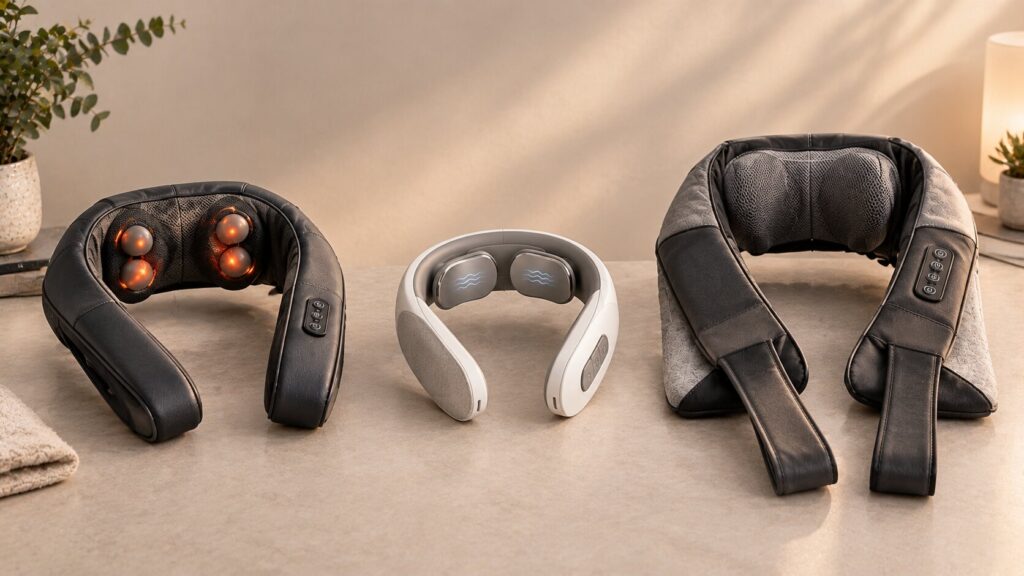
Which Type Is Better for You?
There is no universal winner.
| If you prefer… | Consider… |
|---|---|
| Firm kneading | Shiatsu |
| A pronounced mechanical massage | Shiatsu |
| Neck-and-shoulder coverage | Shiatsu-style wraparound designs |
| A different or potentially gentler sensation | Vibration |
| Simpler operation | Vibration or simpler designs |
| Lots of control over intensity | Either, depending on the model |
| Multiple massage experiences | Combination designs |
These are starting points rather than hard rules.
The individual product still matters.
A well-designed shiatsu massager can be far more comfortable and useful than a poorly designed vibration model, just as a good vibration device can be a better purchase for someone who dislikes kneading.
So, Does Massage Type Matter?
Yes – but personal preference matters more than the label.
If you already know you enjoy kneading pressure, a shiatsu-style massager is likely to make more sense.
If you dislike that feeling, buying the highest-rated shiatsu model simply because it has thousands of positive reviews won’t solve the underlying mismatch.
Likewise, choosing vibration because it sounds gentler doesn’t guarantee that a particular device will feel comfortable.
The mechanism is the starting point.
Comfort, control, positioning and actual customer experience determine whether that mechanism works for you.
And that’s ultimately the theme of this entire buying decision:
The best neck massager isn’t the one with the most impressive technology. It’s the one whose experience you’ll actually enjoy enough to keep using.
If you’re still trying to understand how the different categories overlap, our guide to electric vs. shiatsu vs. neck & shoulder massagers explains what these labels actually mean and how to compare them.
How Often Would You Actually Use One?
A neck massager can look like good value when you’re comparing products online.
But there’s another question that matters just as much as the purchase price:
How often are you realistically going to use it?
A $50 device that becomes part of your routine can provide considerably more value than a $100 device that spends most of its life in a cupboard.
This is one reason we think about value differently from simply looking at the price tag.
The Real Cost Is Connected to Use
Imagine two people buy the same $60 neck massager.
One uses it several times a week for months.
The other uses it twice, decides the pressure isn’t quite right, and puts it away.
They paid exactly the same amount.
But they received completely different value from the purchase.
This doesn’t mean you need to use a neck massager every day to justify buying one. It simply means your expected usage should be part of the decision.
Before buying, try to picture the actual situation in which you’d use it.
After work?
While watching television?
At your desk?
After a long drive?
Before going to bed?
While traveling?
If you can’t identify a realistic use case, there’s a greater chance the product becomes an impulse purchase rather than something you regularly use.
Occasional Use Can Still Be Worth It
You don’t have to use a neck massager constantly for it to be worthwhile.
Some buyers may only want one for particularly long or tiring days.
If you occasionally want a massage-style experience at home and don’t want to book an appointment every time, having a device available when you want it can still have value.
The important distinction is between occasional intentional use and buying something because it sounds useful in theory.
A product doesn’t have to become part of your daily routine to earn its place in your home.
It simply needs to provide enough value when you actually use it.
Convenience Can Increase Usage
This is where design becomes particularly important.
A device that takes seconds to set up and can be comfortably used while sitting on the sofa may naturally get used more often than one that is awkward to position.
The same applies to portability.
A rechargeable model may be more likely to get used by someone who moves between rooms or wants to take the device to work or on trips.
A corded model may be perfectly suitable for someone who has a dedicated place to use it.
In other words:
Convenience isn’t just another feature. It can influence whether you actually use the product.
And a feature that increases real-world usage can be more valuable than a feature that simply looks impressive on a specification sheet.
Don’t Buy for Your Imaginary Routine
This is an easy trap with comfort products.
You imagine yourself coming home every evening, putting your feet up and using the massager for fifteen minutes.
It sounds great.
Then you buy it.
A few weeks later, you’re busy, the device is sitting somewhere inconvenient, and you haven’t touched it.
The problem wasn’t necessarily that the massager was bad.
The problem was that the purchase was based on an imagined lifestyle rather than your actual one.
A better approach is to ask:
When would I use this during my existing routine?
If the answer is obvious, that’s a positive sign.
If you have to invent an entirely new routine to justify the purchase, think twice.
Your Tolerance for Massage Matters Too
Frequency isn’t only about convenience.
It’s also about whether you actually enjoy the sensation.
Someone who loves firm kneading pressure may happily use a shiatsu massager several times a week.
Someone who finds mechanical pressure uncomfortable may quickly stop using the same device.
This is why choosing the right mechanism and intensity can matter more than simply choosing the highest-rated product.
A massager that feels good to you is much more likely to become a regularly used product.
A Simple Value Test
Before buying, ask yourself five questions:
- Do I already know when I’d use it?
- Do I actually enjoy this type of massage?
- Will the device be convenient enough to reach for regularly?
- Does the design fit my routine?
- Would I still consider the purchase worthwhile if I only used it a few times each month?
If you can answer those questions confidently, you’re evaluating the purchase based on your real life rather than the product page.
Think in Cost Per Use
You can even make the value question more concrete.
Suppose a $60 massager is used 100 times.
That’s effectively $0.60 per use before considering electricity or other costs.
Use it 300 times and the purchase becomes $0.20 per use.
Those numbers don’t prove that the product is worth buying, but they illustrate why frequency matters.
Conversely, if a $100 device is used five times, the purchase works out to $20 per use.
That’s a very different value proposition.
The calculation is simple:
Purchase price ÷ realistic number of uses = approximate cost per use.
Of course, enjoyment and convenience can’t be reduced entirely to a number.
But thinking this way can expose whether you’re buying something you’ll genuinely use or simply something that looks appealing right now.
The Bottom Line on Usage
A neck massager doesn’t need to become a daily ritual to be worthwhile.
It needs to solve a real problem, provide an experience you enjoy and be convenient enough that you actually reach for it.
That’s why we consider expected usage one of the most important parts of the value equation.
The best purchase isn’t necessarily the massager with the most features or the highest price.
It’s the one that fits naturally into your life well enough to earn repeated use.
Who Should Consider a Neck Massager?
A neck massager isn’t a universal must-have.
For the right person, it can be a convenient addition to a home comfort routine. For someone else, it may end up being another gadget that gets used twice and forgotten.
So who is most likely to get value from one?
People Who Already Enjoy Massage
This is probably the simplest starting point.
If you already know that you enjoy massage-style pressure, a neck massager is easier to justify because you’re not trying to convince yourself that you’ll enjoy the experience.
You already know you like the basic idea.
The remaining question is which type suits you.
Someone who enjoys firm kneading may gravitate toward a shiatsu-style design, while someone who prefers a different sensation may want to consider vibration or another mechanism.
The important thing is matching the device to your existing preference rather than assuming every massager will feel the same.
People Who Want Convenience at Home
One of the biggest reasons to consider an electric neck massager is simple convenience.
Instead of needing to arrange an appointment or leave home, you have a device available whenever you want to use it.
That doesn’t make it equivalent to a professional massage.
It simply gives you another option.
For someone who regularly wants a massage-style experience but values being able to use something at home on their own schedule, that convenience can be meaningful.
People Who Expect to Use One Regularly
A neck massager becomes easier to justify when you can see yourself using it repeatedly.
That doesn’t necessarily mean every day.
It could mean a few times a week, after particularly long days, during periods when you spend a lot of time sitting, or whenever you want some at-home relaxation.
The more naturally the device fits into your existing routine, the more likely you are to get meaningful value from it.
People Who Want Control Over Their Experience
Some buyers don’t want exactly the same massage every time.
They may want stronger pressure one day and something lighter another day.
In that case, adjustable intensity, different speeds, massage directions or selectable heat can be useful.
But remember that more controls aren’t automatically better.
The useful feature is control that you’ll actually use.
A simple device with a few well-designed settings can be more satisfying than one with a confusing collection of modes.
People Who Want Neck-and-Shoulder Coverage
If your interest isn’t limited to the neck itself, a neck-and-shoulder design may make more sense.
Wraparound designs can provide a broader massage experience and may be particularly appealing to people who want to position the device around both areas.
The trade-off is usually size.
Broader coverage can mean a larger, heavier or more structured device.
That isn’t necessarily a problem, but it’s something to consider before buying.
People Who Value Having a Reusable Option Available
Another potential advantage is simply having the device available whenever you want it.
You aren’t purchasing a single session.
You’re purchasing an object that can potentially be used repeatedly over its useful life.
That makes durability particularly important.
If you expect to use a massager regularly, paying a little more for a design that appears better suited to repeated use can make more sense than choosing solely on the lowest upfront price.
People Who Have a Clear Reason for Buying One
Perhaps the strongest buying signal is simply knowing why you want it.
“I want something I can use after sitting at my desk.”
“I enjoy shiatsu-style massage and want something at home.”
“I want something I can take with me when travelling.”
“I like using heat alongside massage.”
Those are concrete reasons.
By contrast, “It looks useful” is a much weaker reason.
The more clearly you understand what you want the device to do, the easier it becomes to filter out features and products that don’t actually matter to you.
A Neck Massager May Be Worth Considering If…
You may be a good candidate if several of these describe you:
- You already enjoy massage-style pressure.
- You want something convenient for home use.
- You can identify realistic occasions when you’ll use it.
- You have a preference for a particular massage mechanism.
- You want adjustable intensity or other controls.
- You’d benefit from neck-and-shoulder coverage.
- You value portability or cordless operation.
- You’re comfortable with the physical size and pressure of these devices.
- You’re willing to consider durability alongside price.
- You want a reusable comfort product rather than a one-time experience.
None of these guarantees that a particular massager will be a good purchase.
They simply suggest that the category itself may make sense for you.
The Key Is Matching the Product to the Person
This is where the “best neck massager” question becomes more complicated.
A product that works well for someone who loves firm shiatsu pressure may be a terrible recommendation for someone who prefers gentle vibration.
A cordless model may be ideal for a frequent traveler but unnecessary for someone who always uses a massager beside the same sofa.
A large neck-and-shoulder device may be valuable to one person and cumbersome to another.
So before asking “Which neck massager is best?”, it can be more useful to ask:
“What kind of neck massager would I actually enjoy using?”
Once you answer that, the product comparison becomes much easier.
And if you can’t identify a realistic use case, that’s useful information too.
You may not need one at all.
Your ideal neck massager can also depend on how you’ll actually use it. If you spend much of your day sitting at a desk, see our guide to neck massagers for people who sit at a desk all day for a closer look at the features and tradeoffs that matter for that use case.
Who Probably Shouldn’t Buy One?
Not everyone needs a neck massager.
In fact, one of the easiest ways to waste money on a comfort product is to focus entirely on what it can do without asking whether it fits your preferences, routine or expectations.
If several of the following sound familiar, you may be better off skipping the purchase.
People Who Dislike Mechanical Massage
This is the most obvious one.
If you’ve tried massage devices before and disliked the feeling of moving nodes, vibration or mechanical pressure, there’s little reason to assume a different product will suddenly become your ideal solution.
You might prefer hands-on massage, stretching, gentle movement or simply another form of relaxation.
A highly rated massager doesn’t change your personal preference.
People Who Expect a Professional Massage Experience
An electric neck massager is a device.
Even a well-designed one isn’t the same thing as having a trained massage therapist adjust pressure, positioning and technique based on your individual response.
If you’re expecting a device to perfectly reproduce a professional massage, disappointment is much more likely.
A better expectation is that a neck massager provides a repeatable, convenient massage-style experience at home.
That can be useful.
It just isn’t the same thing.
People Who Probably Won’t Use It
This is perhaps the biggest warning sign.
If you can’t identify when you’d realistically use the device, buying one because it might be useful isn’t necessarily a good reason.
Think about your actual routine.
If you rarely sit still, don’t enjoy massage devices and don’t have a particular occasion when you’d reach for one, the massager may spend more time stored away than being used.
No amount of specifications can fix that.
People Who Find Wraparound Designs Uncomfortable
Many popular neck massagers are designed to sit around the neck and shoulders.
That can provide useful coverage and help position the massage mechanism, but it isn’t comfortable for everyone.
Some people may dislike the weight, pressure, shape or feeling of having a device positioned around their neck.
If you already know that kind of design bothers you, don’t assume a highly rated wraparound model will be different simply because other buyers love it.
Look for a different design, or consider skipping the category.
People Who Want Something Completely Silent
Mechanical massage devices can make noise.
The amount varies significantly by product and mechanism, but buyers who expect an almost silent experience should pay attention to customer feedback rather than assuming a compact device will be quiet.
If you plan to use a massager while sleeping, during calls or in situations where noise would be distracting, this may be an important consideration.
People Who Want a Completely Hands-Off Experience
Some neck massagers require you to position the device correctly or adjust straps and handles to control pressure.
That’s part of how many of these products work.
If you’re looking for something that requires virtually no positioning or interaction, certain designs may feel more cumbersome than expected.
Again, the question isn’t whether the product is objectively good.
It’s whether the way it works suits you.
People Who Are Buying Based Only on Features
A huge feature list can make a product look like a bargain.
Multiple massage modes.
Several intensity levels.
Heat.
Rechargeable battery.
Different directions.
Whole-body coverage.
Car adapters.
Carrying cases.
The list goes on.
But if you’re unlikely to use most of those features, they shouldn’t be driving your purchase decision.
A simpler product that does exactly what you want can provide better value than a more expensive model packed with functions you never touch.
People Who Are Choosing the Cheapest Option Without Considering Use
Price matters.
But the cheapest product isn’t automatically the best value.
If you’re expecting to use a massager regularly, comfort, usability and durability become more important.
Saving $20 upfront doesn’t necessarily help if the device is uncomfortable enough that you stop using it.
The better question is:
What is the lowest price at which I can get the features and experience I actually want?
That’s a more useful definition of value than simply choosing the cheapest listing.
People Who Are Ignoring Repeated Customer Complaints
Every popular product will have some negative reviews.
That’s normal.
The important thing is to look for patterns.
If individual customers complain about something unusual, that may not tell you much.
If a recurring theme appears repeatedly – such as durability, reliability, excessive pressure or uncomfortable positioning – it’s worth taking seriously.
A high average rating doesn’t automatically cancel out a recurring weakness.
This is particularly important when deciding whether a product is worth paying more for.
People With Expectations the Product Can’t Reasonably Meet
A neck massager may be a poor purchase if you’re expecting it to do something fundamentally different from what the device is designed to provide.
The category is best approached as a comfort and massage device.
It shouldn’t be purchased on the assumption that an electric massager will automatically solve an underlying health problem or replace appropriate professional care.
If you’re dealing with persistent, severe or concerning symptoms, a product buying guide isn’t the right place to determine what you need.
When Skipping the Purchase Makes Sense
You probably don’t need a neck massager if:
- You dislike mechanical massage.
- You expect a professional massage experience.
- You don’t have a realistic occasion to use one.
- You find wraparound devices uncomfortable.
- You need something extremely quiet.
- You’re unlikely to use the available features.
- You’re buying solely because the product is heavily advertised.
- You’re choosing entirely on the lowest price.
- You’re ignoring repeated negative customer feedback.
- You’re expecting the device to perform a function it isn’t designed to provide.
And that’s completely fine.
A useful buying guide shouldn’t try to turn every reader into a customer.
The Point of the Decision
If you reach this section and realize that a neck massager probably isn’t for you, that’s a successful outcome.
You haven’t wasted $50, $80 or $100+ on a product that was unlikely to fit your life.
For everyone else, the next question is more useful:
If you are going to buy one, which features are actually worth paying for – and which specific products offer the best balance of those features, comfort, price and customer experience?
That’s where a good comparison becomes valuable.
How We Evaluate Products
When we decide whether a neck massager is worth recommending, we don’t look at one specification or simply choose the product with the highest star rating.
Our goal is to understand the overall buyer experience – what you’re getting, where the product makes sense, and where the trade-offs are.
We also believe it’s important to be clear about what we have and haven’t personally tested.
For products we haven’t physically tested ourselves, we don’t present manufacturer claims or customer feedback as hands-on testing.
Instead, we evaluate the available evidence and explain where that information comes from.
What We Look At
Our evaluation typically considers several areas.
Massage Type and Experience
We look at the mechanism used by the product and what kind of experience it is designed to provide.
For example, a shiatsu-style massager that uses rotating or kneading nodes should be evaluated differently from a vibration-based design.
We also look for meaningful controls such as adjustable intensity, speed or massage direction.
The goal is to understand what the product is actually designed to feel like rather than simply repeating its marketing language.
Coverage and Design
We consider where the device is intended to be used and how it is positioned.
A neck-only device has a different purpose from a wraparound neck-and-shoulder massager.
We also consider practical factors such as size, weight, positioning and portability because these can have a direct effect on how convenient the product is to use.
Heat and Other Comfort Features
If a product includes heat, we look at how that feature is implemented and whether it can be controlled independently.
Other comfort-related features can include adjustable positioning, different operating modes and controls that are easy to access.
A feature only adds value when it improves the actual ownership experience.
Power and Portability
Corded and cordless products have different strengths.
For a device that stays in one place, corded operation may be perfectly reasonable.
For someone who wants to move between rooms or travel with the massager, rechargeable operation can be considerably more useful.
We therefore evaluate power options in the context of the type of buyer the product is likely to suit.
Safety and Operating Features
We pay attention to practical features such as automatic shutoff and overheat protection where those specifications are provided.
We don’t treat the presence of these features as proof that a product is inherently safer than every competing model.
Instead, they’re part of the overall evaluation of how the device is designed to operate.
Customer Feedback
Customer reviews can provide useful information that isn’t always obvious from a product specification page.
We look for recurring themes around areas such as:
- Massage quality
- Comfort
- Pressure
- Heat
- Ease of use
- Value
- Portability
- Battery performance
- Durability
- Reliability
A single review doesn’t establish a product’s overall quality.
Repeated patterns are more useful.
We also distinguish between positive and negative feedback rather than using a product’s average rating as the entire analysis.
We Don’t Treat Marketing Claims as Independent Evidence
Manufacturers naturally present their products in the best possible light.
That doesn’t make their specifications useless.
A stated battery capacity, weight, temperature range or number of massage nodes can still be useful information.
But manufacturer claims and independent evidence aren’t the same thing.
When a performance statistic comes directly from a manufacturer, we treat it as a manufacturer claim, rather than presenting it as an independently verified result.
This distinction is especially important for products that make claims about effectiveness, comfort or user satisfaction.
We Don’t Pretend to Have Tested What We Haven’t Tested
This is a simple rule, but an important one.
If we haven’t personally handled a particular product, we won’t write as though we did.
Instead, our conclusions are based on the information available to us, including product specifications, customer feedback and comparison of competing designs.
That means this guide isn’t a substitute for a laboratory test or hands-on review.
It is a research-based buying guide designed to help you make a better-informed purchase decision.
We Look for Trade-Offs
There is rarely a perfect product.
A massager might offer excellent pressure but be relatively bulky.
Another might be lightweight and portable but sacrifice some of the features found on larger corded models.
A cordless design may provide more freedom while introducing battery considerations.
A highly versatile product may cost more than a simpler device.
These aren’t necessarily flaws.
They’re trade-offs.
Our job is to make those trade-offs easier to see.
We Evaluate Products for Different Buyers
Rather than assuming one product is ideal for everyone, we consider different use cases.
For example:
Someone who wants strong traditional kneading may prioritize a shiatsu mechanism and adjustable intensity.
Someone who travels frequently may place more value on portability and cordless operation.
Someone who wants broader coverage may prefer a neck-and-shoulder design.
Someone who simply wants occasional home use may care more about comfort, simplicity and price.
A recommendation becomes more useful when you understand who it is for.
Our Goal
We aren’t trying to identify the product with the longest specification sheet.
We aren’t trying to automatically recommend the most expensive model.
And we aren’t trying to convince every reader that they need a neck massager.
Our goal is to help you spend your money with a clearer understanding of what you’re getting – and what you’re giving up.
If a product looks like a good fit for your needs, we want you to understand why.
If it has meaningful weaknesses, we want you to know those too.
And if a neck massager simply isn’t right for you, we’d rather help you recognize that before you buy one.
Our Bottom Line
So, are neck massagers worth it?
For the right buyer, yes.
But the answer has much less to do with how many features a product has, how expensive it is, or how impressive its product page looks.
It comes down to whether the device provides an experience you actually enjoy, fits naturally into your routine and gives you enough useful use to justify what you paid for it.
A Neck Massager Is More Likely to Be Worth It If…
You already enjoy massage-style pressure.
You have realistic occasions when you’d use one.
You want the convenience of having a massage-style device available at home.
You know whether you prefer shiatsu, vibration or another type of massage.
You care about comfort and adjustability rather than simply buying the product with the longest specification list.
You’d genuinely benefit from features such as heat, cordless operation or broader neck-and-shoulder coverage.
And you’re willing to consider durability and customer feedback alongside the upfront price.
In that situation, a neck massager can be a practical reusable comfort product rather than a novelty gadget.
It May Not Be Worth It If…
You dislike mechanical massage.
You expect the experience to replicate a professional massage.
You don’t have a realistic use case.
You find wraparound designs uncomfortable.
You need something completely silent.
Or you’re mainly attracted to the product because it has a huge list of features, impressive marketing claims or a high star rating.
In those cases, spending the money may not produce much value.
And that’s an important part of the answer.
You don’t need to buy a neck massager simply because other people like them.
The Best Value Isn’t Necessarily the Cheapest
A $40 massager isn’t automatically better value than a $70 one.
Likewise, a $120 model isn’t automatically better simply because it costs three times as much.
The better purchase is the one where the money you’re spending buys improvements you’ll actually notice and use.
That could mean better comfort.
Better pressure control.
A massage mechanism you prefer.
Useful cordless operation.
More suitable coverage.
Or simply a design that fits your routine better.
If an expensive feature doesn’t matter to you, it’s probably not worth paying for.
Think About the Experience, Not Just the Specification Sheet
This is perhaps the biggest takeaway from the entire guide.
When shopping for a neck massager, it’s easy to compare:
8 nodes vs. 16 nodes.
3 speeds vs. 5 speeds.
Corded vs. rechargeable.
100°F vs. 110°F.
But specifications don’t tell the whole story.
A product can have excellent numbers and still be uncomfortable.
Another can have fewer features but be exactly what you want.
The most useful comparison is therefore not:
“Which product has the most?”
It’s:
“Which product gives me the combination of comfort, massage experience, convenience and reliability that I’m actually looking for?”
Our Take
We wouldn’t recommend buying a neck massager simply because it’s popular.
We also wouldn’t recommend automatically spending more for a premium feature set.
Instead, start with the experience you want.
Choose the massage mechanism.
Decide how much coverage you need.
Consider whether heat or cordless operation would genuinely improve your routine.
Look closely at comfort and pressure control.
Then examine customer feedback for recurring strengths and weaknesses.
Finally, compare the price against how often you realistically expect to use it.
That’s a much stronger basis for a purchase than simply picking the product with the highest rating.
For the right person, a neck massager can absolutely be worth the money.
The trick is making sure you’re buying the right kind of experience, rather than simply buying the most impressive-looking product.
Want to Compare Specific Neck Massagers?
If you’ve worked through the questions above and decided that an electric neck massager makes sense for you, the next step is comparing the actual products.
We’ve put together a separate guide covering our current picks, with the focus on massage type, comfort, features, customer feedback, strengths, weaknesses and overall value rather than simply choosing the product with the longest specification list.
Best Electric Neck Massagers of 2026
See the models we recommend, who each one is best suited for, and the trade-offs to consider before buying.
The goal isn’t to find one neck massager that everyone should buy.
It’s to help you find the one that makes the most sense for you.